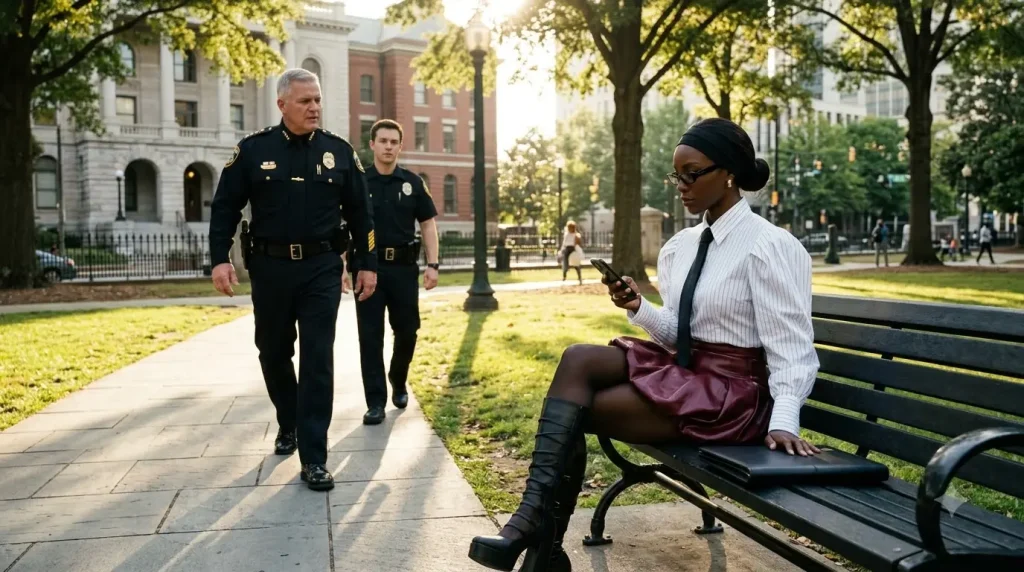
“You chose to come in without him?”
“Yes.”
“Why?”
Price looked at the floor.
“Because I think this is why I was supposed to meet you.”
Amara’s eyes sharpened.
There it was.
The second reason she had been sitting in the park.
She said nothing.
Price continued.
“I sent the letter.”
Three weeks earlier, Amara’s chambers had received an anonymous packet.
Not through the normal electronic filing system.
Paper.
No return address.
Inside were photocopies of internal police emails, body-camera audit logs, and handwritten notes identifying forty-two encounters in which cameras had allegedly been disabled immediately before force was used.
The consent decree already required strict body-camera compliance.
Official department reports claimed compliance exceeded ninety-six percent.
The anonymous material suggested something far worse.
Supervisors had developed a practice they called quiet windows.
Officers would deactivate cameras before certain encounters.
Afterward reports listed technical failure, accidental battery exhaustion, or administrative misclassification.
The allegations were serious enough that Amara referred them through proper legal channels to the independent federal monitor.
Then another note arrived.
I can prove it. I cannot send the files electronically. They audit access. Thursday, 4:30 p.m., south courthouse park. Gray bench near fountain. I will identify myself.
Amara had never intended to conduct a secret investigation personally.
She planned only to receive the whistleblower, then transfer him immediately to the court monitor and federal investigators.
She arrived early.
So did Raymond Mercer.
Amara looked at Price.
“You were the source.”
He nodded.
“How long?”
“Seven months.”
“Why?”
Price breathed out slowly.
“Because my training officer told me the camera was for protecting us.”
“That was day one.”
“Then I got to patrol.”
His hands tightened.
“People started telling me when to turn it off.”
“Who?”
“Sergeants at first.”
“Then lieutenants.”
“Sometimes command.”
“Mercer?”
Price hesitated.
“Yes.”
Amara remained still.
“Directly?”
“Three times.”
“Today makes four.”
Amara glanced toward the empty body-camera mount.
“What exactly is a quiet window?”
Price looked ashamed even though he had not invented it.
“You call out something ordinary.”
“Community contact.”
“Foot patrol.”
“Business check.”
“Then if someone looks like they might become a problem, supervisor says ‘take a quiet window.’”
“Camera goes off.”
“What qualifies as a problem?”
Price looked directly at her.
“Someone who argues.”
“Asks too many questions.”
“Knows policy.”
“Records us.”
“Won’t give ID when they don’t have to.”
Amara’s cheek still burned.
She felt something colder beneath it.
Recognition.
Price continued.
“Mostly Black men.”
“Some homeless people.”
“Protesters.”
“Young people.”
Amara asked:
“Have you participated?”
Price’s face reddened.
“Yes.”
The answer mattered.
She respected it.
“How many times?”
“Five.”
“Did force occur?”
“Twice.”
“Were reports inaccurate?”
He closed his eyes.
“Yes.”
Amara sat back.
“Why come forward now?”
Price took a long time.
“Because of a kid.”
She waited.
“Seventeen.”
“Black.”
“Stopped behind a convenience store.”
“He mouthed off.”
“Sergeant told us quiet window.”
“We shut cameras off.”
“One officer shoved him against a wall.”
“Kid pushed back.”
“Everybody said resisting.”
“He got hit.”
“Broke his orbital bone.”
Amara knew the case.
It was one reason the consent decree had tightened.
“Your report?”
Price looked sick.
“I wrote that he initiated physical resistance.”
“Did he?”
“Not the way the report made it sound.”
“Why?”
Price’s eyes filled.
“Because I was scared.”
“Of?”
“Losing the job.”
“Getting frozen out.”
“Being the rookie nobody backed.”
Amara nodded slowly.
Not approval.
Understanding.
Price continued.
“The kid took a plea.”
“Three months.”
“Probation.”
“Then I saw him at a grocery store with his mother.”
“She recognized me.”
“She didn’t yell.”
“She just looked at me.”
“I couldn’t sleep.”
Amara said quietly:
“Guilt is useful only if it changes behavior.”
Price looked up.
“My father says something like that.”
Amara almost smiled.
“Your father sounds exhausting.”
“He is.”
Then Price’s expression became serious again.
“I copied audit logs.”
“Supervisor texts.”
“Dispatch records.”
“Training notes.”
“Where are they?”
“Safe.”
“Not at my house.”
“Good.”
He looked toward her reddened cheek.
“I didn’t know he’d do that.”
“Neither did I.”
“I should’ve stopped him.”
Amara shook her head.
“You kept the camera running.”
“That may matter more.”
Price stared at her.
“Am I going to jail?”
Amara did not lie.
“I don’t know.”
He nodded.
“You may face consequences.”
“You should.”
His face tightened.
“But if what you’re saying is true, the truth does not become less necessary because you participated in what you are exposing.”
Price looked relieved and terrified simultaneously.
Amara reached for the phone on her desk.
“I’m calling the federal monitor.”
Then she stopped.
“Officer Price.”
“Yes?”
“Before we proceed, I need to make one thing clear.”
He waited.
“I cannot personally supervise an investigation into an assault against me.”
“I’ll recuse from that portion.”
Price nodded.
“But the consent decree is larger than what happened in the park.”
“Your evidence goes where it belongs.”
“Understood?”
“Yes.”
She made the call.
By midnight, the slap had become national news.
By morning, it was no longer the biggest story.
At 7:10 a.m., the federal monitor announced an emergency preservation request covering all police body-camera audit logs, internal messages regarding recording policy, disciplinary files, and server-access records for the previous three years.
At 7:43, the city placed Chief Mercer on administrative leave.
At 8:12, Officer Price formally entered whistleblower protections pending federal review.
At 9:05, Lena Morris’s station released an extended version of her footage.
The public had already seen the slap.
Now they saw everything before it.
Mercer demanding identification without stating a lawful basis.
Mercer taking Amara’s phone.
The shove.
Her warning.
His slap.
Then his order.
Turn it off.
Price’s refusal.
The sequence changed the conversation.
This was not an officer losing control during a chaotic arrest.
There had been no arrest.
No threat.
No screaming.
No weapon.
No crowd pressing around him.
Only a woman sitting on a bench.
But the body-camera recording changed things even further.
At noon, authorized excerpts became part of an emergency federal filing.
One line dominated headlines.
Sometimes people just need to be reminded who owns the street.
Raymond Mercer had said it before approaching Amara.
His attorneys argued the comment was figurative.
Almost nobody cared.
At City Hall, Mayor Thomas Bell sat before six cameras that afternoon.
His statement lasted four minutes.
“The conduct visible in these recordings does not reflect the standards of this city.”
Reporters shouted immediately.
“Mayor, Chief Mercer has served under you for seven years.”
“Were you aware of complaints?”
“Did you know cameras were being disabled?”
“Will you ask for his resignation?”
Bell held up both hands.
“The investigation is ongoing.”
Lena Morris asked from the second row:
“Mayor, is Chief Mercer still being paid?”
Bell hesitated.
“Yes, under administrative-leave procedures.”
The room erupted.
Lena continued.
“What would have happened to an ordinary civilian who slapped someone in that park yesterday?”
Bell’s expression tightened.
“I won’t speculate.”
Lena did not need him to.
The question traveled farther than the answer.
Chief Mercer watched from home.
His wife had gone upstairs.
His adult son had stopped answering calls.
Three news vans sat outside their driveway.
Mercer turned off the television.
Then his attorney, Franklin Wade, entered the living room carrying a legal pad.
“We need to talk about the bodycam.”
Mercer looked away.
“You’ve already talked about it.”
“No.”
Wade sat.
“We need to talk about what happened twenty minutes before the park.”
Mercer’s face changed.
“What?”
“You told Officer Price to disable recording.”
“So?”





