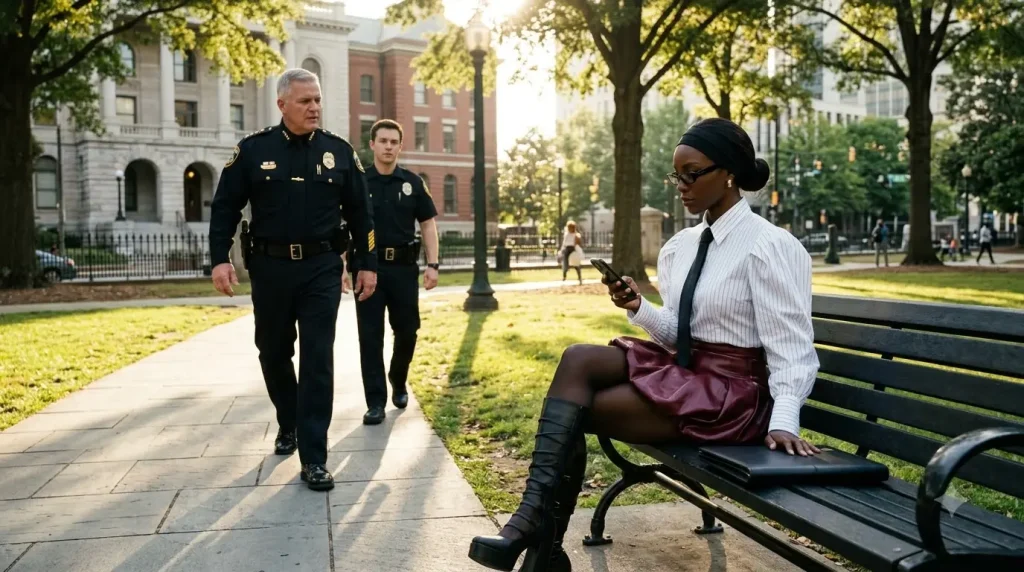
The wooden bench where Amara Bennett had sat forty-one hours earlier was cordoned off with yellow evidence tape.
Two uniformed federal court officers stood guard beside the iron armrest, preserving the site for technical measurements.
At 8:52, a black sedan arrived at the curb.
Franklin Wade stepped out of the passenger side and opened the rear door.
Raymond Mercer emerged into the bright morning glare.
He wore a dark charcoal civilian suit instead of his uniform.
His lapel carried no gold stars.
His chest carried no badge.
Without the dark fabric of command, he looked noticeably smaller.
His shoulders sloped forward slightly.
His hair was uncombed at the crown.
A wall of cameras surged forward against the marshal barricade.
Shouts erupted from thirty reporters simultaneously.
“Chief Mercer, do you intend to plead guilty?”
“Why did you tell Officer Price to turn his camera off?”
“Did you know Judge Bennett was sitting on that bench?”
Mercer did not answer.
He kept his chin tucked against his chest, his eyes fixed on the gray granite steps.
Franklin Wade pushed through the perimeter with both arms raised, shielding his client until they cleared the revolving brass doors of the courthouse lobby.
Inside Courtroom 210, the atmosphere was as cold and sterile as a surgical suite.
Senior Judge Marcus Vance sat high on the bench beneath the Great Seal of the United States.
His black robe hung loosely over his frail frame, but his single good eye was sharp, dark, and merciless.
He did not use a gavel.
When he entered, the rustle of robes was the only sound in the packed gallery.
To the left of the center aisle sat the United States Attorney, four senior trial attorneys from the Civil Rights Division, and Officer Daniel Price.
Price wore a plain navy suit purchased off the rack.
He sat with his hands folded in his lap, looking straight ahead at the empty jury box.
To the right sat Raymond Mercer, Franklin Wade, and three municipal defense attorneys.
Judge Vance adjusted his bifocals and looked down from the bench.
“This court is in session pursuant to an emergency order issued under Case Number 22-CV-8910, the ongoing matter of the United States versus the City of Atlanta,” Judge Vance began.
His voice was thin, but it resonated clearly through the courtroom speakers.
“Before we address the evidentiary motions filed late yesterday evening, the court will hear from the United States regarding the preservation of digital records.”
Assistant United States Attorney Claire Dawson stood up from the prosecution table.
She was forty, slender, with short red hair and a crisp, direct delivery.
“Your Honor, yesterday afternoon federal agents executed a court-authorized search warrant on the primary data repository of the Atlanta Police Department.”
Dawson held up a single blue folder.
“We have successfully recovered seventy-two hours of deleted audit logs from the central server.”
Mercer’s hands tightened on the oak table.
Dawson continued.
“Those logs demonstrate that between 5:15 p.m. and 6:30 p.m. on Thursday—less than ninety minutes after the incident in the park—someone using administrative credentials assigned directly to the chief’s office attempted to wipe twenty-two video files from the storage array.”
A low murmur rippled through the gallery.
Judge Vance’s white eyebrows drew down into a sharp V.
“Did the attempt succeed, Ms. Dawson?”
“No, Your Honor,” Dawson replied.
“The federal monitor’s remote mirror protocol, installed pursuant to Chief Judge Bennett’s previous compliance order, captured the files before the local system could complete the scrub.”
Judge Vance turned his gaze slowly toward the defense table.
He looked at Raymond Mercer for five unbroken seconds.
“Mr. Wade,” Judge Vance said softly.
Franklin Wade stood up.
His posture was that of a man standing before a firing squad.
“Yes, Your Honor.”
“Did your client attempt to destroy evidence currently subject to a federal preservation order?”
“Your Honor, we have not had an opportunity to review the technical telemetry referenced by the government—”
“I did not ask whether you reviewed it, sir,” Judge Vance interrupted.
His voice dropped into a terrifying register of quiet authority.
“I asked whether the man sitting to your left attempted to delete evidence from a server under my jurisdiction.”
Wade swallowed hard.
“We are asserting our rights under the Fifth Amendment at this time, Your Honor.”
Judge Vance leaned forward across the elevated bench.
“That is your privilege, Mr. Wade.”
“However, the Fifth Amendment does not insulate an administrative officer from the civil contempt powers of this court.”
Judge Vance picked up a single sheet of paper from his blotter.
“Under Rule 65 of the Federal Rules of Civil Procedure and the inherent authority of Article III of the Constitution, I find that the Atlanta Police Department has willfully and systematically violated the terms of the consent decree.”
“The command structure of that department has demonstrated an ongoing inability to preserve evidence, protect witnesses, and adhere to constitutional standards.”
Judge Vance signed the paper with a quick, decisive stroke.
“Effective at twelve noon today, the Atlanta Police Department is placed into full federal receivership.”
A collective gasp echoed through the courtroom.
Federal receivership was the nuclear option of constitutional jurisprudence.
It had been used fewer than five times in modern American history.
It meant the mayor had no authority over the police.
It meant the city council had no authority over the budget.
It meant the entire department was now an operational wing of the federal court.
“The court appoints retired Major General Thomas Sterling as temporary receiver,” Judge Vance continued, his voice unrelenting.
“General Sterling will assume direct administrative command of all precincts, internal affairs files, promotional lists, and disciplinary procedures.”
“All police personnel are enjoined from altering, moving, or deleting any digital or physical record without the express written permission of the receiver.”
Judge Vance then turned his attention back to Raymond Mercer.
“As for the former chief.”
Mercer lifted his chin slightly, attempting to summon the remnants of his old bearing.
It failed.





