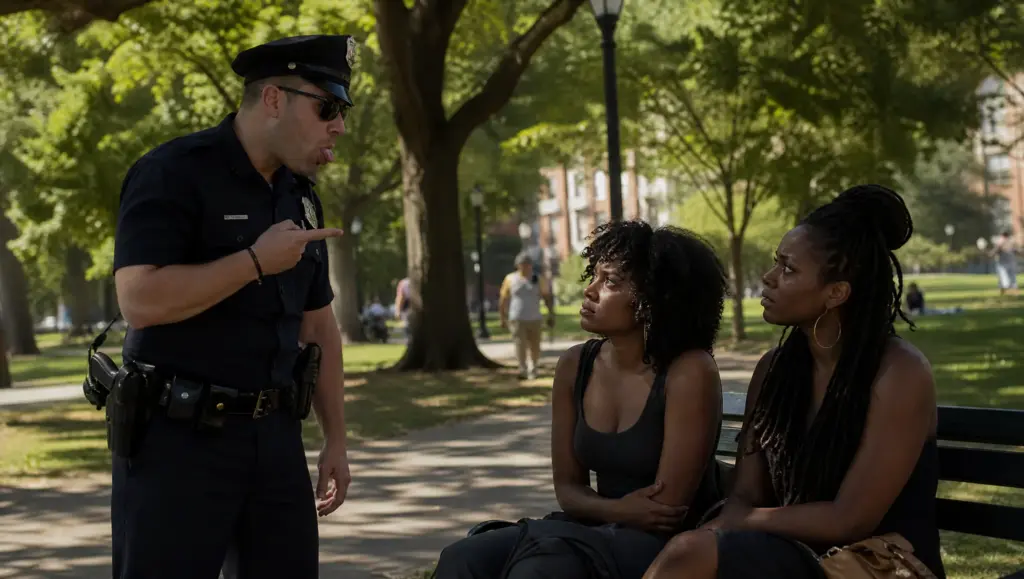
She pulled her hands back. “And I’m still angry. A little at you, more at me.””I thought the worst thing today was a rude stop,” Tessa said. “I was wrong about what my ordinary afternoon would cost. I’m sorry for your wrists.”Nadine waited for the second sentence—the one that explained it. It never came.By supper, the video had passed a million views. By 8:00, the police union’s lawyer had a statement out. Nadine read it aloud at her kitchen table while Tessa’s tea went cold: “Officer Brandt had responded to an unlicensed vendor handling large amounts of cash, and a preliminary field test had indicated narcotics residue on the currency.””He never opened the permit folder,” Nadine said. “He never opened a test kit.””No result is attached,” Tessa said, “and researchers keep finding trace residue on a large share of ordinary bills. It proves what it proves about the cash in your wallet.” She turned her phone over. “It doesn’t have to be true to be printed.”
Hollis’s text had come at 7:00: the $3,860 was logged as evidence under Brandt’s incident number. The county forfeiture unit had placed a thirty-day hold, and release would need a hearing.”Thirty days?” Nadine said. “Thirty-eight women have outfit vouchers due Monday.””I can’t touch it.” Tessa’s jaw was tight. “I’m a party to the incident. Once I’m sworn, I have to recuse from my own case.””Then I’ll pay them—” Tessa started to say, and Nadine caught her hand before she reached for her phone.”No. You’re about to run the agency holding the money. You don’t get to cover for it.”She pinned her broken tote strap back together and opened the Second Coat page instead. By 10:00, strangers had given $1,100 against the 3,860.
Greer called Sunday at 7:00 to the number on the sign. “There’s a car outside my building,” he said. “Since 2:00. A man in it watching my window.” A pause. “Ma’am, I think it’s the department.”Tessa took the phone. “Mr. Greer, lock your door and stay on the line. Do you keep a record?””A spiral notebook. Nineteen times I asked for that receipt: dates, names, what they said.””Photograph every page and send them to this number. Then put the notebook somewhere nobody would think to look.””Chief,” he said, “I’ve lived in this city sixty-seven years. I know where.”Through the phone, they could both hear an engine idling.
At 11:58 that night, Nadine’s phone lit with a number she didn’t know: His captain told me to forget what I saw. I’m on desk duty at 6:00 AM. Under it was a photo: a printed leaderboard, eleven names, Brandt at the top, a column headed Referrals Over $4,000 (Double Unit Credit), and down the far edge beside every row, the same two initials in blue ink: W.H.Tessa read it twice without speaking. Then her own phone buzzed: the office of the police board chair. An emergency session was called for Monday, 8:30 a.m., to consider the union’s petition to withhold certification of the chief designate.”Certification?” Nadine said. “I thought the council confirmed you.””Council appoints. The charter says the board certifies that I’m free of conflicts before anyone can swear me in. Usually, that’s a signature in a drawer.” Tessa’s thumb stopped on the screen. “The union says I’m a party and a witness in a case against one of their members. The chair can hold her signature until she’s satisfied. No signature, no oath.”Nadine glanced at the lock screen where the reminder Tessa had swiped away on Saturday sat unread. She read it now: Mon 9:00 AM – Oath of Office. Thirty minutes after the session that might cancel it.The hearing room on the fourth floor held sixty chairs and one clock above the door. At 8:30, it read exactly that, and everyone looked up at it once. Nadine sat in the second row beside Alvin Greer, her tote on her knees, the broken strap held with a safety pin. Greer had worn a tie; inside his jacket was the spiral notebook he’d refused to let anyone carry for him.
Chair Elena Pike was a small woman with glasses on a chain and no visible interest in being liked. The union’s attorney, Carl Dunmore, rose first. “Madam Chair, the chief designate is a party and a material witness to an open complaint. She can’t be certified while she’s—”Tessa stood in the charcoal suit and slid one page to the clerk. “My recusal from the Brandt matter, signed at 7:00 this morning. The state attorney general takes the referral. I won’t touch that case, and I won’t pretend a department-wide review is the same case.”Dunmore tried another door: “She sat in a park in jeans, hiding who she was, waiting for an incident.””I wasn’t hiding,” Tessa said. “I wasn’t asked.””Sit, Mr. Dunmore,” Pike said. “Officer Pruitt.”Pruitt took the stand in uniform, hat in both hands, one knee bouncing against the table leg.
“You’re a year out of the academy,” Pike said. “On probation. Saturday, you were ordered to forget what you saw. You understand what testifying costs you?””Yes, ma’am.””Then why are you here?”Pruitt looked at Nadine, then at the clock. “Because the form said 4,120. The count was 3,860.”Dunmore rose, smooth now: “Or a rookie twenty feet back in a crowd heard a number wrong. Officers miscount under stress. It happens.””He counted the same bills twice, sir, a few minutes apart on one bench, on my camera.” Pruitt’s knee had stopped. “260 over. And the line for a referral is 4,000. Over it, an officer earns double unit credit toward the quarterly ranking, and that ranking decides who gets overtime shifts and who gets recommended for sergeant. A mistake doesn’t land that neatly on the right side of the line.”





