Nobody coughed. Dunmore looked for his next question, and Nadine watched him not find it.The clock said 8:41.Pike’s eyes went up to the gallery. “Mr. Greer, nineteen entries in your notebook?””Nineteen, ma’am.””Entered.”Captain Hollis had come in late in a uniform no one had asked him to wear, carrying a banker’s box against his chest like something that might spill. Pike waited until he reached the stand.
“Captain, your initials are on these forms. Why are you here?””I signed the forms,” Hollis said. “I won’t sign another lie.””How many bear your initials beside Officer Brandt’s?””Forty-one.”The room made a sound. Hollis kept going, as if stopping now would be worse: “Of sixty-three he filed in three years, fifty-five were from Black residents. Four ended in a charge. The median seizure was $1,900.” He set a page on the rail. “Mr. Greer’s is on page 12.”Greer touched his jacket where the notebook was.
“The car outside his building Sunday?” Pike said. “Department business?””Mine, Madam Chair. I wanted to know if he’d go to the press.” Hollis looked at the box. “I was wrong.”Pike lifted the last sheet from the bottom and read it for a full minute. The clock moved to 8:52.”Mr. Dunmore, this is the ledger for Fund 114—the forfeiture fund. There’s an $18,000 retainer to your firm dated a month ago, the week her name was announced, to challenge the incoming chief’s certification on whatever grounds turned up.” She took off her glasses. “Public money. Money taken out of people’s coats is paying for this hearing.””That’s privileged.””The fund is not.”At 8:56, Pike signed. The pen scratched once.”Certification granted. The board directs the chief, once sworn, to audit every cash seizure in the department. Mr. Dunmore, you’ll be hearing from us.”Tessa was at the door before the gavel finished falling. Nadine caught her in the corridor where Hollis was waiting with the last page in his hand and none of his captain’s posture left.”I brought you the page Pike didn’t read aloud,” he said.Beneath every line of Fund 114, in the same blue ink, stood a single authorizing signature: R.C.“Raymond Calder,” Tessa said.”Public Safety Director. He runs the forfeiture unit. He’s not on the leaderboard. He doesn’t have to be.” Hollis’s voice dropped. “By custom, the director holds the book at every chief’s oath.”Nadine read the clock through the doorway of the oath room: 8:57. Inside, a tall man in a gray suit stood at the dais with a leather Bible under one arm. He smiled at the empty chairs the way Brandt had smiled at his crowd.Tessa folded the page once. She did not look at Nadine.Calder waited at the dais with the leather book against his chest. “Chief designate. By custom, the book is held by someone the oath protects.”Tessa looked past him to the doorway. “Mr. Greer, would you?”Greer crossed the empty chairs with the notebook under his arm. Calder’s smile stayed up a second too long. Then he set the book in Greer’s hands as though it had gotten warm. Tessa laid her palm on the cover.
In the second row, Nadine counted the words of the oath the way she counted lipsticks. Pruitt stood at the back in uniform, hat under his arm.Afterward, in her first words as chief, Tessa said only this: “A right that needs a rank to defend it isn’t a right. It’s a favor.”A few days later, Calder resigned and the forfeiture fund was frozen. Over the following months, Brandt pleaded guilty to falsifying reports and official oppression, and the state revoked his certification. Hollis was removed from command and kept testifying. Pruitt kept his badge and joined the audit team, which found Greer’s file among the sixty-three.Under the Receipt Rule, adopted by the board, no officer could take a dollar without a written receipt, a supervisor’s call, and a running camera. The county released the $3,860, and thirty-eight women got their vouchers.A few weeks later in Marlow Park, Tessa handed Alvin Greer a check for $11,400 and a printed receipt. He read the receipt twice, front and back.”Two years,” he said. “I only wanted something I could hold.”
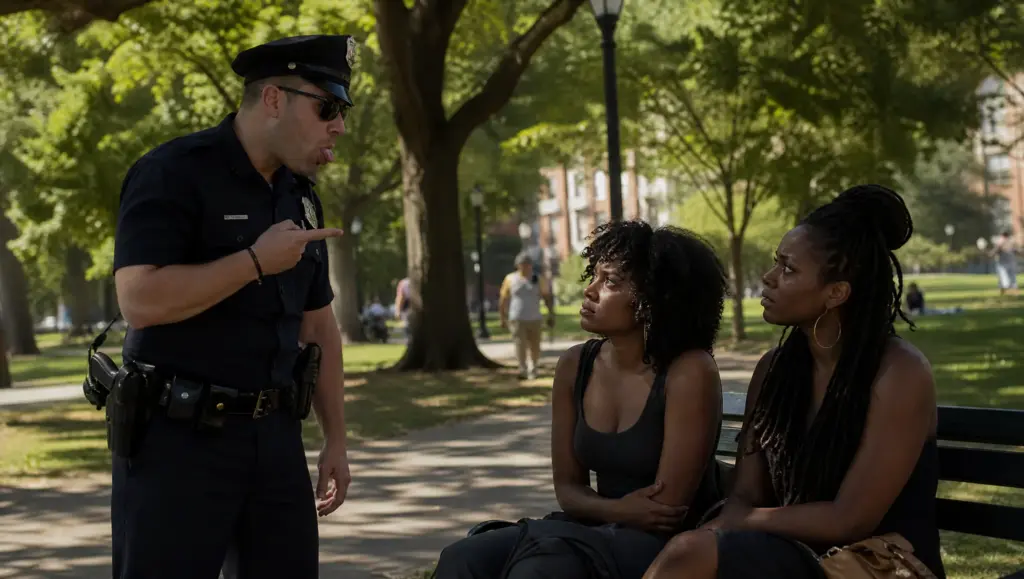
He folded it into the spiral notebook and, for the first time since Nadine had met him, sat down on a bench without watching the path.On a Saturday after that, the Second Coat table stood on the east lawn again. Nadine had never replaced the tote; the strap was still pinned. A new tag hung on a new shade, a deep brick red: Count It Again.A sixteen-year-old held up plum to the light, and Tessa, in jeans and a white tank top, told her it was still the one.Two officers crossed the grass. The older one stopped at the table. “Permit?”Nadine handed him the blue folder. He opened it and read every page. Then he handed it back with both hands.This story is a work of fiction. All characters, events, and situations are not real and do not represent any actual people or true stories.





