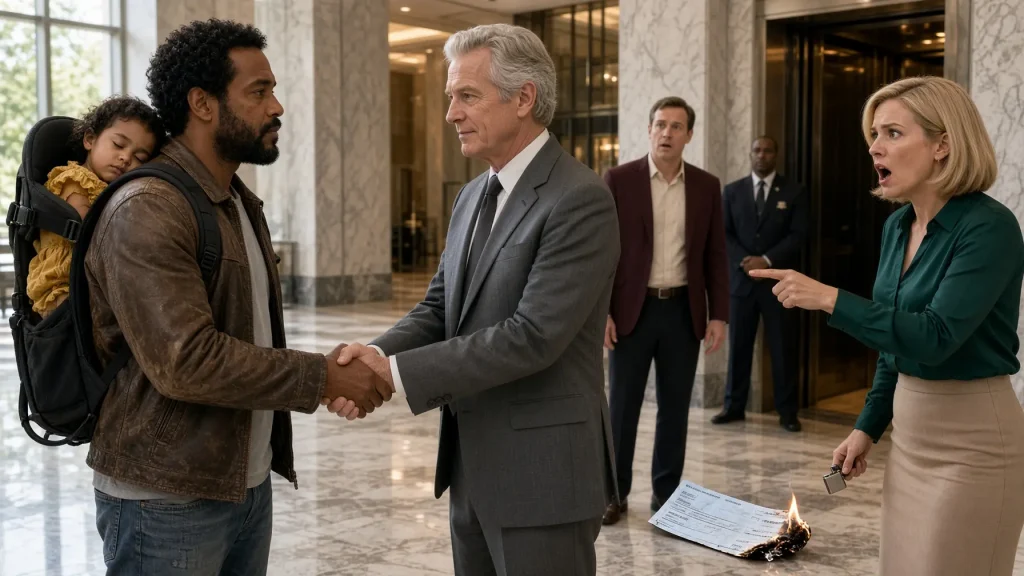
The first person who greeted Sydney that Saturday morning smiled at Milly.
“She’s got the right idea.”
Sydney glanced toward his shoulder, though he could see only the edge of his daughter’s yellow dress and one small white sneaker. Her cheek rested against the padded carrier, and her breathing had settled into the steady rhythm he knew meant she would be asleep for a while.
“Busy morning,” he said.
“For both of you?”
“Mostly for her.”
The woman at the reception desk laughed softly and asked what he needed. Sydney took an envelope from the inside of his worn brown leather jacket and held it rather than opening it immediately.
“I need to deposit a check.”
She directed him toward the counter.
Nothing about the exchange suggested trouble. The lobby was bright, natural light coming through tall windows and falling across the marble surfaces. Customers stood in a short line, a security guard waited near the entrance, and somebody behind a desk was helping an older man untangle a question about a statement.
Sydney stepped into line and checked the carrier’s lower strap.
Milly had insisted on wearing the yellow dress because Saturday was supposed to be their day. He had explained that they needed to do one grown-up errand first.
“How long?”
“I don’t know yet.”
“Long like groceries?”
“Maybe.”
She had considered that seriously, then asked whether they could get something to eat afterward. He had promised they could.
Now he looked at the envelope and hoped he would not have to revise the promise.
The check inside it was for one million dollars.
He had read the amount often enough that the number no longer surprised him, but the responsibility attached to it still did. He had kept the envelope somewhere secure, checked the papers accompanying it, and made sure he had everything he might reasonably be asked to provide.
He was not expecting to walk out carrying a bag of money.
He wanted the bank to do its work.
That seemed simple enough when he was standing behind two people discussing whether they had fed a parking meter. It became less simple when the teller opened the envelope.
Her eyes moved across the check.
Then they returned to the amount.
“One moment, please.”
Sydney nodded.
She checked his identification, looked at the account information available to her, and asked a few questions in a calm voice. He answered them, keeping one hand near Milly’s leg when she shifted in her sleep.
The teller glanced up.
“She comfortable?”
“She’ll let everybody know if she isn’t.”
The woman smiled, then looked toward an office beyond the counter.
“I’m going to have my manager review this.”
“That’s fine.”
He meant it.
A million-dollar check ought to produce more attention than an ordinary deposit. Sydney had come prepared for that, and the teller had given him no reason to resent it.
Before moving away, she checked that the name on the check matched the identification. Sydney watched her compare the papers without embarrassment.
She asked him to confirm a detail, and he did. She repeated it to make sure she had heard correctly over the lobby noise.
Nobody smiled at the size of the amount.
Nobody looked down at his boots.
The exchange gave Sydney a modest confidence that stayed with him longer than it should have. Even after Kendra began speaking differently, he kept expecting the conversation to return to this shape: a person asking for information, another person providing it, and the work moving forward.
He would remember that first exchange later because it proved the morning had not needed to become anything else.
She took the check and identification to the office.
Sydney remained at the counter.
Across the lobby, a woman in an emerald blouse stood up from behind a desk.
Kendra Slade saw the check before she saw the customer.
The teller placed it in front of her and explained what Sydney was asking to do. Kendra looked at the amount, then toward the lobby.
Her eyes found the brown jacket.
The faded jeans.
The boots.
Finally, the child carrier.
Her expression changed in a way the teller noticed but did not immediately understand.
“Where did he get it?”
“He has some supporting papers.”
“I asked where he got it.”
“I was bringing that to you for review.”
Kendra looked down at the check again.
She was thirty-four, with a sleek blonde bob and a habit of keeping her clothes, desk, and voice so controlled that customers often mistook her certainty for accuracy. The emerald blouse fitted neatly above a beige pencil skirt; her heels made a precise sound against the floor when she walked around the desk.
She took the check between two fingers.
“Let me handle him.”
The teller followed with the identification and envelope
A man in a burgundy blazer looked up from a neighboring work area as Kendra passed. Chad was her fiancé, though the relationship was usually mentioned only after a customer had already noticed the familiarity between them.
He saw the paper in her hand.
“What’ve you got?”
Kendra gave him a small look.
“Apparently, a millionaire.”
Chad turned toward the counter.
Sydney saw both of them approaching.
He straightened slightly, not to impress them but because Milly’s weight had settled unevenly. He adjusted the carrier without disturbing her and placed the supporting papers on the marble where they could be examined.
Kendra stopped opposite him.
She did not introduce herself.
“This is yours?”
“Yes.”
“You’re asking us to accept it?”
“I’m asking to deposit it.”
She looked at the check again, then slowly back at his face.
“Do you understand how much money this says?”
Sydney paused.
“I do.”
Chad stopped beside her, close enough to look at the check and far enough from the counter that he could pretend he had merely wandered over.
Kendra turned the paper over.
Sydney waited for a question about the issuer, the account, or the documents beside his hand. Instead, she looked at the worn seam near the shoulder of his jacket.
“Interesting.”
He felt the first small change in the encounter.
Not a refusal. Not yet.
An invitation to become embarrassed.
He had felt it before in places where someone looked at what he wore and decided that the explanation of his presence would probably be inconvenient. He had learned not to respond to a suggestion as though it were already an accusation.
“What do you need to verify?” he asked.
Kendra smiled.
“Quite a lot, by the look of it.”
That morning had begun with Milly standing in the kitchen doorway holding one sneaker.
“Something’s inside.”
Sydney took the shoe, shook it gently, and caught a small plastic bead in his palm.
“How did that get there?”
She considered whether the question required an answer.
“I don’t know.”
He looked at her.
She looked at the bead.
“I was making it pretty.”
Sydney laughed and checked the other shoe before helping her put them on. She had eaten breakfast slowly, pausing between bites to ask questions about the day.
He gave her answers he could keep.
They would go to the bank. They would get lunch. After that, they would see how the afternoon looked.
“Can I bring my book?”
“Yes.”
“The big one?”
“If you carry it.”
That had lasted until they reached the front door.
By the time they left, the book was in Sydney’s small bag, Milly was wearing the yellow dress, and he had checked the envelope once more before putting it inside his jacket.
He had considered wearing something else.
The thought irritated him even then.
He owned clothes suitable for more formal occasions, but this was a Saturday errand with a four-year-old who might spill juice, decide to sit on a sidewalk, or need to be carried halfway through the morning.
He chose the jacket because its inside pocket held the envelope securely.





