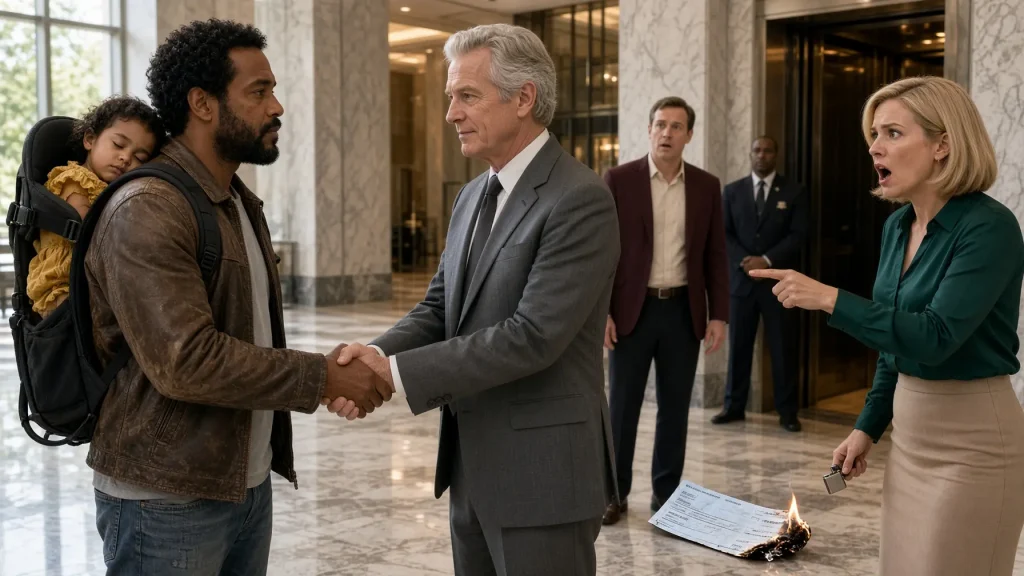
“I came in to make a deposit. If you need information, ask me.”

Kendra finally picked up the supporting documents.

She turned the first page, glanced at the second, and stopped.

There was enough there to begin a review.

The existence of the papers annoyed her more than she expected. She had already decided what kind of encounter this was, and Sydney’s calm insistence on ordinary handling made the decision harder to present as expertise.

She could have taken the documents to her office.

She could have asked the teller to complete the checks necessary for a proper review. She could have explained that the deposit might require additional time without making any judgment about his character.

Instead, she looked up.

“Why this branch?”

“It’s open on Saturday.”

“There are other branches open.”

“This one is convenient.”

“For a check like this.”

“For me and my daughter.”

Chad gave a short laugh.

Kendra looked toward the small white sneaker visible near Sydney’s side.

“People sometimes think bringing children makes staff less willing to ask difficult questions.”

For a moment, Sydney did not understand that she had said it aloud.

Then he looked directly at her.

“My daughter is here because she’s with me today.”

“I’m speaking generally.”

“You said it to me.”

Kendra’s posture stiffened.

Across the lobby, the receptionist looked up.

Nobody had raised a voice, but the conversation had developed the uncomfortable rhythm that made people notice a counter even when they could not hear every word.

Sydney lowered his voice rather than increasing it.

“Ask your questions. Leave her out of them.”

Chad shifted closer to Kendra.

“You might want to watch your tone.”

Sydney looked at the two of them.

He could feel Milly’s weight against his back, her breathing continuing through something she did not know was happening. That knowledge restrained him more effectively than any warning Chad could have offered.

“I am watching it.”

The teller moved the empty envelope nearer the documents.

“Ms. Slade, I can begin checking the issuer information.”

Kendra turned toward her.

“I said I would handle it.”

The teller went quiet.

Sydney noticed.

Until then, he had been trying to understand whether the treatment was clumsy caution or deliberate contempt. The refusal of useful assistance removed one of the explanations he had been willing to consider.

He looked at the check.

“Then handle it.”

Kendra stared at him.

The sentence had been calm.

That seemed to make it worse.

Near the entrance, the guard changed his position slightly.

He had been watching the lobby rather than the counter, but the repeated glances toward Sydney drew his attention. From where he stood, he could see a large check, a manager, and a customer who was becoming visibly frustrated.

He could not hear the beginning of the conversation.

That missing beginning would become important.

Chad looked toward him, then back at Sydney.

“We don’t need a scene.”

“Neither do I.”

“You’ve got people waiting.”

Sydney glanced behind him.

The teller beside the next station was helping another customer. The line had moved normally, and nobody was waiting for the space he occupied except the employee who had chosen to turn it into a confrontation.

He looked back at Chad.

“Then let somebody review the check.”

Kendra gathered the documents.

“I’ll be right back.”

She took them into the office, leaving the check on the marble beneath her hand until the last moment. Then she lifted it too and walked away.

Sydney watched her go.

For the first time, he wondered whether he should take everything back and leave.

He was not trapped.

There were other banks, other branches, and other days.

But Milly was asleep, the morning had already taken longer than he expected, and he disliked the thought of beginning again because someone had decided his appearance made him unworthy of ordinary service.


The teller looked at him.

“I’m sorry for the wait.”

“It’s not the wait.”

She understood.

He could see that she understood.

But Chad was still nearby, and understanding did not give her permission to change what was happening.

Sydney moved away from the counter just enough to keep the area clear.

There was a bench near the windows. He could not sit comfortably without adjusting Milly, so he remained standing beside it and took her book from the bag.

He did not open it.

Holding something that belonged to their morning helped him remember there would be a day beyond this lobby.

The receptionist approached quietly.

“Would you like some water?”

“Yes. Thank you.”

She brought a small cup and offered to find a chair that would make it easier to rest with the carrier. Sydney thanked her but declined.

“She’s settled.”

The woman looked toward the office.

“I hope they finish soon.”

“So do I.”

She returned to the desk without asking about the amount on the check. Sydney appreciated that more than he could explain.

The older man who had been working through his statement rose from the nearby desk. He held several pages and seemed relieved that someone had finally made sense of them.

His gaze went to Milly.

“Four?”

Sydney nodded.

“Thought so. My granddaughter falls asleep anywhere except when you want her to.”

Sydney smiled.

“That sounds familiar.”

The man looked toward the counter, then lowered his voice.

“They sorting something out for you?”

“Supposed to be.”

He seemed to consider offering advice, then decided against it. Instead, he nodded toward the water.

“At least someone thought of that.”

After he left, Sydney watched the employee return the chair to its place and prepare for the next customer. The small consultation had taken time. It had required explanation, patience, and a few pages checked against one another.

Nobody had treated the need for those things as evidence against the man asking for help.

At the next counter, a woman in a tailored coat was discussing a large transfer. Sydney could not hear the details, but he could hear the employee explaining what still needed to be confirmed.

The woman asked a question.

The employee answered.

Neither seemed offended by the other person’s uncertainty.

Sydney looked down at Milly’s book.

He did not need everyone in the building to admire him. He did not need them to believe the check simply because he said it was valid.

He wanted the same ordinary distinction he was watching at the other counter: a question was a question, not a verdict.

The teller who had first helped him came out from behind her station carrying his identification. She stopped several feet away, with a glance toward Kendra’s office.

“I can give this back now.”

Sydney accepted it.

“Thank you.”

The woman remained there.

“Your documents are still with the manager.”

“I know.”

She looked at the children’s book in his hand, then toward Milly. Something about the quietness of the two of them seemed to make the earlier exchange harder for her to dismiss.

“I asked whether I should start the verification.”

“What did she say?”

“That she was reviewing everything.”

Sydney put the identification away.

“Did she ask you to check anything?”

The teller hesitated.

That hesitation answered him before she did.

“No. Not yet.”

He nodded.

He wanted to ask her to do it anyway. But the office was visible from where they stood, and he could see how carefully she was choosing the boundary between helping him and openly contradicting her manager.

“I’m not asking you to get yourself in trouble,” he said.

Her face tightened.

The sentence seemed to make the problem clearer rather than easier.

“You shouldn’t have to say that.”

Sydney looked at her.

“No.”



