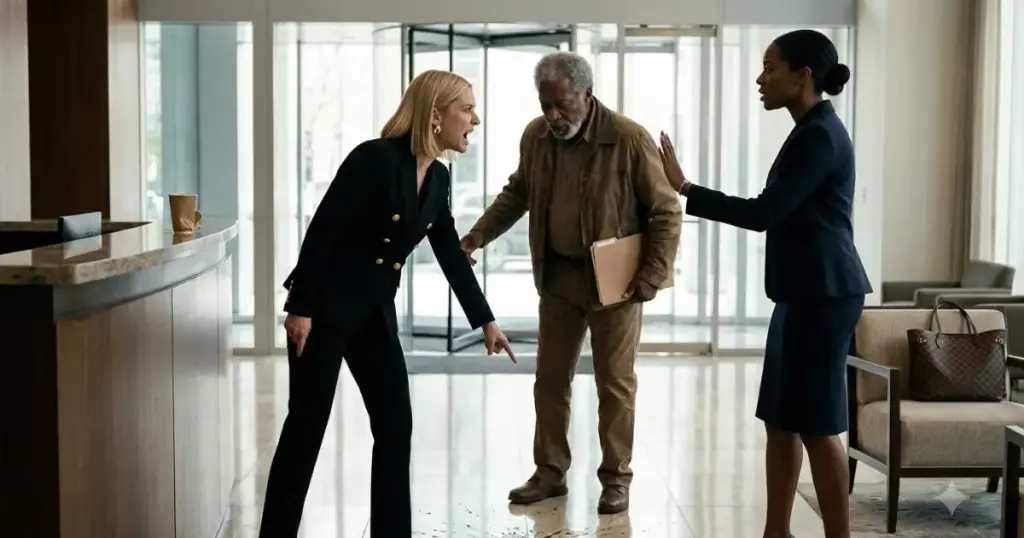
Eleanor picked up the bag, her fingers wrapping around the worn handles as she walked the woman to the seating area.
It was a small gesture, almost entirely unconscious, but as she returned to the desk, she caught Daniel watching her with a quiet smile.
“The executive conference room is waiting for you, Ms. Price,” Daniel said softly.
Eleanor thanked him, her heart thumping a familiar rhythm against her ribs as she stepped into the elevator.
The doors closed, sealing her inside the polished steel box that had once felt like a cage of her own making.
When she stepped out onto the top floor, the view of the city was just as breathtaking, the river glittering under the mid-morning sun.
She walked toward the heavy walnut doors, taking a deep, stabilizing breath before pushing them open.
The room was exactly as she remembered, down to the precise arrangement of the leather chairs around the massive table.
Marcus Whitmore sat near the center, reviewing a file, while Vanessa Brooks and Rachel Morgan were engaged in a quiet conversation.
And there, at the head of the table, sat Samuel Bennett.
He was wearing the same faded tan jacket, the old leather briefcase resting on the floor beside his chair.
The moment Eleanor entered, the conversation stopped, and four pairs of eyes turned toward her.
She didn’t freeze, and she didn’t look away.
Instead, she walked forward, extending her hand to Marcus first, greeting him with a steady voice that carried no trace of her former arrogance.
She moved down the line, shaking hands with Rachel and Vanessa, acknowledging them not as judges, but as potential partners.
Finally, she reached Samuel.
He stood up slowly, his brown eyes studying her with the same thoughtful intensity that had unnerved her months ago.
“Mr. Bennett,” Eleanor said, her voice clear and even.
“Ms. Price,” Samuel replied, taking her hand in a firm, warm grip.
“It is good to see you again.”
He gestured toward the chair opposite him, the exact seat she had occupied during her disastrous interview.
Eleanor sat down, opening her canvas tote bag and retrieving her presentation materials.
She didn’t start with a polished introduction or a boastful summary of her accomplishments.
She started by projecting a photograph onto the large screen.
It was a picture of Harold Jenkins, the sixty-four-year-old former factory worker she had helped on her first day at the center.
“This is Harold,” Eleanor began, looking around the table.
“He spent forty years managing production teams, solving complex mechanical failures, and keeping his coworkers safe.”
She explained how Harold had been repeatedly rejected by automated hiring systems because he lacked a formal degree, despite possessing decades of practical leadership experience.
She then showed a slide detailing the employment center’s new training program, designed to bridge the gap between traditional corporate requirements and the real-world skills of older workers.
Eleanor spoke passionately about the untapped potential sitting in community centers and living rooms across the city.
She didn’t use corporate buzzwords; she used stories, data, and a deep, genuine understanding of the people she represented.
Rachel leaned forward, her analytical mind clearly engaged by the structure of the proposal.
“How do you measure the success rate of these placements, Ms. Price?” Rachel asked, her pen poised over her notebook.
Eleanor answered without hesitation, detailing the retention rates and the specific feedback they had gathered from partner employers.
Vanessa asked about the cultural integration of older workers into younger, fast-paced teams.
Eleanor shared the story of Patricia Lane, explaining how cross-generational mentorship had actually increased productivity in several of their pilot programs.
She didn’t hide from the challenges; she addressed them head-on, proving that she understood the operational realities of a company like Whitmore & Hayes.
Throughout the presentation, Samuel remained quiet, his notebook open, his pen occasionally scratching against the paper.
When Eleanor finished, she turned off the projector and folded her hands on the table, waiting for the verdict.
The room was silent for a long moment before Marcus spoke.
“This is a very compelling proposal, Eleanor,” Marcus said, glancing at the others.
“It aligns perfectly with the new initiatives Rebecca has been trying to implement.”
Rachel nodded in agreement.
“The financial model is sound, and the risk mitigation strategies are well thought out.”
Vanessa offered a warm, approving smile.
“I think this could be a very valuable partnership.”
All eyes finally turned to Samuel.
He closed his notebook slowly and looked directly at Eleanor.
“You have presented an excellent case for these workers, Ms. Price,” Samuel said, his voice quiet but commanding.
“But I have one final question.”
Eleanor braced herself, expecting a difficult inquiry about her past behavior or her current motivations.
“If we agree to this partnership,” Samuel continued, “who will be our primary liaison at the center?”
Eleanor blinked, surprised by the simplicity of the question.
“I will be, sir,” she answered.
Samuel nodded, a faint smile touching the corners of his mouth.
“Then I believe Whitmore & Hayes would be fortunate to work with you.”
The tension in Eleanor’s shoulders evaporated, replaced by a profound, overwhelming sense of relief and accomplishment.
She hadn’t just secured a vital partnership for the center; she had proven to herself that she was capable of genuine change.
As the meeting concluded, the executives stood to leave, shaking Eleanor’s hand with sincere respect.
When only she and Samuel remained in the room, he walked over to her, his battered briefcase in hand.
“You wrote me a very thoughtful letter, Eleanor,” Samuel said gently.
“I meant every word of it, Mr. Bennett,” she replied, meeting his gaze.
“I know you did,” he said, his eyes crinkling with a warm, grandfatherly affection.
“Margaret always told me that the true measure of a person isn’t how they act when they are on top, but how they rebuild when they fall.”
He reached out and patted her shoulder lightly.
“You are building something very strong, Eleanor. Keep going.”