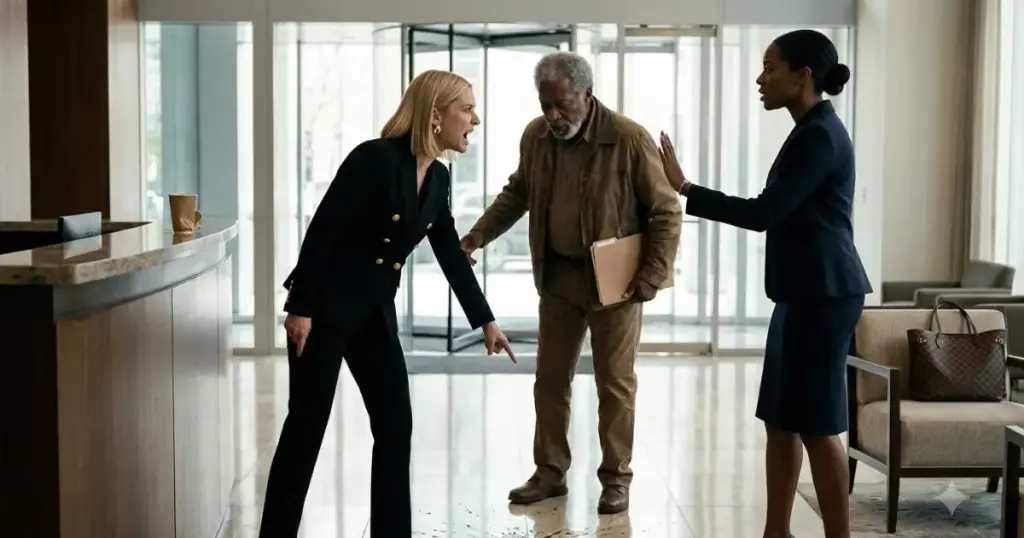
Now she remembered Patricia standing outside the conference room, holding a cardboard box.
The woman hadn’t cried.
She had simply looked exhausted.
“Twenty-two years,” Patricia had said quietly. “I thought that would mean something.”
Eleanor had replied, “The company has to move forward.”
She had forgotten the conversation almost immediately.
Until now.
Samuel noticed the change in her expression.
“Something on your mind, Ms. Price?”
Eleanor hesitated.
Then, for the first time during the interview, she answered without preparing the words first.
“I think I made decisions that hurt people.”
The room grew quiet.
She looked toward the window.
“I told myself I was doing what the business required.”
Samuel waited.
“And perhaps some decisions were necessary,” she continued. “But I didn’t always consider what those decisions meant to the people affected.”
Rachel nodded slowly.
“What would you do differently?”
Eleanor took a breath.
“I would listen before deciding.”
Samuel said nothing.
She continued.
“I would ask whether we had provided the training and support people needed. I would separate poor performance from circumstances that management had created.”
Vanessa studied her.
“And how would you respond to an employee who told you that your leadership made them afraid to speak?”
Eleanor’s instinctive reaction was to defend herself.
She felt it rising.
She had been trained by years of corporate competition to resist criticism and protect her reputation.
But she stopped.
“I suppose,” she said slowly, “I’d need to ask why.”
Samuel watched her carefully.
“And if the answer was uncomfortable?”
Eleanor looked directly at him.
“I’d need to hear it anyway.”
It wasn’t a perfect answer.
But it was the first one that sounded entirely honest.
When the interview ended, Marcus thanked Eleanor for her time.
Rachel collected her documents.
Vanessa stood.
Samuel remained seated.
Eleanor looked at him.
“Mr. Bennett, may I say something before I leave?”
He nodded.
“Of course.”
She folded her hands.
“I know I’ve probably lost this opportunity.”
Nobody responded.
“I also know that saying I’m sorry doesn’t undo what happened.”
Samuel watched her.
“But I want you to know that I am sorry.”
He gave a small nod.
“Thank you.”
Eleanor swallowed.
“I wish I’d behaved differently.”
Samuel’s expression softened.
“Then behave differently the next time.”
The simplicity of the statement surprised her.
She had expected punishment.
Instead, he had given her a responsibility.
Vanessa escorted Eleanor to the elevator.
Neither spoke until the doors closed.
Then Eleanor asked the question she had been afraid to ask.
“Did you know who he was downstairs?”
Vanessa looked at her.
“Yes.”
Eleanor closed her eyes.
“So you watched me humiliate the founder of the company.”
Vanessa shook her head.
“No, Ms. Price. I watched you humiliate a man you believed had no influence over your future.”
Eleanor opened her eyes.
Vanessa continued.
“Those are two different things.”
The elevator descended.
Eleanor stared at her reflection in the polished doors.
For years, she had believed leadership meant never appearing weak.
Never admitting uncertainty.
Never allowing other people to question her authority.
But in the span of one morning, an elderly man in a worn jacket had exposed something she had spent her entire career avoiding.
Her confidence had depended far more on status than on character.
When the doors opened, Vanessa stepped aside.
“Thank you for coming.”
Eleanor nodded.
“Thank you for your honesty.”
She walked toward the exit.
Daniel was standing behind the reception desk.
Peter, the maintenance employee, was adjusting a small sign near the hallway.
Both men looked up.
Eleanor stopped.
Her first instinct was to keep walking.
It would be easier.
There was no reason to prolong the embarrassment.
She could leave the building, return to her apartment, and begin looking for another executive position.
No one was forcing her to confront what she’d done.
But Samuel’s final words returned.
Then behave differently the next time.
Eleanor turned toward Daniel.
“Excuse me.”
He looked surprised.
“Yes, ma’am?”
“I was rude to you earlier.”
Daniel hesitated.
“It’s all right.”
“No. It wasn’t.”
She took a breath.
“You were doing your job, and I treated you as though your opinion didn’t matter. I’m sorry.”
Daniel looked at her for a moment.
Then he nodded.
“Thank you.”
Eleanor turned toward Peter.
He straightened immediately.
“Ma’am?”
“I also owe you an apology.”
Peter looked confused.
“For what?”
“For speaking to you the way I did when your papers fell.”
He glanced toward the cart.
“Oh. It’s okay.”
“It’s not how I should have treated you.”
Peter studied her face.
Then he smiled slightly.
“Everybody has a rough morning.”
The kindness in his response made Eleanor feel worse.
She thanked him and walked outside.
For the first time in years, she wasn’t thinking about how she appeared to other people.
She was thinking about how other people felt when they encountered her.
And that was the beginning of a change she didn’t yet understand.
Back upstairs, the executive panel remained around the conference table.
Marcus was the first to speak.
“Well,” he said, “that was interesting.”
Rachel closed her folder.
“Her qualifications are outstanding.”
Vanessa nodded.
“They are.”
Marcus looked toward Samuel.
“What do you think?”
Samuel rested his pen on the notebook.
“I think she is extremely capable.”
Rachel leaned forward.
“But?”
“I don’t believe she’s ready to lead this company.”
Marcus nodded.
“I agree.”
Vanessa looked thoughtful.
“Do you think people can change?”
Samuel smiled faintly.
“I’d be a poor man to ask if I didn’t.”
Rachel considered that.
Samuel continued.
“But change requires more than embarrassment. It requires responsibility, effort, and time.”
Marcus looked toward the door.
“So we reject her?”
“For this position,” Samuel said, “yes.”
He glanced down at the interview notes.
“However, I hope she takes something useful away from today.”
Vanessa smiled sadly.
“Some people don’t.”
Samuel looked toward the window.
“Some do.”
The official rejection arrived in Eleanor’s inbox three days later.
It was polite, professional, and brief.





