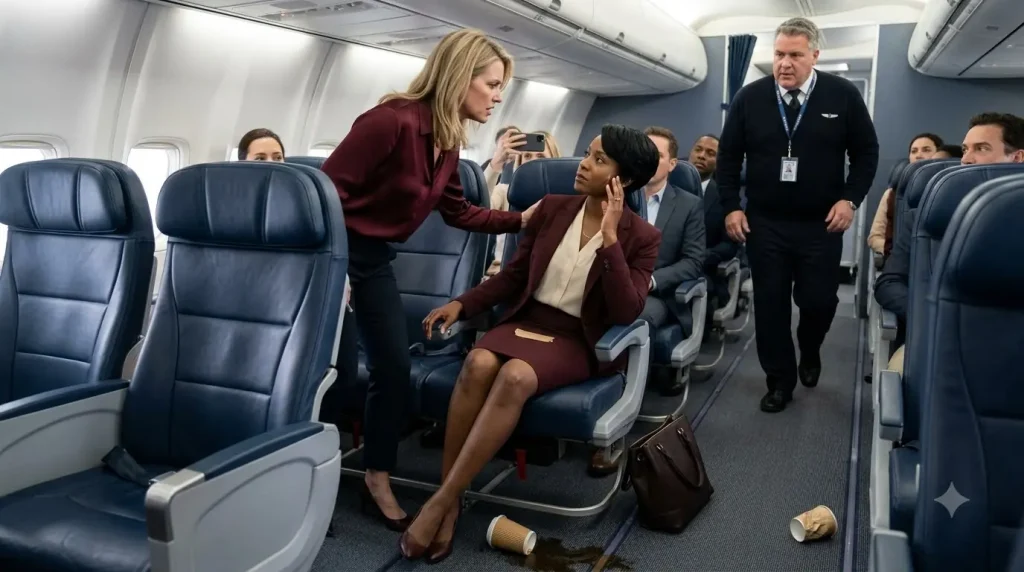
The Boeing 777-300ER was a pressurized tube of cold air, polished composite, and low-frequency engine thrum, waiting at Gate B22 under the gray, sleet-washed light of Chicago O’Hare.
Elena Brooks sat in 3B, her spine aligned perfectly with the ergonomic contour of the charcoal leather. She had spent twenty-two years studying the anatomy of metal tubes just like this one—how they held together at thirty-eight thousand feet, and how easily they unraveled when human discipline gave way to friction.
She did not touch her coffee. The paper cup sat wedged into the recessed ring of the armrest console, its dark surface vibrating in concentric ripples every time the auxiliary power unit beneath the cabin floor cycled its load. In her lap lay a stiff, black faux-leather binder, open to an unlined page where she had written three precise entries in black ballpoint ink:
06:42 – Gate agent boarding announcement out of sequence; priority zone called before pre-clearance verified.06:49 – APU bleed-air cycle audible; forward cabin temp nominal at 68°F.06:55 – Crew cross-check initiated prior to jet bridge detachment.
Elena was forty years old, with skin the shade of roasted chicory, cheekbones carved with architectural severity, and hair smoothed into a flat, razor-parted chignon at the nape of her neck. Her burgundy wool blazer was tailored to sit square across her shoulders without pulling, the fabric heavy enough to resist terminal drafts and anonymous enough to blend into any mid-level corporate cohort traveling between regional hubs.
Her job was not to be seen. Her job was to measure the hairline fractures before the airframe cracked.
Two rows ahead, Morgan Whitaker was vibrating at an entirely different frequency.
Morgan had not sat down since stepping across the threshold of the forward entry door. She was forty-eight, razor-thin, with ash-blonde hair cut to a blunt, swing-chin line that had cost eight hundred dollars on Newbury Street and looked as though it had been lacquered against atmospheric pressure. She wore a collarless burgundy silk blouse that caught the overhead cabin LEDs like wet garnet, tailored cigarette trousers, and four-inch pointed leather heels that clicked with the dry, deliberate cadence of a metronome against the ribbed galley floor.
“If the hanger bag is crushed,” Morgan said into the titanium-cased phone pressed to her ear, her tone flat, nasal, and entirely unmodulated, “I am not signing off on the restructuring terms before the three o’clock call. Tell Julian that directly. I don’t care if his associates have been at the Palmer House since dawn. I don’t wait on second-year analysts, and I certainly don’t attend partner presentations in wrinkled gabardine. Make it his problem.”
She snapped the call shut without waiting for a reply and turned toward the open coat closet opposite the forward galley.
Daniel Price, the cabin supervisor—a broad-shouldered man of fifty-eight whose silvering temples and gold-striped cuffs spoke of three decades navigating transcontinental redeyes and corporate turbulence—was carefully sliding a suit bag onto the rack.
“Excuse me,” Morgan said. The words were not an inquiry; they were an incision.
Daniel turned, offering the practiced, warm half-smile that Northstar Airways drilled into its senior service personnel. “Good morning, ma’am. We’ll have the rest of the coats stowed as soon as the boarding line moves through.”
“Not that one,” Morgan said, her manicure—lacquered in a translucent, weaponized nude—pointing directly at a navy canvas garment bag Daniel had just settled onto the rail. “Take it down. Move it to the back.”
Daniel’s brow twitched, the barest micro-expression of fatigue quickly smoothed by protocol. “The closet operates on a first-come basis for the forward cabin, ma’am. There’s ample room for your garment right here on the outboard rail.”
“That bag belongs to someone who boarded behind me,” Morgan said. “And it’s canvas. Mine is lambskin. I’m in 2A. The forward closet space corresponds to seat rank. If you don’t know how to organize a bulkhead storage compartment, call someone who does.”
“Ma’am, there is no assigned closet priority,” Daniel replied, keeping his voice carefully pitched beneath the general roar of the boarding door. “I will personally ensure your coat is hung without contact. If you’d like to take your seat in 2A, I can bring you a pre-departure water or juice.”
Morgan stared at him for three full seconds, her pale blue eyes narrowing until the crow’s feet at their corners tightened like stitches. “Don’t manage me. Do your job, or I’ll have the district station director standing in this vestibule before the doors close. His name is Walter Vance. Would you like me to dial his private cell, or can you find the strength to move a canvas bag six inches to the left?”
In seat 3B, Elena Brooks made another note.
07:02 – Forward entry vestibule bottleneck: passenger in 2A asserting non-standard priority over shared crew-stowage. Crew response: de-escalation attempted, procedural boundary maintained, but entry lane obstructed.
Elena did not look up when Morgan finally turned away from the closet, her heels biting hard into the carpeted runner.
Morgan did not sit. She stood in the aisle at row two, her structured calfskin tote bag resting half on the leather of seat 2B, her hip angled outward so that the steady stream of passengers entering from the jet bridge had to twist their shoulders to pass her. A tired mother carrying an infant in a sling edged past, her diaper bag brushing Morgan’s silk sleeve.
Morgan recoiled as if touched by a live wire. “Watch it.”
The woman mumbled a flustered apology and scurried toward row fourteen.
Then Morgan’s eyes found Elena.
It was not a casual glance. It was the deliberate, calculating gaze of someone scanning a room for an outlet for an ambient, toxic charge. Morgan took in the notebook, the neutral burgundy blazer that subtly mirrored the color of her own expensive silk, the posture that did not fold or fidget under appraisal.





