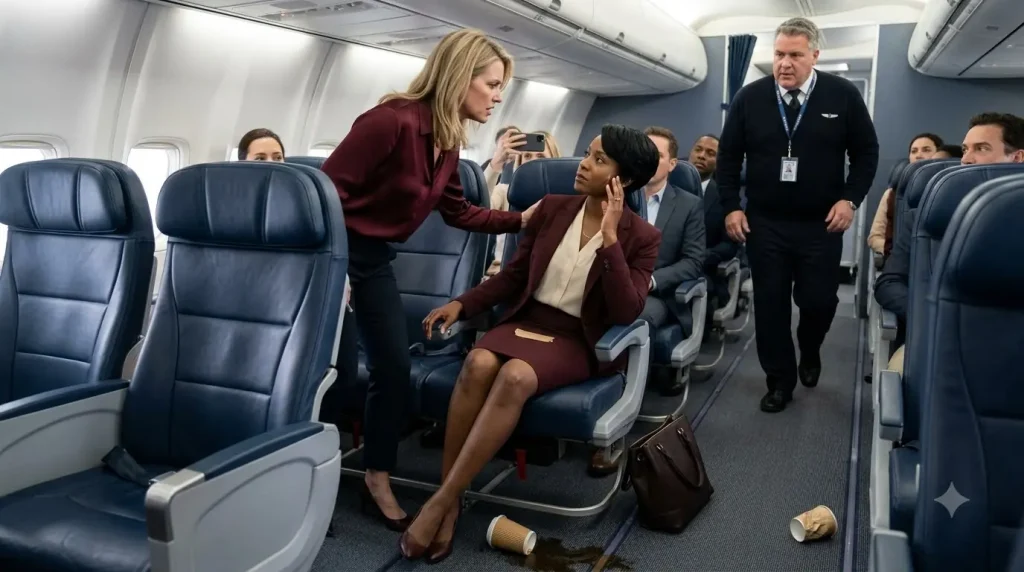
Elena did not drop her gaze, nor did she challenge it. She simply looked back with the detached, level curiosity of a clinician observing an irregular heartbeat on an EKG monitor.
Morgan stepped into the row-two seat pocket, her lips parting in a thin, cold sneer. “Is there something fascinating about my luggage, or do you always stare at people who have somewhere important to be?”
“The aisle is narrow, ma’am,” Elena said evenly. “People are trying to board behind you.”
“I didn’t ask you for traffic management advice,” Morgan said, her voice dropping into a low, vicious register that carried clearly beneath the hum of the air conditioning. “Mind your own business.”
Elena uncapped her pen, her fingers relaxed. “When you block the boarding path, you make it everyone’s business.”
Morgan took half a step forward. Her chin lifted. The scent of her perfume—tuberose, metallic and sharp—hit Elena’s face like an aerosol.
“Do you know who I am?” Morgan asked. The phrase was delivered not with curiosity, but as an article of faith.
“You’re a passenger on Flight 448,” Elena said. “Just like the people waiting behind you in the bridge.”
“I am a managing partner at Whitaker-Vance Capital,” Morgan said, her voice rising now, deliberately pitched to claim the ears of every executive, consultant, and commuter in the first four rows. “I spend more on Northstar priority fares in a quarter than you make in a fiscal year. So when I want to stand in this aisle, I will stand in this aisle. And you will keep your eyes in your lap.”
Elena did not blink. She capped her pen with a quiet, plastic click. “Your ticket entitles you to seat 2A and safe transport to New York. It does not purchase the right of way in an emergency exit path.”
Morgan’s face went white at the cheekbones, the blood retreating into spots of furious mottled red along her jaw. She looked around the cabin—at the venture capitalist in 1B pretending to read the Financial Times, at the tech consultant in 2F staring resolutely at his phone, at the flight attendant standing frozen two paces back with a plastic tray of orange juice.
Nobody spoke. Nobody moved. The silence was the classic, coward’s silence of a public space: everyone waiting for someone else to absorb the blow.
“You don’t talk to me like that,” Morgan hissed. “People like you don’t talk back up here.”
“Ma’am,” Elena began, her voice dropping half an octave into absolute stillness. “Take your seat.”
Morgan’s hand moved before anyone in the cabin registered the shift in her weight.
The slap cracked through the forward cabin like a rifle shot in a tiled room.
The force of the open palm was hard, flat, and brutal. Elena’s head snapped to the right, her jaw absorbing the brunt of the kinetic impact. Her notebook slipped from her fingers, tumbling against the edge of the seat pocket. Her elbow clipped her untouched coffee cup; the lid popped, and eight ounces of lukewarm roast splashed in a dark, jagged arc across the cream leather of the bulkhead and pooled in a thick crescent around the heels of her polished black oxfords.
In the aisle, her structured leather shoulder bag was kicked sideways by Morgan’s trailing foot, tumbling into the center aisle where its zipper gave way, disgorging a small leather card case, a silver pen, and an unsealed manila folder.
For three seconds, the cabin stopped breathing.
The man in 1B froze with his carry-on suspended halfway into the bin, his biceps locked. The flight attendant near the galley let out a short, choked gasp, her fingers flying to her mouth.
Elena did not scream. She did not raise her hands.
She sat motionless for a beat, feeling the sharp, rhythmic throbbing beneath the skin of her left cheekbone. The pain was real, hot and throbbing, but her mind—trained across two decades of high-stress accident reconstructions, black-box transcriptions, and federal regulatory enforcement—instantly categorized the sensation and moved past it.
The blow was not an argument. It was a federal crime.
Slowly, deliberately, Elena turned her head back to face Morgan.
Her eyes were entirely clear. Not a single tear had formed. Her breath was slow, rhythmic, drawn through her diaphragm.
“You should have stopped at the slap,” Elena said.
Morgan let out a high, ragged laugh—the sound of an ego running on pure adrenaline and historical impunity. “You think anyone here cares what you say? You were insolent. You provoked me. I’ll have you escorted off this aircraft in zip-ties before the bridge pulls back.”
To punctuate the statement, Morgan drove the sharp toe of her designer heel into Elena’s shoulder bag, kicking it another two feet down the carpeted aisle toward the forward galley. The bag slammed into the metal pedestal of seat 1D, and a slim, black, bonded-leather credential case slid out from an inner pocket, flipping open as it slid.
Daniel Price appeared from the galley partition like a storm cloud, his face flushed dark red, his composure entirely shattered.
“That is enough!” Daniel roared, his voice cutting through the stunned cabin like a siren. “Ma’am, do not move another inch! Step away from that passenger!”
Morgan turned on him, her eyes flashing with triumphant venom. “Finally! The supervisor. This woman has been verbally harassing me since I stepped into the vestibule. She pushed her knees into the aisle, she made threatening remarks about my travel, and when I told her to back down, she lunged at me. I want her off. Now. Get the gate agent, call Port Authority police, and have her removed.”
Daniel didn’t look at Morgan. He was staring at the floor between row one and the galley bulkhead.
There, lying flat on the gray diamond-pattern carpet, was the open credential case.





