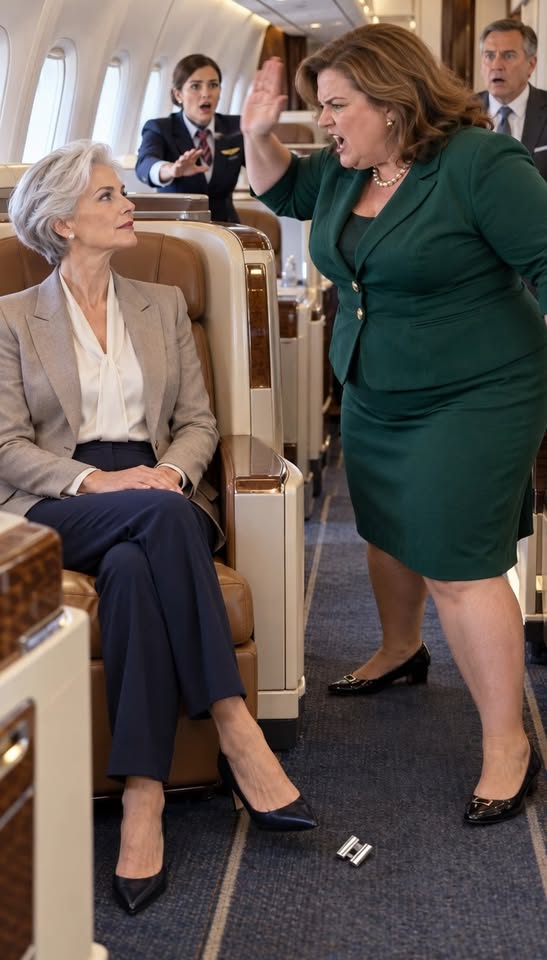
Richard began to retreat.
Victoria did not.
“You people always enjoy the little bit of power you can get,” she told the woman in 2B.
I looked up then. I remember that precisely, because I could have spoken. I could have said, She answered you. I could have said, Leave her alone. Instead, I watched the edge of my magazine as though the next paragraph might contain instructions for being brave.
Victoria reached toward the woman’s lapel.
It happened quickly. A finger caught the edge of the jacket pocket as the older woman turned away. The small navy pouch slipped free. Its loose fold opened, and the silver pin inside struck the carpet with almost no sound.
“Don’t touch my clothes,” the woman said.
Sarah moved forward.
Victoria slapped her before Sarah could reach them.
Afterward, the insignia lay between the women like a question nobody had expected to ask.
“Remain seated, ma’am,” Sarah told the older woman. Then, to Victoria: “You will stay away from her.”
“She threatened me.”
“No,” I said.
My own voice surprised me.
Victoria looked across the aisle.
“She asked you not to touch her clothes,” I said. “Then you hit her.”
Richard shut his eyes.
Sarah looked at me. “Did you see the entire interaction?”
“Yes.”
“Please remain available to provide a statement.”
Victoria pointed toward the pin. “She’s military. Surely she can survive a little argument.”
The older woman finally moved. She looked down, and something passed across her face that had not appeared after the slap. Pain, sudden and unguarded.
Sarah crouched and picked up the silver bars with a clean napkin.
“Does this belong to you?”
The woman held out her hand.
“Yes.”
Her fingers closed carefully around the pin. Her thumb traveled along one silver edge as though following a familiar road.
“You’ve just made the worst decision of your life,” she told Victoria.
There was no theatrical threat in it. She sounded exhausted.
Victoria folded her arms. “I want your name.”
“Dr. Eleanor Mercer.”
“And I want someone in charge.”
Sarah’s expression did not change. “I am responsible for this cabin.”
She moved Victoria back several feet and signaled another crew member beyond the curtain. Then she used the interphone. I could not hear the words, only the careful professional cadence of a report someone knew would be reviewed later.
Richard was staring at Dr. Mercer’s closed hand.
“I’m sorry,” he said.
His wife swung toward him. “Don’t you dare apologize for me.”
“I wasn’t.”
The words landed with surprising force.
For a few seconds, the cabin filled with ordinary sounds again: a seat motor, the ventilation, a soft chime. It was astonishing how indifferent machinery could remain to human humiliation.
Sarah offered Dr. Mercer a cold compress. She accepted it, thanked her, and held it against her cheek. She declined an immediate medical assessment but agreed to speak with someone at the gate.
“At the gate?” Victoria repeated. “We’re already delayed.”
“The captain has been informed of the incident.”
“Well, inform him that I need to be in Washington tonight.”
Sarah returned to the interphone without answering.
I watched Dr. Mercer place the silver bars inside the cloth pouch. One of the clasp points had bent. She tried to fold the cloth over it, stopped, and tried again.
“May I help?” I asked.
She looked at me. Her eyes were gray, direct, and startlingly tired.
“No. Thank you.” Then, after a moment: “You already did.”
I wanted to tell her it had taken me too long. Instead, I picked up the empty water glass that had tipped against her armrest and handed it to Sarah.
Victoria released an audible breath. “Finally.”
But we were turning away from the runway.
The first officer appeared at the forward entrance to the cabin. Beside him stood a man in a charcoal suit with an airline identification badge and a black folder. I had seen him board before departure and assumed he was another passenger. He later introduced himself as Daniel Cho, a duty manager traveling to Washington for a training meeting.
His eyes found the woman in 2B.
“Dr. Mercer?”
She lowered the compress.
He noticed her cheek. His expression sharpened.
“What happened?”
“My wife hit her,” Richard said.
Victoria made a strangled noise. “Richard.”
Daniel looked at Sarah, who nodded once.
“The aircraft is returning to the gate,” he said. “Airport officers and ground staff will meet us there.”
Victoria pointed at Dr. Mercer. “Because of her?”
“Because a passenger was assaulted.”
“No, I mean because she’s somebody.”
Daniel hesitated. The first officer looked toward the flight deck.
Then Daniel said, more softly, “Captain Mercer has also been informed that the injured passenger is his wife.”
Dr. Mercer straightened.
“My husband is flying this route?”
The first officer looked surprised. “You didn’t know?”
“He was scheduled to finish in Seattle.”
“He took a reassignment this morning.”
For the first time, a small, bewildered smile appeared on her face and disappeared almost immediately. “Of course he did.”
Victoria stared toward the flight deck as though its door had become a trap.
“That is a conflict of interest,” she said.
Daniel’s answer was even. “The return decision was made in response to the reported assault. The crew are documenting it.”
There was a difference between that explanation and the story Victoria would later tell online. At the time, however, she seemed unable to hear anything except the word wife.
Our aircraft rolled toward the terminal.
I looked through the window opposite my seat. Ground vehicles moved beneath us. A baggage cart paused near the neighboring jet bridge. Beyond the gate windows, ordinary travelers stood with paper cups, unaware that the small world inside our cabin had changed its shape.
When we stopped, two airport police officers were waiting beside airline supervisors.
There was also a man in an Air Force uniform.





