I was sitting in my mother’s room, trying to coax a spoonful of soup out of a plastic lid that had become unexpectedly architectural. The phone displayed an unfamiliar number. I answered because freelance work teaches you to be afraid of missing a call.
“Ms. Bennett,” she said. “I’d like to clear up a misunderstanding.”
I recognized her voice immediately.
“How did you get this number?”
“Your business listing is public.”
It was. That did not make hearing her less unpleasant.
“My attorney would like to speak with you informally,” she continued. “There are certain inaccuracies in the impression people have taken from that incident.”
“Then your attorney can contact the officer who took my statement.”
“I don’t think you appreciate the damage this is doing.”
I looked at my mother. She had stopped pretending not to listen.
“I described what I saw.”
“You described one moment.”
“I described the twenty minutes before it too.”
Victoria paused.
“There is no reason for you to involve yourself further.”
“You called me.”
Her breath sharpened.
“I am trying to give you an opportunity to be fair.”
I wrote the time on the back of a pharmacy receipt. My mother slid me a pen before I had to ask for one.
“Please have any further contact come through the investigator,” I said.
Then I ended the call.
For several seconds, I could hear my own pulse.
“Did you get the soup open?” Mom asked.
I laughed so hard I nearly dropped the phone.
It was not courage in a grand sense. It was a woman in a visitor’s chair, frightened about her next invoice, deciding not to let another woman move the boundaries of a conversation she had never agreed to have.
I documented the call and sent a factual account to Officer Alvarez. I did not describe it as a crime. I did not know what it was. I described the words I remembered and which ones I could not quote exactly.
Eleanor called that evening. I told her about it.
“She tried to contact us too,” she said.
“To apologize?”
“To discuss the way the situation was being characterized.”
“That’s a long way to say no.”
For the first time, I heard her laugh without effort.
The laugh did not mean she was all right. During the weeks that followed, I learned how often people mistake a person’s capacity for a good moment as proof they have finished enduring a bad one.
Eleanor still woke when a door slammed. Sarah kept replaying the movement of Victoria’s hand. Thomas disliked leaving his wife alone in crowded places and knew that hovering made her feel watched rather than safe.
They talked about it. Sometimes they argued. Nobody became wiser simply because a cruel thing had happened to them.
The public story grew faster than the real one.
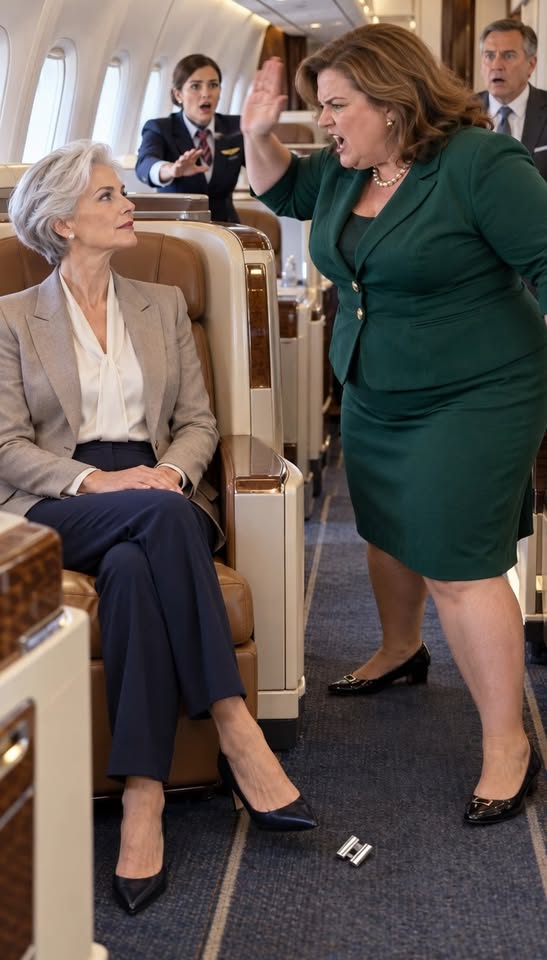
A longer passenger recording eventually surfaced. It showed Victoria’s hand catching the jacket, the pouch falling, and the slap. The silver pin was only a bright speck near the seat, but Eleanor’s stillness afterward was clear.
People began calling her the Captain of Seat 2B.
She asked Daniel to correct that whenever he could.
“My daughter earned the rank,” she told him. “I carried the pin.”
Some outlets used the correction. Others kept the better headline.
There were online attacks on Victoria’s appearance, her clothes, her weight. Eleanor objected to those too.
“What she did is enough,” she said when someone sent her a cruel cartoon. “You don’t need to invent another reason to dislike her.”
I saved that message. I would need it later, when anger started making cruelty feel efficient.
At work, I continued transcribing depositions about property lines, insurance disputes, and a restaurant partnership that had ended over an industrial refrigerator. My life had not become a suspense film. My electricity bill still arrived on time.
But underneath the ordinary days, records were moving.
Richard’s attorney delivered the maintenance export through the agreed channels. Technical reviewers compared it with archived service notices, vehicle assignment sheets, dispatch communications, and the materials used in the original inquiry. Former employees were interviewed separately. Ravi provided the packet he had kept in a box beside Zoe’s old hospital bracelets.
One document did not prove everything. Several documents, fitted together, began to show what one convenient summary had concealed.
The affected backup power modules had not all failed. That uncertainty had been used to argue that removing vehicles from service would be excessive. A vendor had asked for inspection before further use. The scheduling office had warned of lost contract hours. The exception approval had categorized the issue as a routine service interval.
The vehicle carrying Lily and Zoe had remained on the schedule.
None of that explained the initial collision. It did explain why the equipment that should have provided a margin afterward had not been ready.
The distinction mattered to Eleanor.
“I don’t need them to have caused everything,” she said. “I need them to stop saying they could have prevented nothing.”
A former fleet coordinator named Marisol Reyes contacted the review team. She had sent the original warning onward and been told, later, that operations had received updated guidance. She had never seen that guidance herself.
When she was invited to meet the family, she nearly canceled.
Eleanor asked whether I would come. By then, we had become friends in the unplanned way people do when they have already seen each other on a day that strips away introductions.
We met in a conference room at an attorney’s office. Marisol arrived in a raincoat with a broken button. She kept apologizing for being late, though she was six minutes early.
“I should have pushed,” she said before sitting down.
Eleanor gestured toward a chair.
“Tell us what happened.”
“I sent it to my supervisor. I marked the vehicle numbers. I asked whether dispatch should stop using them.”
“What answer did you get?”
“That engineering had it covered.”
“Did you have authority to remove the vehicles?”





