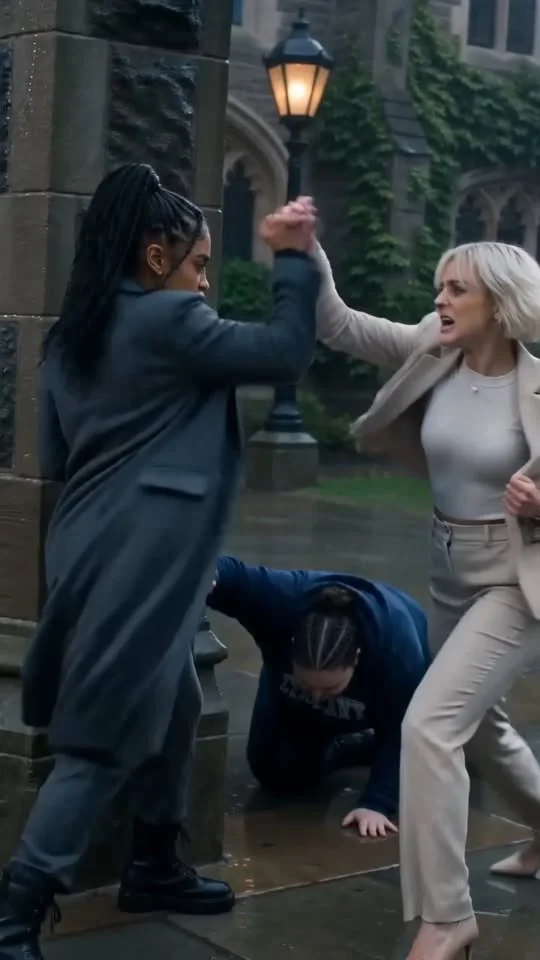
Julian’s head jerked up then. For a fraction of a second, the fear in his dark eyes didn’t vanish—it compressed, burning down into something hard, dark, and utterly silent. He didn’t lunge. He didn’t curse. He simply pushed himself up from his haunches, his hands gripping the wet wood of the pier as he hoisted his shivering frame out of the water, the dark lake water streaming from his clothes like oil.
Sloane watched him rise, her smile hardening just a fraction. There was something unsettling about the way he moved—too quiet, too controlled, like an animal that had stopped running and turned its head to face the hounds.
“Oh, look,” Sloane sneered, taking an involuntary step back as he straightened up, water pooling around his boots. “He thinks he’s brave now. Go on, Julian. Go home to your little split-level on the south side and write a very stern, tear-stained letter to the principal. I’m sure my father will read it right before he fires the entire school board over breakfast.”
Julian didn’t say a word. He turned his back on them, his shoulders hunched against the wind, and began walking slowly toward the gravel access road that led up to the parking lot, his wet sneakers squelching in the dirt.
“What a pathetic loser,” Brooke muttered, tapping her screen to save the video file. “Should we post it to the junior class feed now or wait until Monday morning?”
“Wait for Monday,” Sloane replied, her eyes narrowing as she watched Julian’s retreating figure dissolve into the gathering dusk. “Let it marinate over the weekend. Some people just need to be reminded of their exact weight in the universe.”
They turned back toward the clubhouse deck, their laughter drifting across the dark water, entirely unaware that the tide had already turned.
The Monday morning air in the corridors of St. Andrew’s Collegiate was thick with the scent of floor wax, old paper, and the suppressed panic of mid-semester exams. St. Andrew’s sat on a jagged limestone bluff overlooking Lake Michigan like an ivy-covered fortress, its Gothic stone arches and leaded glass windows designed to remind every student that they were merely temporary custodians of an elite lineage, while the real owners sat in boardrooms in Chicago and New York.
In the second-floor chemistry laboratory, however, the atmosphere was considerably more volatile.
Dr. Aris Vance—no relation to Julian, though the coincidence was a favorite parlor game among the gossiping faculty—stood at the front of the lecture theater, adjusting the lens of an overhead projector with surgical precision. Dr. Vance was fifty-two, with iron-grey hair combed straight back, steel-rimmed glasses that caught the fluorescent glare, and a reputation for being the only instructor on campus who couldn’t be bought, charmed, or intimidated by a six-figure donation to the athletic endowment.
“Page one hundred and twelve,” Dr. Vance announced, his voice slicing through the low murmur of thirty teenagers trading weekend gossip and posting digital fallout from homecoming. “If everyone has recovered from the intellectual exhaustion of homecoming weekend, we might actually manage to cover organic synthesis before the state accreditation boards shut us down for incompetence.”
In the third row, Sloane Harrington sat with her legs crossed, a gold-plated fountain pen poised over a pristine Moleskine notebook. Beside her, Brooke was busy filing her nails with an emery board shaped like a diamond, occasionally glancing at her phone to check engagement metrics on her weekend posts.
Two rows back, sitting completely alone at an oversized lab bench, was Julian. He wore a simple black crewneck sweater that smelled faintly of laundry detergent and woodsmoke. His hair was dry, his dark eyes fixed on the empty glass beaker in front of him. He hadn’t spoken a single word to anyone since walking through the front gates at 7:45 AM, ignoring the sidelong glances and muffled snickers from the lacrosse row at the back.
The heavy oak door at the back of the lecture hall swung open with a slow, deliberate creak that silenced the room instantly.
All thirty heads snapped around.
Standing in the doorway was Maya Lin.
Maya wasn’t a student at St. Andrew’s. She was nineteen, a sophomore at the University of Michigan spending her fall semester on an intensive research fellowship at the municipal freshwater institute down by the harbor, and she occasionally assisted Dr. Vance with advanced lab preparations and water quality assays. Today, however, she wasn’t wearing a lab coat or safety goggles. She wore a faded canvas field jacket, heavy-duty combat boots that crunched with dried mud against the parquet floor, and carried a large, water-damaged leather satchel that looked like it had survived a tactical extraction in a war zone.
She walked down the central aisle with the measured, unhurried stride of someone who didn’t care whose ancestral portrait was hanging on the wall or how many millions of dollars their grandfather had donated to the building fund. Her dark hair was tied back in a messy knot, and her face bore the faint, pale crescent of a scar along her left jawline—the kind of mark earned not on a tennis court, but on a concrete wrestling mat or a rough dockside scuffle.
She didn’t stop at the front desk. She walked past Dr. Vance, who offered a brief, knowing nod without looking up from his notes, and continued straight down the row toward Sloane Harrington’s desk.
Sloane didn’t look up immediately, assuming it was just another townie bringing makeup or lost property. “Can I help you?” Sloane asked, her voice dripping with bored aristocracy. “If you’re collecting for the alumni charity drive, Brooke has the checkbook.”
Maya didn’t answer. She dropped the heavy leather satchel onto Sloane’s pristine Moleskine notebook with a wet, heavy thud that splattered a circle of dark, foul-smelling lake water across the cream-colored paper.





