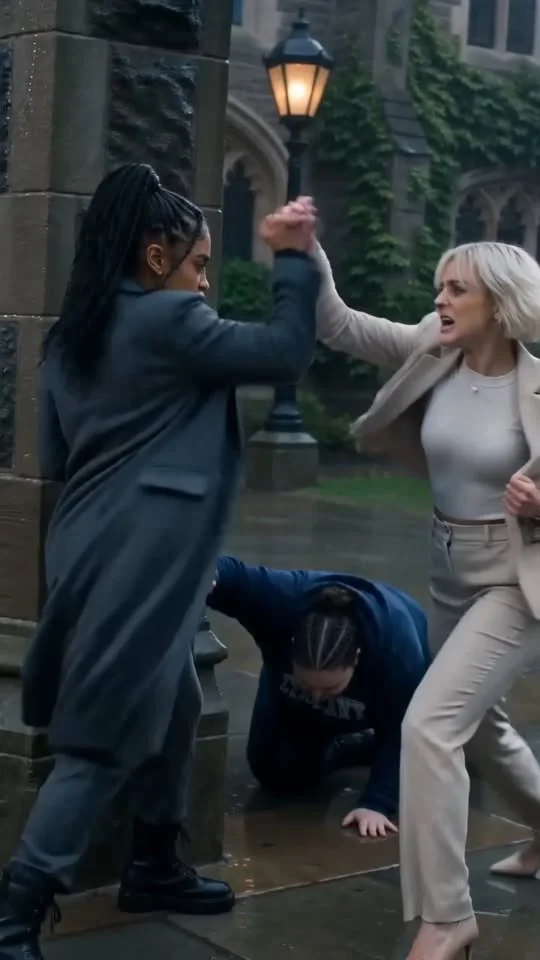
Maya didn’t look up from the file she was unlacing. Her fingers were steady, calloused at the tips from years of handling core samples and hydraulic rigs. “Your father thought he was protecting you by burying that report,” she said quietly, sliding a sheaf of onionskin paper across the desk. “He thought if he signed the NDA and took the clinic relocation, the Harringtons would leave your family alone. But predators don’t stop when you feed them, Julian. They just learn where the kitchen is.”
Julian’s eyes scanned the top page—a ledger of offshore accounts, shell corporations registered in Delaware under fictitious timber holdings, and a direct money trail leading from the St. Andrew’s Collegiate capital improvement fund straight into a private trust controlled by Arthur Harrington. The numbers didn’t just show embezzlement; they showed systemic, generational rot. Every scholarship granted to a working-class student in the county had been funded by federal grants meant for municipal watershed restoration—grants that had been siphoned off, laundered through dummy construction bids, and spent on private golf courses and country club renovations.
“They used my tuition waiver,” Julian whispered, the realization hitting him with the cold weight of lead. “Every time Sloane reminded me that I was on a scholarship… she was paying for her own family’s theft with money stolen from my father’s department.”
“And then they threw you in the lake,” Maya added, her dark eyes flashing with a cold, unforgiving fire. “Which was a tactical error on their part. If Trey Callahan had kept his hands in his pockets, your father’s signature would have stayed buried in a federal archive for another ten years. But arrogance makes people sloppy. They thought because you wore a wet hoodie, you didn’t have anyone behind you who knew how to read the current.”
She reached into her satchel and pulled out a second, smaller document—a heavy cardstock summons bearing the seal of the Michigan Sixth Judicial Circuit.
“What’s this?” Julian asked.
“An injunction,” Maya replied smoothly. “Filed forty minutes ago by my uncle at the district water commission. It halts all construction on the North Bay marina development effective immediately, citing environmental contamination and fraudulent land acquisition permits. The injunction lists Arthur Harrington, the entire St. Andrew’s board of trustees, and—because he signed off on the initial zoning variance—your school’s headmaster as co-respondents.”
Julian stared at the paper. The names inked across the top were the very pillars of West Michigan society—men and women whose families had owned the shoreline since the lumber barons cleared the white pines in the late nineteenth century. For generations, they had operated with absolute impunity, treating the town, the schools, and the courts as private extensions of their summer estates.
“They’ll fight it,” Julian said, though the tremor in his voice was gone, replaced by a steady, rising heat. “Arthur Harrington has three federal judges in his golf foursome. He has retained the most expensive defense counsel between Chicago and Grand Rapids.”
“Let him try,” Maya said, leaning back and crossing her arms. “Judges can’t ignore public water poisoning, Julian. Not when the state lab results hit the Associated Press wire at six o’clock tomorrow morning. By noon, every major news outlet in the Midwest is going to want to know why Lake Macatawa’s municipal watershed has been testing positive for heavy metals and industrial runoff for the past three years—and why the St. Andrew’s endowment fund was used to pay off the local inspectors.”
She reached across the table and tapped the corner of the manila envelope. “Your father’s testimony is the keystone. With it, the whole structure comes down. Without it, they’ll find a scapegoat among the junior vice presidents and keep right on pouring concrete into the bay.”
Julian looked down at his hands. For seventeen years, he had lived in the margins of a world designed to make him feel small. He had memorized organic chemistry reactions, translated Latin prose, and swallowed every snide remark in the hallways of St. Andrew’s because he believed the myth of their superiority—the idea that some people were born to rule the lake and others were born to drown in it.
Now, looking at the ledger entries and the federal injunction, he saw the truth. They weren’t gods. They were just accountants who had lost track of their liabilities.
“What do you need me to do?” Julian asked.
Maya smiled—a sharp, fleeting curve of her lips that held no warmth, only absolute resolve. “Put on your dry hoodie, Julian. Tomorrow morning, we’re going to history class.”
The morning sun over Lake Macatawa did not break through the clouds so much as it forced its way through a jagged tear in the grey ceiling, casting long, bruised bars of golden light across the manicured lawns of St. Andrew’s Collegiate.
Inside the main administration building, however, there was no light—only the frantic, low-frequency hum of institutional panic.
By 7:30 AM, the oak doors of the headmaster’s office had been slammed shut three times. By 7:45 AM, two sleek, black Lincoln Navigators bearing Lansing plates had pulled up directly in front of the grand portico, their tinted windows reflecting the grey stone pillars as four men in charcoal suits strode past the marble reception desk without signing the visitor log.
In the second-floor chemistry lecture hall, Dr. Aris Vance stood at the front demonstration table, methodically arranging glass pipettes and porcelain crucibles. He didn’t look at the door when it opened. He didn’t need to.
Thirty students sat in stunned, suffocating silence. The usual Monday morning chatter—the post-mortem analysis of weekend parties, the casual dissection of who had slept with whom, the lazy, privileged arrogance that usually filled the room—was entirely absent. Phones buzzed continuously in pockets and leather backpacks; screens lit up with push notifications from local news sites, Twitter threads, and leaked municipal documents that had begun circulating among the student body before the first bell had even rung.





