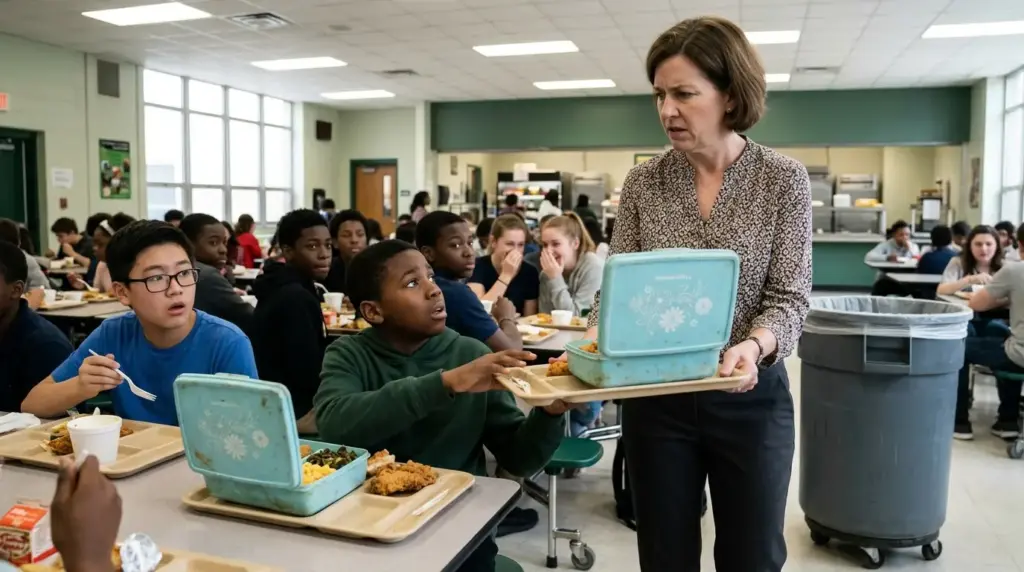
In sixth period English, Patterson assigned an essay: “What does respect mean in our community?” She made direct eye contact with Marcus. After class, she stopped him.
“Marcus, I hope you learned something today about appropriate behavior.”
Marcus replied quietly, “I learned something about you.”
Patterson’s smile vanished. “Excuse me?”
“Nothing, Ms. Patterson.” He walked away.
Outside, Tyler was already texting. The video was uploaded to the school group chat first, then wider.
Marcus pulled out his phone, texted his grandmother: Grandma, can you call Dad? I need to talk to him.
Her reply came fast: Baby, he’s on a mission. Coming home Friday. What’s wrong?
Marcus stared at the screen, typed: Nothing. It’s okay. But his face said everything wasn’t okay.
Thursday morning, Marcus woke to his grandmother’s voice in the kitchen, tense and worried. He crept to the doorway. Dorothy sat at the table reading an email on her old laptop, her hand covering her mouth.
“Grandma, what’s wrong?”
She looked up, her eyes showing exhaustion. “Baby, the school sent an email. They want a meeting today at 3:00.”
Marcus’ stomach dropped. “A meeting about what?”
Dorothy turned the laptop toward him. The subject line read: “Student conduct discussion required: Marcus Williams.” The email was from Ms. Patterson, copied to Principal Cartwright and the school counselor.
Marcus read over his grandmother’s shoulder. Words jumped out at him: Disruptive behavior. Defiance. Refusal to acknowledge school standards. Created a hostile environment in the cafeteria.
“They’re saying I was the problem?” Marcus’ voice rose. “She threw away my food!”
“I know, baby. I know.” Dorothy’s jaw tightened. “We’re going to that meeting. We’re going to sort this out.” But her tone didn’t sound confident; it sounded defeated.
Marcus got ready for school in silence. His backpack felt heavier. Everything felt heavier.
At school, the video had spread. Tyler’s post from yesterday got 200 views overnight. Students Marcus barely knew approached him in the hallway:
“Yo, that was messed up what Patterson did.”
“My cousin had her last year. She’s always like that to Black kids.”
“You should report her.”
But some students avoided him completely, especially the white kids who laughed yesterday. They looked at him differently now, like he was trouble, like he brought this on himself.
In second period, his history teacher, Mr. Anderson, pulled him aside. Mr. Anderson is Black, 40 years old, and teaches with passion; students love him.
“Marcus, I saw what happened yesterday.” Anderson’s voice was low. “That wasn’t right.”
Hope flared in Marcus’ chest. “Can you help? Can you tell them?”
“I’m non-tenured.” Anderson looked pained. “Patterson has influence with Cartwright. If I speak up, I might not have a job next year.”
The hope died. “So, nobody can help?”
“I didn’t say that.” Anderson pulled a small notebook from his desk. “Document everything. Dates, times, witnesses, what was said exactly. If you’re going to fight this, you need evidence.” He handed Marcus the notebook. Their hands touched briefly—a moment of solidarity that couldn’t be spoken aloud.
“Thank you,” Marcus whispered.
“Your mother was a fighter.” Anderson’s eyes were serious. “I knew her. She taught at Roosevelt High before she got sick. She never backed down from injustice. Neither should you.”
The words sat in Marcus’ chest like warm stones.
At lunch, Marcus sat with Tyler, Aaliyah, and Devon. None of them brought food from home; they all bought the sad cafeteria pizza. Marcus opened Anderson’s notebook, started writing.
“What are you doing?” Aaliyah asked.
“Building a case.” Marcus’ pen moved fast. “Ms. Patterson. September 15th: confiscated Aaliyah Jackson’s bonnet. Called it inappropriate sleepwear.”
Aaliyah nodded slowly. “My mom complained. Nothing happened.”
“September 28th: Raj Patel’s curry. Patterson said strong odors disrupt learning.” Marcus looked at Devon. “Your sister Kesha Thomas.”
“October 10th: jollof rice,” Devon leaned in. “She cried for two hours. My mom called the school three times.”
“October 3rd: Miguel Hernandez, tamales, ‘too ethnic.'” Marcus wrote faster. “And yesterday, November 6th: me.”
Tyler watched the list grow. “That’s five incidents in two months. All students of color.”
“But white kids…” Marcus’ pen tapped the paper. “Nobody stops Emma’s lasagna, or Connor’s gyros, or that kid who brings Irish stew every week.”
The pattern was undeniable on paper—crystal clear.
“This is evidence,” Devon said quietly. “Real evidence.”
Marcus felt something shift inside him: not hope exactly, but purpose.
The afternoon dragged. In English class, Patterson was overly sweet to him, fake-concerned. “Marcus, I hope you’re reflecting on yesterday’s lesson about respect and boundaries.” Her smile was plastic. “Some students need more guidance than others.” She assigned extra homework just to him: three additional essay questions about personal responsibility and accepting constructive criticism.
After school, Marcus and his grandmother walked to the administrative building. Dorothy wore her church clothes, her good shoes, like she was going to court.
They arrived at 2:55 p.m., five minutes early. The secretary led them to a conference room. Principal Cartwright sat at the head of the table, Ms. Patterson to her right, and the school counselor, Mrs. Reynolds, to her left—three against two. Dorothy and Marcus sat across from them. The power imbalance was immediate, obvious.
“Thank you for coming, Ms. Williams.” Cartwright’s voice was professionally neutral. “We wanted to discuss Marcus’ recent behavioral concerns.”
“Behavioral concerns?” Dorothy’s tone was careful. “From what Marcus told me, Ms. Patterson threw away his lunch and humiliated him publicly.”
Patterson jumped in. “With all due respect, that’s not what happened. I was enforcing our cultural appropriateness initiative.”
“Where is that policy written?” Dorothy interrupted. “Show me the handbook page.”
Cartwright shifted. “It’s part of our professional judgment framework. Teachers have discretion.”
“Discretion to target my grandson?” Dorothy’s voice rose slightly. “To throw away food he spent hours making in his dead mother’s container?”





