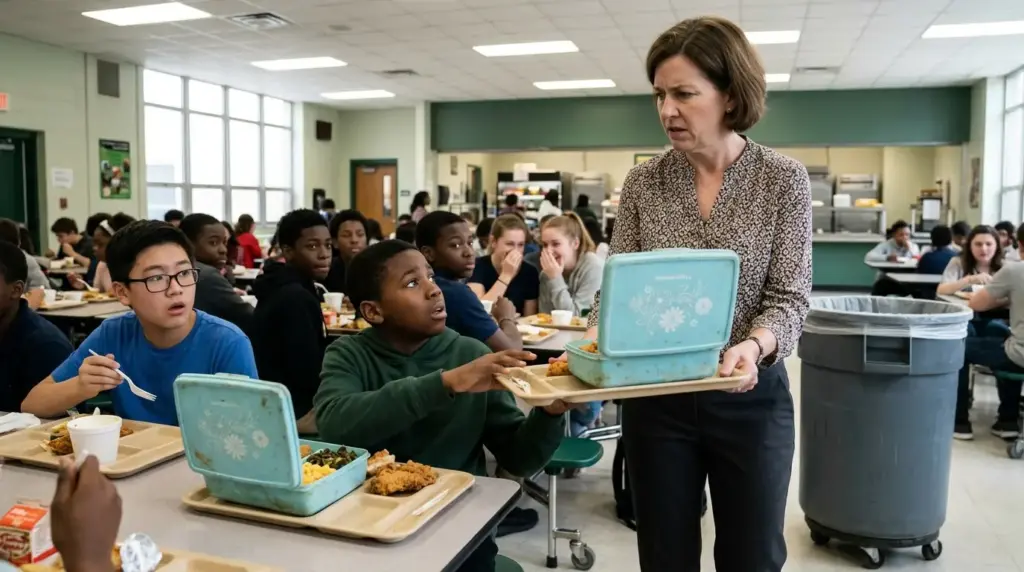
Marcus spoke quietly. “My history teacher gave me the notebook. Said evidence matters.”
“Mr. Anderson,” Torres nodded. “Smart man.”
23 minutes later, Ms. Jennifer Patterson arrived. She walked into the crowded office and stopped dead. She saw Colonel Williams in full uniform, saw the superintendent, saw the attorney, saw Marcus. Her face drained of color.
“Sit down, Ms. Patterson.” Torres’ voice left no room for argument.
Patterson sat, tried to compose herself. “Superintendent, I’m glad you’re here. There’s been a misunderstanding.”
“There’s been no misunderstanding.” The attorney opened a file folder. “Ms. Patterson, you’re being placed on immediate administrative leave pending investigation into civil rights violations under Title VI of the Civil Rights Act.”
Patterson’s mouth fell open. “Violations? I was enforcing school standards!”
“There are no standards,” Torres cut through. “We’ve reviewed every policy document. There is no ‘cultural appropriateness initiative,’ no written policy about food, no guidelines about cultural dress.” She leaned forward. “You created a discriminatory pattern targeting students of color. That’s not education. That’s bigotry.”
Patterson turned to Cartwright, desperate. “Helen, tell them! You approved everything!” Cartwright looked away.
Torres turned to the principal. “Dr. Cartwright, you’re also on administrative leave. You enabled discrimination by dismissing complaints. That’s a failure of leadership.”
“You can’t! I have 20 years—”
“And you used them to protect racism.” Torres stood. “Security will escort you both out.”
Patterson’s desperation peaked. She turned to David. “You’re military! You understand the chain of command, following orders! This is political!”
David’s voice was ice: “I understand integrity. Something you lack.”
Patterson tried again: “But who even are you two?!”
Another knock at the door. A man walked in: Black, 51 years old, distinguished in a tailored suit—Mayor Jonathan Bradley of Washington, D.C.
Everyone stood instinctively. Patterson’s remaining color drained away.
The mayor looked around, his eyes landing on David. They shared a look of deep familiarity. “Dave. Welcome home.” They shook hands, something far more than casual.
David nodded. “John.”
Marcus stared, confused. “Dad?”
The mayor turned to Marcus, his expression softening. “Marcus. Last time I saw you, you were this tall.” He gestured to waist height.
“I… I don’t…”
David put his hand on Marcus’ shoulder. “Marcus, this is Mayor Jonathan Bradley. Your mother’s brother. Your uncle.”
The room went completely silent. Marcus’ world tilted. “My uncle?”
“Your mom and I drifted after she got sick. That’s my failure. But I’m here now.” Bradley looked at Patterson. “And I’ve seen everything.”
Patterson couldn’t speak. She was facing the mayor—the mayor who was Marcus’ uncle.
Bradley continued, his voice controlled but tight: “My sister Angela Williams passed away three years ago. She was a teacher. She believed every child deserved dignity.” He looked directly at Patterson. “That lunch you threw away—those were her recipes, her legacy, taught by her mother to her son.” He let that sink in. “You didn’t just throw away food, Ms. Patterson. You threw away my sister’s memory.”
Patterson’s lips trembled; no words came.
Bradley turned to Torres. “Superintendent, I trust this investigation will be thorough.”
“Absolutely, Mayor Bradley.”
“Good, because I’ll be monitoring it personally.” He turned to Marcus, crouching to eye level. “Your mom would be so proud of you for standing up, for documenting everything.”
Marcus’ eyes filled with tears. “Uncle John… I didn’t know.”
“I’ve been mayor for two years; I should have been present sooner. That’s on me.” Bradley stood. “But I’m here now, and this ends today.”
David added, “I called John from the plane because this isn’t just about family. It’s about civil rights.”
Bradley nodded. “If Marcus weren’t my nephew, this would still be wrong. That’s why we’re implementing new oversight, district-wide bias training, and independent reporting systems.”
Torres added, “Fort Myer has expressed concerns. 40% of students here are military dependents. The base is reviewing whether this school remains suitable.”
The weight of that hung heavy: losing military students meant losing funding.
Patterson tried once more. “This isn’t fair! It’s just food! Just school rules!”
Marcus spoke up, his voice stronger: “You threw away my mother’s container. You called my food inappropriate. You suspended me for being humiliated.” He looked her in the eye. “What standard is that?”
Patterson had no answer.
Security arrived. Torres nodded. “Ms. Patterson, Dr. Cartwright, you’re escorted off campus immediately.”
As they were led out, students in the hallway parted. Everyone was watching, phones recording. Patterson tried to hide her face, but couldn’t.
Someone called out, “You said my tamales didn’t belong!”
Another voice: “You took my sister’s bonnet!”
Patterson kept walking—no defense possible.
Outside, news vans were gathering; Torres had called them for transparency. Mayor Bradley gave a statement on the school steps, David standing beside him, Marcus between them:
“Today, Lincoln Heights failed one of its students. Marcus Williams showed courage by documenting discrimination. We’re implementing immediate reforms.”
A reporter asked, “Is Marcus your nephew?”
“Yes, but this isn’t about family connection. It’s about civil rights. Marcus happened to have a family that could amplify his voice, but he shouldn’t have needed that.”
Another reporter: “Colonel Williams, your message?”
David stepped forward. “I’ve served 22 years. I’ve been in combat. I never imagined my son would face discrimination in his own school.” His voice cracked, but he held steady. “I’m proud of him. He documented. He spoke the truth. He stood firm.”
Marcus was pulled forward, shy and overwhelmed. “I just wanted to eat my lunch that I made for my dad,” his voice was small but steady. “No kid should be afraid to be themselves.”
The gathered students erupted in applause. Tyler held up a sign: All Foods Welcome. Other students raised their phones, recording, making this permanent.
Friday evening, the Williams apartment smelled like home. Grandma Dorothy stood at the stove cooking the same meal Patterson threw away: fried chicken sizzling in cast iron, mac and cheese bubbling in the oven, collard greens simmering with ham hocks.





