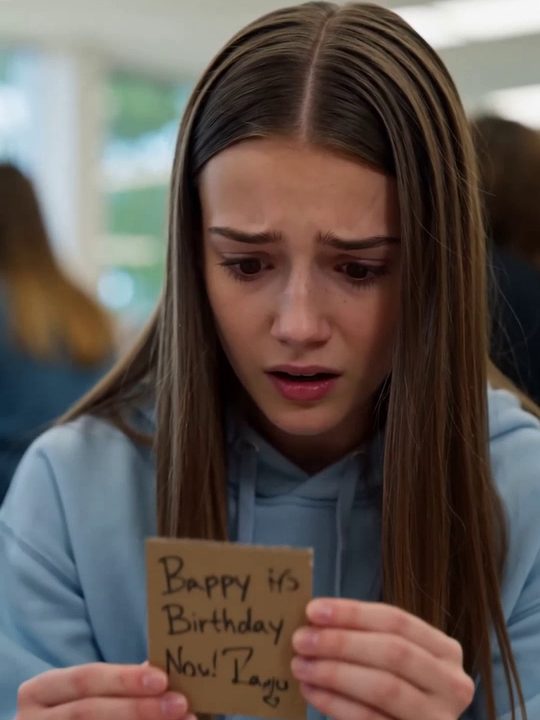
Derek turned his head back around, his smile curling with the easy contempt of someone who didn’t like being addressed once the joke was finished. “What?”
“It’s my brother’s birthday,” she said. “He turned ten today.”
A low murmur ran through the adjacent tables. Across the aisle, Connor Bell, the starting center and Derek’s shadow since kindergarten, stopped snickering. His hand remained halfway inside a bag of barbecue chips. Two girls near the milk coolers lowered their phones, their screens still recording, their expressions shifting from manufactured amusement to something uncomfortably sharp.
Derek felt the shift in the room’s oxygen. Westbrook was a town built on hierarchy, but it was also a small town, and small towns didn’t like cruelty when it was stripped of its humor. He felt an adolescent urge to push harder, to reassert the boundary line before the balance tipped away from him.
He spread his arms wide, projecting his voice toward the cafeteria monitors by the double doors. “Then tell your mom to whip up another box of Betty Crocker, Hart. It’s lunch, not a bake sale.”
A couple of his offensive linemen offered a nervous, dutiful bark of laughter, but it died quickly.
Sophie didn’t look at them. She slowly sank into a crouch. Her knees clicked against the tile. With steady, unhurried fingers, she reached past the broken edge of the sponge cake, ignoring the smeared blueberries and the gray institutional grime that had already begun to adhere to the sweet sugar crust.
She wasn’t trying to save the food.
Her fingers slid beneath the rectangular bottom of the cardboard box. Taped to the underside, protected by a strip of clear packing film, was a photograph.
It had been clipped down with scissors, its corners yellowed by humidity and age, the glossy coating cracked into a spiderweb of fine white fissures. Across the top, written in faded blue permanent marker in the shaky, uneven hand of a young boy learning to control a pen, were two words:
BENJAMIN MERCER.
And beneath that, in pencil so light it looked like a shadow:
Save me a slice.
Connor saw it first. He had leaned down, his six-foot-four frame hunching over the lunch table, trying to make out what she was peeling away from the greasy cardboard. The smirk slid off his face so completely it was as though someone had wiped it away with a wet cloth.
“Derek,” Connor whispered.
“Drop it, Connor,” Derek muttered, his gaze still fixed on Sophie’s lowered head. “Let her play the victim. It’s what she does.”
“Derek, look at the damn paper.”
Connor’s hand clamped down on Derek’s sleeve. The grip was tight—panicked, even.
Derek pulled his arm away with a scowl, his eyes dropping to where Sophie was carefully lifting the taped print.
His vision narrowed until the rest of the room blurred into gray static. The name hit him like a blunt blow to the solar plexus, driving the air up into his throat in a dry, rattling gasp.
BENJAMIN MERCER.
For six years, that name had belonged to a drawer in his father’s study that remained locked with a brass key. It belonged to an eighteen-inch headstone in the municipal cemetery on Route 9, set between two weeping willows that shed sticky yellow sap in July. It belonged to an empty white coffin that the town council had paid for after the National Guard divers gave up their search along the swollen banks of Blackwater Creek during the Memorial Day flood of 2020.
Most of all, it belonged to the silence at the dinner table—to the heavy, bourbon-scented quiet that descended whenever his father, Sheriff Thomas Mercer, looked across the roast beef at his remaining son and let his eyes linger just long enough to communicate the sentence he never spoke aloud: The wrong one came out of the water.
Derek’s fingers twitched against the seam of his jeans. “Where did you get that?”
The words sounded rusted, tearing at his throat.
Sophie rose to her feet. She held the small square of photo against her chest, her fingers curled protectively over the edges. Her eyelashes were wet, but there was an unnatural, terrifying steadiness in her jaw.
“You really don’t remember what you told him?” she asked softly.
The cafeteria noise had receded entirely now. Even the industrial dishwashers in the back kitchen seemed to have fallen silent behind their stainless-steel partitions.
“What are you talking about?” Derek took a step forward, his chest heaving under the wool jacket. “That’s my brother’s name. Where did you get that picture, Hart?”
“You told him you’d come back,” she said.
The floor beneath his feet seemed to lose its solidity. The smell of fried cafeteria nuggets and bleach vanished, replaced instantly, violently, by the copper reek of river mud and rotting leaves.
Rain hammering on the corrugated tin roof of the old municipal pumping station.The creek rising two inches every ten minutes, gurgling through the rusted drainage grates.Eleven years old, his sneakers slick with brown sludge, his palms bleeding from where he’d scraped them trying to force the deadbolt.And the voice through the iron door, high and thin as a reed against the roar of the spillway: ‘Dee? Dee, the water’s at my knees. Dee, please…’
Derek took a jagged step back, his spine colliding with the edge of a lunch table. A plastic tray clattered. “No.”
“You told him he wouldn’t have to be afraid in the dark,” Sophie said, her voice rising just enough to reach the first three rows of silent, staring teenagers. “You told him that if he stayed on the high ledge and kept his eyes shut, you’d run to the main road and bring our dad back with the crowbar.”
“Shut up,” Derek snarled, the terror in his blood curdling into an ugly, desperate rage. He reached out, his hand lunging toward the scrap of cardboard. “Give that to me. Give it here!”





