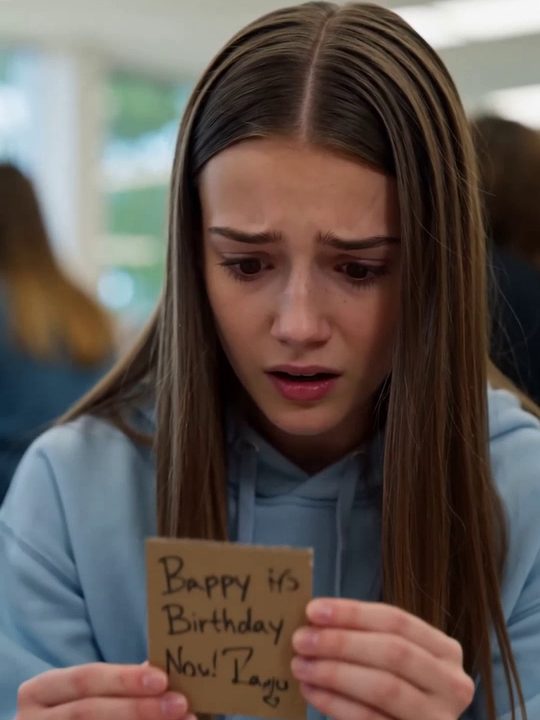
Sophie squeezed her eyes shut. A single tear leaked down the side of her nose, disappearing into the collar of her hoodie. “It doesn’t matter. None of it matters.”
“You said…” Benjamin’s chin hitched. “You said if we brought it to the high school, he’d remember. You said he’d want a piece.”
The words struck Derek with the physical impact of a helmet to the ribs.
He looked at the cake. Really looked at it.
It wasn’t a store-bought sheet cake with uniform borders and machine-extruded sugar flowers. The sponge was uneven, slightly lopsided where it had risen against an old, warped tin. The frosting had been applied with a butter knife, showing the circular, patient strokes of someone who had stood over a kitchen table late at night by the light of a single range bulb. The blueberries were wild—small, dark, and sour—arranged in the shape of a crooked numeral 10.
Sophie hadn’t brought it to start a fight. She hadn’t brought it to make a scene.
She had brought it because a ten-year-old boy, living in a house three miles down the creek road with a family that wasn’t his own, had spent six years believing that the older brother who used to tap on his bedroom wall still loved him enough to eat a piece of cake.
And Derek had kicked it across the floor to make Connor Bell laugh.
“Can we go now?” Benjamin whispered, burying his face into Sophie’s neck. “Please, Soph. My head hurts.”
“Yeah,” Sophie whispered into his hair. “We’re going right now.”
Martha Hart looked over the heads of the children. Her gray eyes, usually so weary and gentle when she handed out tetanus shots at the clinic, were like two cold steel chisels. She didn’t look at Derek with hatred; she looked at him with the profound, pitying disgust that women who work with the dying reserve for those who choose to be small.
“Martha,” Derek pleaded, stepping forward, his hands open, empty, useless. “Wait. Please. What happened to him? Why didn’t you bring him home? My dad… my dad spent two months searching those woods.”
Martha took Benjamin’s hand, turning him firmly toward the corridor.
“Your father,” Martha said, her voice dropping into a register that made the hair on Derek’s arms stand up, “knew exactly which side of the creek Ben was on that night. Now stay away from this child, Derek. You Mercer boys have done enough to him.”
“Wait!”
Derek lunged after them, but Sophie turned in the doorway. She didn’t shout. She didn’t step back.
“I didn’t know,” Derek choked out, the words tasting like ash in his mouth. “Sophie, swear to God, I didn’t know who it was for. I thought it was yours. I thought—”
“You didn’t know whose it was,” she said, her voice dropping like an iron grate between them. “You just knew I was the one holding it.”
She stepped through the double doors, and the heavy oak swung shut, clicking into the brass latch with the finality of a prison door.
The rain started before third period ended, turning the red clay hills outside the high school into the same greasy, treacherous soup Derek remembered from the spring of 2020.
He didn’t go to practice.
Coach Miller had come looking for him in the locker room, find him sitting on the wooden bench in his street clothes, his varsity jacket wadded into a ball beneath the bench like an oily rag. Miller had opened his mouth, seen Derek’s face—the dead, gray hollow behind his cheekbones—and slowly closed the door without saying a word.
Derek drove his father’s old Ford F-150 out of the student lot, its tires spinning in the mud. He didn’t turn toward Sycamore Street. He drove south, toward the low ground where the county road narrowed to a single lane of cracked asphalt and the drainage ditches filled with brown water after an hour of drizzle.
Blackwater Creek wasn’t a river. Most of the year it was an ugly, shallow ditch choked with willow roots, discarded tires, and gray limestone boulders. But it drained five thousand acres of strip-mined timberland in the ridges above the county line, and when the spring storms stalled over the gap, the water came off the hills with the velocity of a burst main.
He stopped the truck near the old railroad trestle.
The pump station still stood seventy yards off the road, half-swallowed by honeysuckle and sumac. It was a cinder-block box built by the Works Progress Administration in the thirties, its green steel door rusted through at the bottom.
Derek got out of the truck, leaving the driver’s door swinging open.
The memory didn’t come in fragments this time. It came whole, cold and suffocating, washing over him as his boots sank into the wet mud along the embankment.
May 24, 2020.
They had been skipping stones. Their father had been on duty—a three-car pileup on the interstate—and Derek was supposed to have Benjamin at the community library until five. But Benjamin had wanted to see the minnows in the pool below the culvert.
The storm hadn’t looked bad until it crossed the ridge. Then the sky had turned the color of a bruised plum, and the hail had started—ice pellets the size of marbles rattling against the culvert pipe.
Derek had shoved Benjamin through the small access hatch of the pump station to get him out of the hail. ‘Stay there,’ he had told him. ‘I’m going to run to the road and flag down the highway truck.’
He hadn’t known the upstream retention dam at the coal wash had failed.





