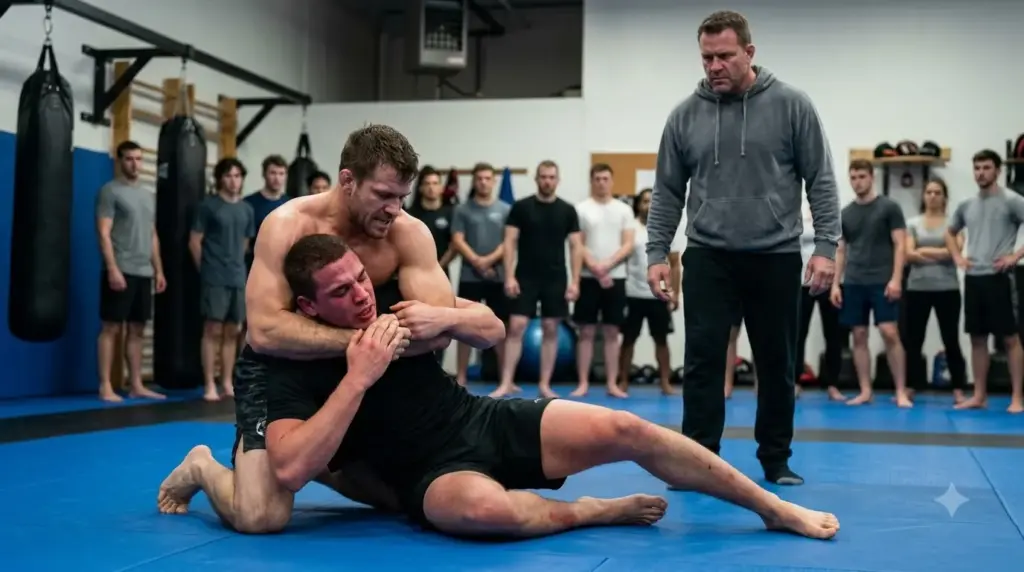
He stared at the screen until it stopped ringing.
A voicemail notification appeared.
Daniel did not play it.
Not yet.
At Harbor Street, Evan spent Sunday afternoon watching the round until he hated every frame.
He watched Daniel redirect the first shot.
He watched the armbar opening appear and disappear.
He watched the back take.
He watched himself struggle under a position that did not even threaten a submission.
The comments were worse.
Champion couldn’t move against a middle-aged hobbyist.
Old school technique > ego.
Immediate release on tap. That’s the lesson.
One comment had twenty thousand likes.
He didn’t beat Evan. He taught him.
Evan threw his phone across the couch.
It struck a cushion and fell to the floor.
His girlfriend, Natalie, looked up from the kitchen table.
“You know throwing it doesn’t delete the internet.”
Evan glared at her.
“Helpful.”
You’ve been watching the same video for four hours.”
“Everyone’s acting like he destroyed me.”
“Did he?”
“No.”
“Then why do you care?”
Evan looked at her as if the question were absurd.
“Because they think he did.”
Natalie closed her laptop.
“That sounds like a you problem.”
He stood.
“You don’t get it.”
“Then explain it.”
“My invitational is in thirteen days. Sponsors watch this stuff. Opponents watch it. Promoters watch it. People decide who you are from clips.”
“And what did that clip show?”
“That I got controlled.”
“Before that.”
Evan’s mouth tightened.
“That Malik tapped.”
“And?”
“I released.”
“After Raymond told you.”
Evan walked to the window.
“You weren’t there.”
“I saw the video.”
“Video doesn’t show context.”
“What’s the context for keeping a choke after somebody taps?”
He turned sharply.
“He wasn’t in danger.”
Natalie held his gaze.
“That’s not your decision once he taps.”
Evan looked away.
The silence stretched.
Natalie had been with him six years, long enough to remember when he trained in a public recreation center because he could not afford Harbor Street. Long enough to remember him taking two buses to morning practice. Long enough to remember when he was the smallest wrestler on his high school team and older boys locked him in equipment cages because they thought it was funny.
She knew where his aggression came from.
That did not make it harmless.
“You keep saying people don’t understand you,” she said. “Maybe. But do you understand Malik?”
Evan’s shoulders stiffened.
“He signed up to train.”
“That wasn’t my question.”
He said nothing.
Natalie reopened her laptop.
“I’m not asking you to hate yourself. I’m asking you to stop treating every uncomfortable thing like an attack you have to win.”
Evan stared out at the rain.
For once, he had no comeback.
Monday morning, Daniel arrived at Harbor Street at six twenty-five.
Raymond had already unlocked the door.
The academy was dark except for the office and one strip of overhead lights above the mat.
Daniel removed his shoes at the edge and walked across in socks.
Raymond handed him coffee.
“Black?”
“Thanks.”
They sat on the mat with their backs against the wall.
For a while, neither spoke.
Then Raymond said, “When did you stop competing?”
“Twenty-six.”
“Why?”
Daniel looked into the coffee.
“A training partner got hurt.”
“You hurt him?”
“No.”
Raymond waited.
Daniel told him about Aaron.
Not dramatically.
No speeches.
Just facts.
Nineteen years old. Heel hook. Tap. Two-second delay. Torn knee. Two surgeries. Scholarship gone.
Then Daniel said the part he had almost never said out loud.
“I heard him tap.”
Raymond looked over.
“You weren’t in the round.”
“No.”
“You weren’t coaching.”
“No.”
“Then what were you supposed to do?”
Daniel’s eyes stayed on the far wall.
“Step forward.”
The words landed softly.
“I thought Brent would let go. He was experienced. I thought the coach would see it. I thought I didn’t want to look dramatic in front of everyone. I thought a lot of things in about one second.”
“And you blame yourself.”
“Not for the injury.”
For what?”
“For valuing the room’s comfort over one person’s safety.”
Raymond leaned his head back against the padding.
The academy’s three rules were visible across from them.
Protect your partner.
Leave your ego outside.
Everybody goes home healthy.
“I’ve been doing that,” Raymond said.
Daniel looked at him.
“For months.”
Raymond rubbed his palms together.
“Evan started winning. People came because of him. Then he started teaching without me asking. Then he decided beginners were too soft. Then he got rough with people and I told myself they needed to speak up if it bothered them.”
“Some did?”
“Two quit. One transferred gyms. A woman named Claire told me he wouldn’t release a wrist lock until she yelled. I said I’d talk to him. I did. He apologized. Then I moved on.”
Daniel said nothing.
“I built this place because my first gym was toxic,” Raymond continued. “I swore mine would be different.”
“Most places don’t become bad in one day.”
“That’s supposed to make me feel better?”
“No. It means you can change it before it gets worse.”
Raymond looked at him.
“Will you help?”
Daniel’s first instinct was no.
He felt it before Raymond finished the sentence.
No leadership.
No attention.
No being responsible for other people’s choices.
He had built a life around those refusals.
But then he remembered Malik coughing on the mat.
He remembered Aaron on the couch with ice around his knee.
He remembered the voicemail he still had not played.
“With what?” Daniel asked.
“Safety protocols. Training culture. Whatever you see that I’ve stopped seeing.”
“I’m not a consultant.”
“I’m not asking for a consultant.”
“What are you asking for?”
“Someone who notices taps.”
Daniel looked down.
The phrase was unfairly effective.
Raymond knew it.
“One month,” Daniel said. “Then you own it.”
Raymond nodded.
“One month.”
At seven fifteen, the first morning students arrived.
Daniel left before anyone could ask questions.
He drove directly to work.
At lunch, he finally listened to the voicemail.





