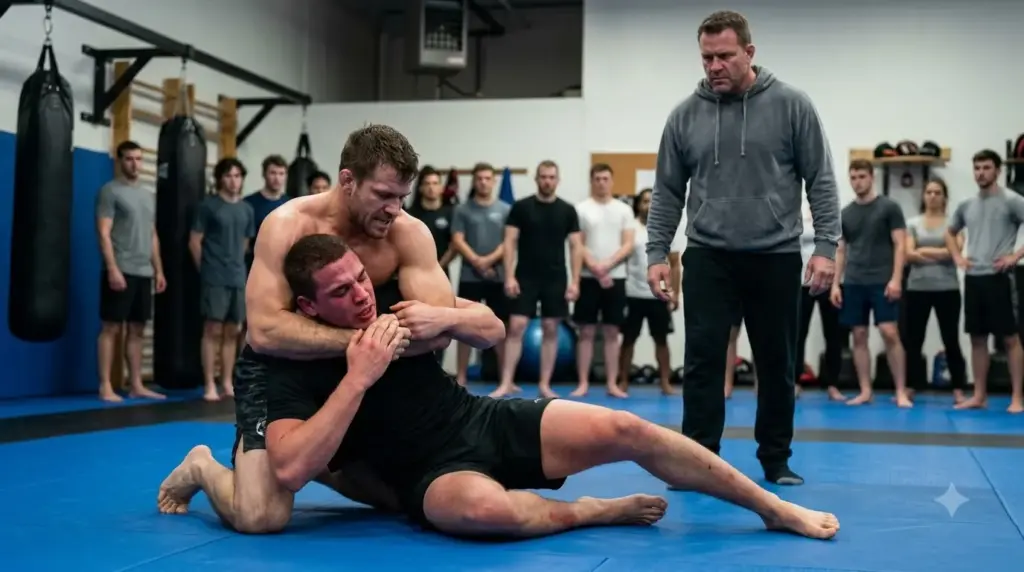
Evan Coleman was present. He wore a new training gear set, walking into the gym with a much more thoughtful expression than usual. Seeing Daniel adjusting Malik’s belt near the corner, Evan paused for a few seconds before walking over.
“Hey,” Evan spoke up, his voice devoid of its usual arrogance.
Daniel raised his head. Malik stepped back slightly with a wary look.
“What do you want, Evan?” Daniel asked calmly.
Evan looked down at the mat for a moment, then met Daniel’s eyes directly. “I rewatched the video of our round. Dozens of times.”
“And?”
“And… I realized where I was wrong,” Evan admitted—a difficult admission for a fighter preparing for a major tournament. “I thought I was tougher than everyone else because I never stopped. But it turns out knowing when to stop is the hardest part.”
Daniel nodded lightly, respect flashing in his eyes for the first time since they met. “True strength in martial arts doesn’t lie in how many people you can take down, but in how many people you keep safe around you.”
Evan remained silent for a long time, then reached his hand forward. “This morning… a technical round to kick things off? No bets, no audience.”
Daniel looked at Evan’s waiting hand, smiled slightly, and shook it firmly.
“Alright. But this time, don’t make me remind you about your breathing.”
The room chuckled softly. Malik, standing nearby, smiled along. On the wall near the exit, the three classic rules of Harbor Street echoed in everyone’s minds clearer than ever: Protect your partner. Leave your ego outside. Everybody goes home healthy.
Maya said, “Reject.”
Raymond said, “Conditional month.”
Evan sat back.
Five years earlier, the decision would have been easy for him.
Keep the champion.
Manage the damage.
Use the talent.
He knew that logic intimately.
“Reject,” he said.
Raymond looked at him.
Evan continued.
“Not forever. Tell him exactly why. He can reapply in six months if he trains somewhere else without incidents and comes back willing to follow the culture. But we don’t make the room absorb his learning curve because he’s good.”
Malik nodded.
Maya nodded.
Raymond looked at Daniel.
Daniel shrugged.
“Sounds like you built a system.”
They rejected Tyler.
He reacted badly.
He posted online that Harbor Street was afraid of real competitors.
A few people agreed.
His college coach called Raymond and accused the academy of wasting talent.
A sponsor representative hinted they might have supported the gym if Tyler had joined.
For three uncomfortable weeks, the decision looked expensive.
Then the noise faded.
Six months later, Tyler emailed Evan.
No apology at first.
Just one sentence.
Can I try again?
Evan replied with the conditions they had already documented.
Tyler accepted.
He returned quieter.
Not transformed.
Not humbled into sainthood.
Just more aware.
During his second trial, a beginner tapped early to a shoulder lock.
Tyler released instantly.
The beginner apologized.
Tyler shook his head.
“Don’t apologize. Reset.”
Evan heard it from across the room.
He did not smile.
He did not praise him.
He simply made a small check mark on the evaluation form.
At the end of the month, Tyler was accepted.
Years later, he would become one of Harbor Street’s strongest competitors.
People sometimes told the story as evidence that the academy had “saved” him.
Tyler hated that version.
“They didn’t save me,” he would say. “They told me no before my talent could buy an exception. That was better.”
Daniel liked that version too.
Because a healthy room was not one where everyone arrived good.
It was one where being gifted did not excuse being unsafe, where change remained possible, and where no person’s importance grew larger than the rules protecting everyone else.
That was the opposite of the room Daniel had left at twenty-six.
It was also the opposite of the room Harbor Street had almost become.
By then, nobody at Harbor Street used the phrase “tough room” the way they once had. Toughness was no longer measured by who stayed silent longest under pain or who could embarrass the newest person without consequence. It showed up in smaller choices: a competitor admitting an injury before a tournament, a teenager telling a heavier partner to slow down, a coach changing a drill because one student’s body required a different angle, an experienced athlete accepting “no” without demanding an explanation.
Those choices were not dramatic enough for highlight reels. They rarely produced stories anyone outside the academy would care about. That was exactly why Daniel trusted them. Culture lived in repeated decisions that felt too ordinary to film.
Sometimes visitors still misunderstood the place. They saw the rules and assumed Harbor Street had become soft. Then they stayed for competition class and discovered how hard people trained. They watched Evan push advanced athletes through exhausting rounds, Maya demand perfect breakfalls from teenagers, Malik make beginners repeat escapes until the movement was clean, and Daniel stop a round the instant safety disappeared. The intensity had not gone anywhere. It simply had boundaries.
Daniel came to believe boundaries were not the opposite of seriousness. They were what made seriousness sustainable.
He thought about that whenever he saw the old sign above the mat. Six years earlier, the words had been decoration. Now they were habits. Not perfect habits. People still made mistakes. Tempers still flared. Coaches still missed things. But the room had learned how to correct itself before one person’s status could become more important than another person’s safety.
That, more than medals or ownership shares or viral redemption stories, was what Daniel considered the real victory.
One winter evening, long after the old video had disappeared beneath years of newer internet noise, Daniel finished teaching class and walked toward the lobby.
A group of beginners stayed behind drilling escapes.
Evan, now part owner of Harbor Street, watched from the wall with Sophie sitting on his shoulders.
She was eight and already corrected adults when they forgot to bow off the mat.





