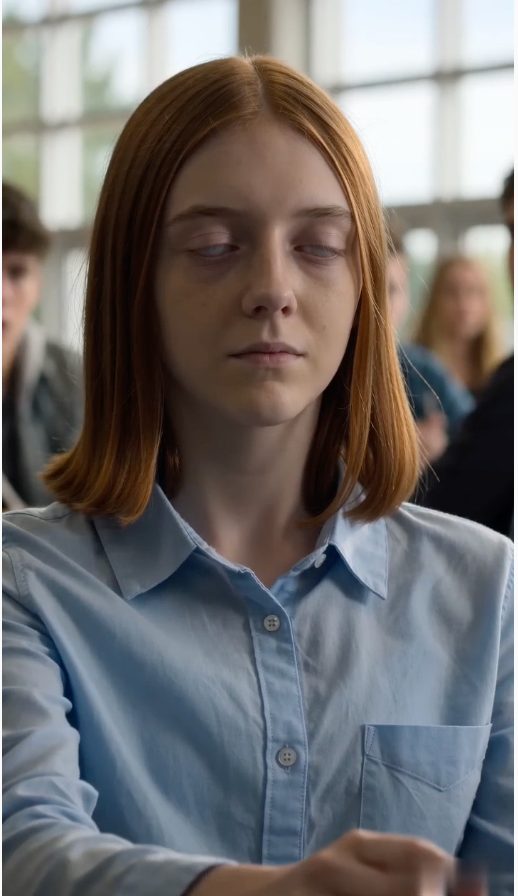
I allowed my free hand to drift toward the space beside me, as though searching for orientation.
The movement had the effect I expected.
He became even more confident.
“Look at you,” he said, chuckling.
His friends laughed again.
I said nothing.
I could tell from his breathing that he was enjoying himself.
His chest rose in shallow, quick movements between remarks, and his voice carried the energized excitement of someone who believed a crowd was on his side.
He wanted a stronger reaction.
My silence frustrated him.
That was when he decided to make the confrontation physical.
His right hand moved suddenly.
I detected the change before his fingers reached me.
A subtle shift in his stance.
The movement of his jacket.
The air disturbed near my arm.
I knew his hand was approaching the cane.
I could have moved it.
I could have stepped backward.
I could have turned my wrist and kept the handle beyond his reach.
But doing so would have revealed more control than I wanted him to see.
And I still believed the situation might end without becoming worse.
So I let his fingers close around the aluminum shaft.
He pulled sharply.
The cane slid free of my grasp.
I allowed it to go.
“Got it,” he announced.
The boys behind him burst into laughter.
My hand remained suspended in the air for a fraction of a second.
It was an odd sensation.
The cane had become such a familiar part of my public movements that its absence felt immediately noticeable, even though I knew exactly where I stood.
I listened to him adjust his grip.
The lightweight tube shifted against his fingers.
He was holding it horizontally.
“Hey,” I said, allowing uncertainty into my voice.
“Please give that back.”
He laughed.
“Why?”
“Because it belongs to me.”
“So?”
“I need it.”
I made the last sentence sound smaller than the others.
A little frightened.
A little embarrassed.
Exactly what he wanted.
I heard him raise the cane.
The shaft moved through the air with a faint whistle.
“Aw, come on,” he said.
“I’m just looking at it.”
“Please.”
“Relax.”
He moved it again.
The quick sweep of aluminum told me he was holding it above shoulder height.
I could have reached up and taken it from him if he brought it close enough.
But doing that would mean moving with a certainty that directly contradicted everything I had allowed him to believe.
Instead, I extended my hand.
My fingers moved through the empty air.
“Can I have it back now?”
Trent laughed again.
“Seriously?
You need this thing that much?”
I hesitated.
The pause was intentional.
“Yes.”
He seemed delighted.
“That’s crazy.”
I heard one of his friends mutter something I couldn’t distinguish, followed by another burst of laughter.
Then Trent swung the cane through the air.
He wasn’t trying to hit me.
He was playing with it, testing its weight, showing the watching students that he could do whatever he liked with something I had asked him to return.
The sound made several people shift uneasily.
Someone nearby whispered, “Dude, give it back.”
Trent ignored that too.
I stood with my hand extended.
The gesture felt humiliating, even though I had chosen it.
That was something I hadn’t fully anticipated.
I knew I was acting.
I knew the frightened girl standing in front of him was not an accurate reflection of what I could do.
But pretending to be helpless didn’t make the experience painless.
Every laugh landed somewhere inside me.
Every second he kept the cane reminded me that the audience was watching a person being treated badly and finding reasons not to interfere.
I wondered whether I had made a mistake.
Perhaps I should have spoken more firmly earlier.
Perhaps I should have walked away before he reached for the cane.
Perhaps I should stop pretending now.
But I could still hear my father’s voice in the back of my mind.
You always have more than one choice.
Don’t forget that just because someone wants you to panic.
I lowered my hand.
“Please don’t damage it,” I said.
The words were sincere.
Whatever additional purpose the cane served, it was still mine.
It had accompanied me through crowded streets, unfamiliar buildings, and countless ordinary days.
It was a practical tool, but it also represented years of learning how to live independently.
I didn’t want to see it damaged.
Trent, however, heard something else in my voice.
He heard fear.
And that made him smile.
The cafeteria began changing around us.
Conversations stopped in an expanding circle.
The students nearest the confrontation were no longer laughing as freely as before.
I heard a girl draw in a sharp breath.
A chair moved backward.
Someone’s fork struck a tray with a small metallic click.
Trent still held my cane.
He moved it between his hands, apparently examining the joints.
“What is this made of?” he asked.
“Aluminum.”
“Aluminum?”
“Yes.”
He gave a theatrical scoff.
“Feels pretty cheap.”
I kept my expression composed.
“It’s not a toy.”
He laughed.
“Did you hear that?”
One of his friends answered.
“Yeah, man.”
“She says it’s not a toy.”
The other boy chuckled, but the sound was weaker than before.
Something had shifted.
I could sense it in the room.
The confrontation had been amusing to some students when Trent was only blocking my path.
Taking my cane had changed its meaning.
A few people were beginning to realize how cruel the situation was.
Unfortunately, realization hadn’t yet become action.
No one stepped forward.
No one ordered him to stop.
I stood alone in the opening he had created.
The distance between us was less than two feet.
His cologne was overpowering.
I could hear the faint friction of his fingers against the aluminum.
He held the cane by both ends now.
I recognized the change in grip.
My stomach tightened.
“Trent,” I said.
It was the first time I had used his name.





