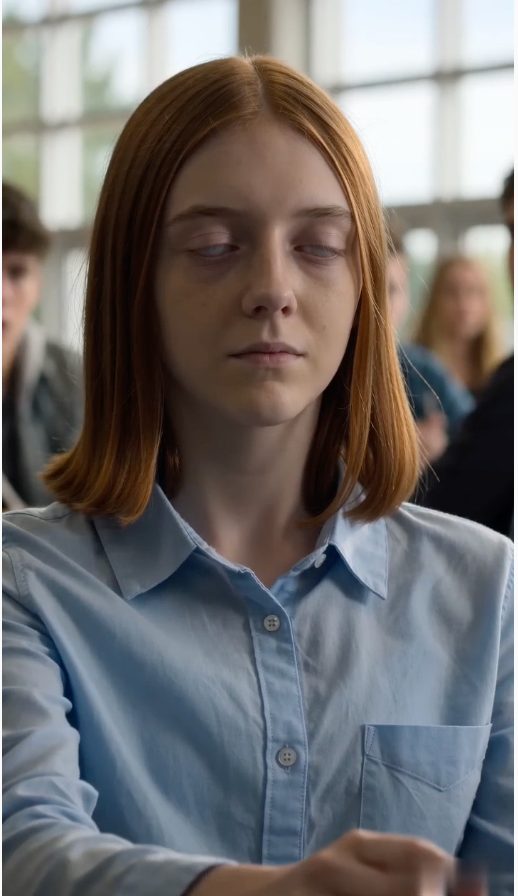
But I understood its usefulness.
People who thought they already knew me rarely bothered to look any closer.
And on the morning I started at Ridgewood High, I decided that being underestimated might make my first day easier.
I had no idea how wrong that assumption would become.

Ridgewood High stood in a quiet suburban neighborhood in Ohio.
It was a large brick school, the kind with long hallways, polished floors, bright classroom lights, and a cafeteria designed to accommodate hundreds of students at once.
Before my first day, I had been given information about the building’s layout.
I had practiced the main routes I expected to use, paying attention to doorways, intersections, stairwells, and the distance between important locations.
But a school building changes when it fills with teenagers.
An empty corridor is one environment.
A hallway crowded with students rushing between classes is something else entirely.
On my first morning, I stood just inside the entrance and listened.
Lockers slammed on both sides of the hall.
Sneakers squeaked over polished linoleum.
Dozens of voices overlapped, rising and falling as students greeted friends, argued about homework, and complained about the beginning of another school day.
Someone nearby sprayed far too much perfume.
Another student rushed past carrying what smelled like a warm breakfast sandwich.
A loudspeaker crackled overhead, producing a brief burst of feedback before an announcement began.
For anyone else, it might have been ordinary Monday morning chaos.
For me, it was a complicated landscape of moving bodies, shifting echoes, and unpredictable interruptions.
I tightened my fingers around the handle of my cane.
Tap.
Sweep.
Tap.
Sweep.
The tip moved steadily across the floor.
I kept my shoulders slightly rounded and my chin lowered, allowing my expression to suggest more uncertainty than I actually felt.
It worked immediately.
Students moved aside.
Some stepped backward with surprising urgency, their shoes scraping across the floor when they noticed my cane approaching.
Others stopped talking until I passed.
A few whispered.
“Is she new?”
“I think she’s blind.”
“Watch out.”
I heard the embarrassment in their voices.
Nobody wanted to be the person who accidentally bumped into the blind girl.
Most seemed determined to give me so much space that I could have walked between them carrying furniture.
I couldn’t decide whether to be amused or annoyed.
It was useful, certainly.
The crowd opened around me, creating a relatively clear path.
But there was something lonely about the way everyone moved away.
I hadn’t asked them to disappear.
I simply wanted enough room to walk.
I reached my first classroom without difficulty.
The teacher greeted me politely and explained where the available seats were located.
I chose one near the side of the room, where the acoustics were easier to interpret and I could keep track of movement without being surrounded on every side.
When the other students arrived, I heard the same pattern repeat.
A moment of curiosity.
An uncomfortable pause.
Then the careful adjustment of voices as people tried not to say anything inappropriate.
I took out my school materials and waited for the lesson to begin.
No one asked me what music I liked.
No one complained to me about the homework.
No one made the casual, meaningless conversation that usually marks the beginning of a friendship between classmates.

They were too worried about saying the wrong thing.
By the end of the period, I was beginning to understand that my greatest problem at Ridgewood might not be moving through the building.
It might be convincing people that I was someone they could speak to normally.
I became aware of the football captain before anyone introduced us.
His footsteps were distinctive.
He walked heavily, with the kind of deliberate rhythm that suggested he expected other people to clear his path.
Some students hurried through the halls because they were late.
Others moved casually because they had nowhere urgent to be.
This boy walked as though every corridor belonged to him.
His heels struck the floor with a firm, confident thud.
A powerful, expensive cologne arrived several seconds before his voice.
There was also a faint leather smell beneath it, the familiar scent of a varsity jacket.
He was surrounded by other boys.
I could hear them laughing before I could distinguish what they were saying.
“Man, you should’ve seen his face.”
“Coach would’ve lost it.”
“Whatever.
I still made the play.”
Their laughter rolled down the hallway.
Students moved aside as they approached.
Unlike the space people gave me, this movement seemed automatic and familiar.
Nobody hesitated.
Nobody appeared surprised.
The group simply advanced, and the crowd opened.
I paused near a row of lockers, waiting for them to pass.
One of the boys noticed me.
“Hey, who’s that?”
Another answered.
“New girl, I think.”
A third voice, lower and more confident than the others, joined in.
“Seriously?”
I heard the speaker slow his steps.
For an instant, I felt his attention settle on me.
I continued sweeping my cane across the floor.
The boys moved on.
Their laughter resumed a few seconds later.
At the time, I didn’t know the voice belonged to the most popular athlete in the school.
I learned that during the next class.
The boy was named Trent.
He was the football captain, a junior with a reputation that seemed larger than his actual achievements.
Teachers knew him, students admired him, and his friends treated almost everything he said as an invitation to laugh.
He was tall, broad-shouldered, and accustomed to being noticed.
I learned the details of his appearance through overheard conversations and the casual descriptions people gave when they spoke about him.
But I didn’t need to see his face to recognize his personality.
His voice did most of the work.
He liked being heard.
He liked being answered.
And he enjoyed the little silence that appeared when someone realized he had become the center of Trent’s attention.
By the end of the morning, I understood one thing clearly.





