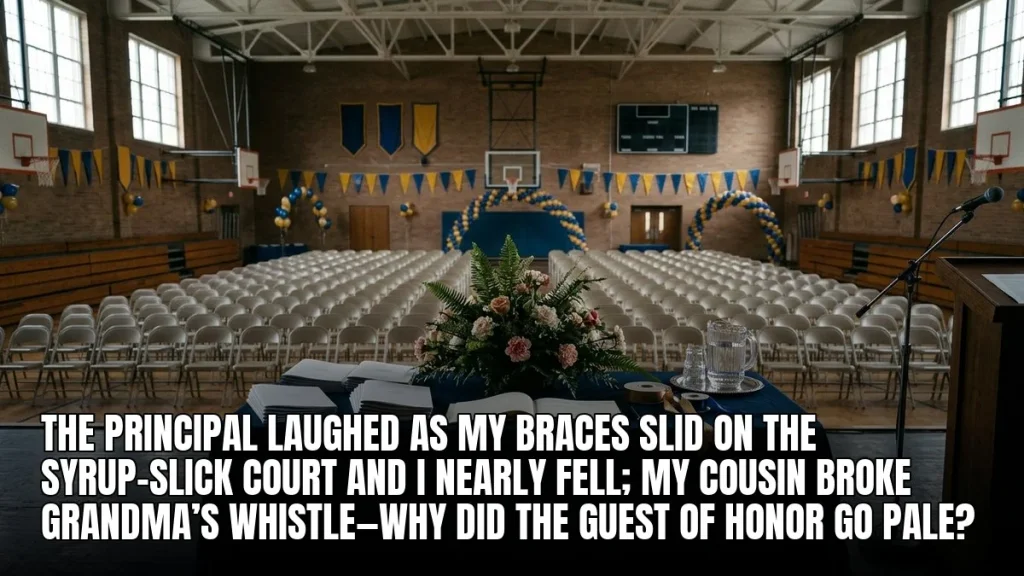
Beneath the blinding gloss of the newly refinished maple floor, forty years of scuff marks, sweat, and history had been sanded into dust and vacuumed away. High above the bleachers, where the bronze block letters reading COACH ELAINE BELLAMY GYMNASIUM had anchored the brickwork since the year my mother was born, a massive vinyl banner now stretched taut between steel grommets. WELCOME TO FALCON ARENA, it proclaimed in sharp crimson and silver. Only the very bottom serifs of my grandmother’s name poked out from beneath the vinyl hem, like fingers clinging to the edge of a cliff.
I adjusted my weight, and the left hinge of my ankle-foot orthosis gave a tiny, traitors’ click.
In the noisy chatter of three hundred parents, school board members, and local press, nobody heard it except my cousin Audrey. She stood three feet away in her pristine varsity cheer uniform, the giant crimson bow in her hair stiffened with enough spray to survive a hurricane. In her right hand, she held a thirty-two-ounce cherry slushie from the booster club concession stand—strictly forbidden on the new court for anyone whose mother didn’t run the building.
“You’re migrating, Tessa,” Audrey murmured without looking at me, keeping her bright, camera-ready smile aimed toward the photographer from the Oakridge Herald. “Mom put your folding chair behind the potted ficus by the fire exit for a reason. The front row is for the ribbon-cutting committee and the spirit squad.”
“I’m family,” I said quietly, my fingers closing over the heavy brass Fox 40 whistle hanging from a faded braided lanyard around my neck. The metal was warm against my palm, worn smooth in the exact crescent where Grandma’s thumb had rested for four decades. There was a dark silver seam of old solder along the bail where the loop had snapped during the ’98 regional semifinals, and a shallow dent near the mouthpiece from the day she dropped it pulling a seventh-grader out of a pileup. “The program said the Bellamy family was invited to sit by the podium.”
Audrey finally turned her head, her eyes sweeping down my navy-blue dress to the molded plastic and carbon-fiber supports strapped around my calves. Grandma and I had spent three hours last summer sticking tiny holographic blue stars along the lateral struts so I wouldn’t hate wearing them to seventh grade. Now that Grandma was gone—three months in the ground at St. Jude’s Cemetery, and two months since my parents’ sedan hit a patch of black ice coming back from clearing out her probate files—those peeling little stars felt like the only armor I had left in my aunt’s house.
“My mother is the family now, Tessa,” Audrey said, her voice dropping into that sweet, syrupy register she used when teachers were within earshot. “And let’s be honest, nobody from the Waverly Foundation wants their big philanthropic check photographed next to a charity case in clunky plastic boots. Go sit by the ficus before you trip and sue the district.”
“I’m not moving, Audrey. Grandma built this program.”
“Grandma was a gym teacher who hoarded smelly sneakers in her office and refused to retire,” Audrey snapped, the pleasant mask slipping for a fraction of a second. Her gaze dropped to my chest. “And take that disgusting thing off. It looks like you fished it out of a storm drain.”
Before I could step back, Audrey’s manicured hand shot out and snagged the lanyard.
“Don’t!” I gasped, pulling backward.
My left brace caught the edge of the ceremonial runner carpet. To steady myself, I planted my right foot on the bare hardwood—the exact spot where Audrey, with a practiced flick of her wrist, tipped her plastic cup.
Half a quart of melting, neon-red cherry slushie hit the fresh polyurethane right beneath my heel.
It was like stepping onto wet glass. My right leg shot out from under me with terrifying speed. The carbon-fiber strut of my brace skidded across the crimson puddle with a loud, screeching scrape, my knee twisting awkwardly as Iwindmilled my arms to keep from cracking my skull against the edge of the stage. I went down hard on one hip, the cold, sticky syrup soaking instantly through the hem of my dress and coating the white Velcro straps and blue stars of my braces in thick, scarlet slime.
Because my neck jerked back as I fell, the lanyard pulled taut in Audrey’s fist. Instead of letting go, she gave the brass whistle a sharp, vicious twist.
Snap.
It wasn’t a loud sound, not compared to the collective gasp of the front two rows, or the clatter of my brace hitting the floorboards. It was a dull, brittle pop as the forty-year-old solder seam finally gave way, tearing the brass chamber cleanly from the mouthpiece and ring.
Ten feet away, standing beside Superintendent Albert Gentry and the velvet-draped table holding the giant ceremonial scissors, my aunt Valerie didn’t rush over. She didn’t ask if I’d wrenched my bad hip. Instead, she pressed two manicured fingers to her lips and let out a light, airy laugh—the kind of indulgent chuckle an adult gives when a clumsy toddler walks into a screen door.
“Honestly, Tessa,” Valerie projected effortlessly to the immediate cluster of donors, her pearl brooch catching the television lights. “Fourteen hundred square feet of dry floor, and you manage to find the one spot where Audrey spilled her drink. Up we get, dear, before you ruin the finish.”
A scattering of polite, uncomfortable chuckles rippled through the booster club parents who wanted to stay on the principal’s good side. Audrey stood over me, dangling the torn lanyard and the tiny broken top loop from her fingertips before dropping it into my lap, right alongside the severed brass body of the whistle.
“Oops,” Audrey whispered, her eyes glittering with triumph. “Guess the antique couldn’t take the pressure.”





