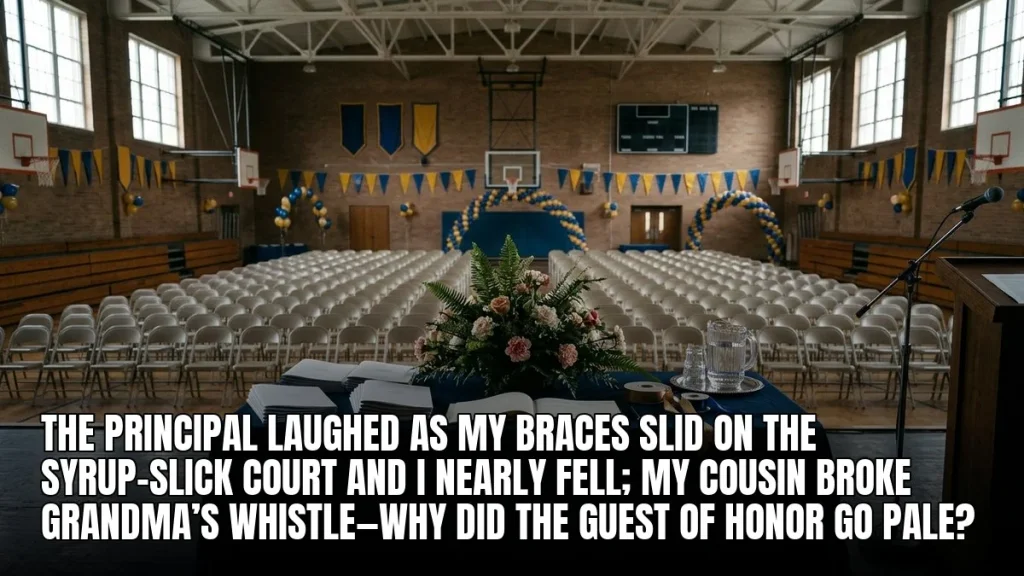
Jackie looked down at the broken brass in her hand, then gave me a small, heart-wrenchingly sad smile. “Michael was nine years old when I was here. He used to sit on the bottom bleacher doing his math homework while your grandmother ran us through suicide drills. He had your exact eyes.”
She carefully aligned the jagged edge of the broken bail with the top of the whistle chamber, holding the two pieces together in her palm so they looked whole again.
“I am so sorry this happened to you today, Tessa,” she said.
Those eight words nearly undid me. Not because they fixed the whistle, or took the sticky red syrup off my braces, or brought my dad and Grandma back. Because for the past sixty days, under my aunt’s roof, I had been treated like a piece of damaged luggage left behind at an airport—an awkward, expensive obligation to be tucked behind a potted plant. For the first time in two months, an adult was looking at me like I was a human being who mattered.
Valerie’s heels clicked sharply right behind Jackie’s shoulder. “Jackie, really, perhaps we should allow Tessa a few moments in the nurse’s office to compose herself. She is clearly overwhelmed by the crowd.”
Jackie slowly rose to her full six-foot height, turning to look down four inches at my aunt.
“I’m not entirely sure Tessa is the one who needs to compose herself, Principal Crawford,” Jackie said, removing her hand from the microphone so her voice rang out clearly across the packed bleachers.
A sharp, electric murmur rippled through the audience. On the stage platform, Superintendent Albert Gentry—a florid, silver-haired man who hated bad publicity more than budget cuts—shifted uncomfortably next to the ceremonial table. He looked from Jackie’s rigid spine to Valerie’s tight smile, and then, finally, his gaze dropped to me.
For the first time since the ceremony began, the superintendent seemed to actually register the bright crimson syrup congealing along the metal uprights of my braces and soaking the front of my dress. His eyebrows shot up.
Valerie saw him looking, and a flush crept up her neck beneath her pearls. Her smile stretched until it looked painful.
“Albert, everyone, I assure you this is being handled with the utmost care,” Valerie announced, gesturing grandly with both arms toward the newly painted walls and the glittering digital scoreboard hanging from the center rafters. “We have a historic dedication ceremony to complete this morning, and I know Coach Bellamy herself would be the last person to want a minor family mishap to distract from the district’s incredible investment in our students’ future!“
She swept her arm upward toward the massive crimson-and-silver vinyl banner dominating the north wall. “Look at what we have accomplished here together—the birth of Falcon Arena!“
Jackie slowly followed the line of Valerie’s manicured finger up to the vinyl banner. Her eyes narrowed as she studied the bottom edge, where the bronze serifs of C-O-A-C-H E-L-A-I-N-E B-E-L-L-A-M-Y peeked out like a secret someone had failed to bury deep enough.
“Is that where her name used to be?” Jackie asked into the microphone.
Valerie’s chin lifted slightly. “Yes. The legacy masonry lettering is being retired as part of the Phase Two modernization.”
Jackie turned her head back toward my aunt. “Retired.”
“Of course,” Valerie said smoothly. “Buildings evolve, Jackie. We’re moving forward.”
“And what, precisely, does ‘moving forward’ mean for the name on that wall?”
Valerie’s smile tightened around the edges. “It means the school is adopting a unified, contemporary brand identity. ‘Falcon Arena’ represents our commitment to competitive excellence, corporate partnership, and the future of Oakridge athletics.”
“And Elaine Bellamy?” Jackie pressed, her voice dangerously quiet.
Valerie gave a tiny, dismissive wave of her wrist, as though brushing a crumb off a tablecloth. “Elaine was a beloved longtime volunteer and physical education instructor in the old building. Her contributions in prior decades were certainly appreciated, naturally, but the steering committee decided that a modern facility required a less… parochial identity.”
A longtime volunteer.
Something hot and jagged twisted inside my chest, burning away the lingering shock of my fall.
My grandmother hadn’t been a “volunteer.” She had been the spine of this entire town for forty-one years. When the textile mill closed in the nineties and half the kids on the girls’ varsity roster couldn’t afford lunch, let alone eighty-dollar basketball shoes, Grandma took a second job supervising the county rec center at night so she could keep thirty pairs of brand-new high-tops in sizes six through eleven stacked in her back office. When parents worked double shifts at the hospital, Grandma kept the gym lights on until nine o’clock, sitting at her scarred wooden desk grading health tests while kids did homework on the mats and ate peanut butter sandwiches out of her mini-fridge. She had worn out two hips and a knee on this floor, and she had died with the calluses of a basketball net still grooved into her fingers.





