No dramatic convoy.
Just movement.
Controlled.
Deliberate.
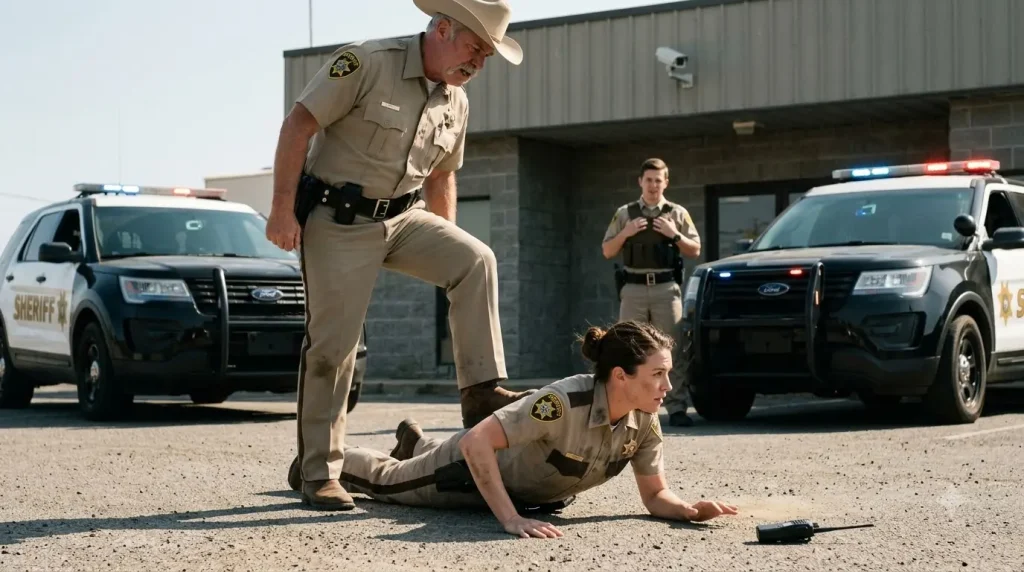
Sheriff Hollis looked down at Elena.
“Who are you?”
She slowly pushed herself onto one knee.
Dust streaked the front of her tan uniform.
One elbow had torn.
Her cheek carried a thin scrape.
She reached for neither the sheriff nor her weapon.
She looked toward Mason.
“Deputy Cole.”
He seemed startled that she addressed him.
“Yes?”
“Pick up my radio.”
He looked toward Hollis.
The sheriff glared.
Mason hesitated.
Elena said:
“That is not his radio.”
Mason swallowed.
Then walked over and picked it up.
Sheriff Hollis watched him.
Something subtle changed in the parking lot.
The first order he had ever given without speaking had just been disobeyed.
Elena took the radio from Mason.
Checked it.
Still functioning.
She keyed the microphone.
“Integrity One to command.”
The sheriff stared.
A voice answered immediately.
“Go ahead, Integrity One.”
Elena looked straight at Hollis.
“Primary subject made physical contact.”
Pause.
“Multiple cameras active.”
Another pause.
“Probable evidence interference witnessed.”
The voice on the radio answered:
“Copy. Hold position. Team approaching.”
Sheriff Hollis’s face became almost gray.
Mason whispered:
“Integrity One?”
Elena stood fully.
She rolled one shoulder.
Wincing slightly.
Then she removed the small gold sheriff’s badge from her tan shirt.
Mason stared.
She turned it over.
A second identification plate, concealed behind the county shield, slid free.
STATE BUREAU OF LAW ENFORCEMENT STANDARDS
SPECIAL INVESTIGATOR
ELENA TORRES
Mason took one involuntary step backward.
Hollis stared at the credentials.
“No.”
Elena looked at him.
“My name really is Elena Torres.”
The sheriff’s mouth opened.
She continued.
“And I really am a sworn peace officer.”
Behind them, the state SUVs stopped.
Doors opened.
Men and women wearing plain clothes and tactical identification vests stepped out.
One carried a sealed evidence case.
Another began photographing the parking lot before anyone moved anything.
Elena looked back at Hollis.
“The part you got wrong…”
She brushed dust from her sleeve.
“…is who I work for.”
Eleven weeks earlier, Elena had driven into Red Mesa County in a white state sedan with government plates removed two counties away.
By the time she reached the sheriff’s office, she drove a twelve-year-old pickup registered under her own name.
Nothing about her arrival appeared unusual.
That was intentional.
Red Mesa County covered nearly eleven hundred square miles of ranchland, oil roads, dry creek beds, cattle fences, and small towns built far enough apart that local law enforcement often operated without immediate outside oversight.
The county seat had fewer than fourteen thousand residents.
The sheriff’s department had forty-three sworn deputies.
One jail.
One courthouse.
One evidence warehouse.
And seventeen years of complaints that seemed to vanish whenever they reached the same office.
The State Bureau of Law Enforcement Standards first noticed the pattern after a lawsuit involving a former deputy named Sarah Donnelly.
Donnelly alleged Sheriff Dean Hollis had ordered her to rewrite a domestic violence report involving the son of a county commissioner.
She refused.
Two weeks later, she was accused of mishandling evidence.
Her termination paperwork described “integrity concerns.”
Donnelly sued.
During discovery, her attorney requested body-camera footage from the night of the domestic call.
The sheriff’s office responded that the file had been corrupted.
They requested server logs.
Those were missing.
They requested dispatch audio.
The retention period had supposedly expired.
The case settled quietly.
Donnelly received money.
No admission.
No investigation.
Normally, the story might have ended there.
Then another deputy contacted the state.
He claimed Sheriff Hollis had struck him during a closed-door meeting after he refused to arrest a ranch worker without probable cause.
The deputy withdrew the complaint forty-eight hours later.
A month afterward, he resigned and moved to Arkansas.
Then a jail nurse reported bruising on detainees who had no corresponding use-of-force paperwork.
Then a clerk found two evidence envelopes unsealed after the sheriff entered the property room alone.
Then an assistant district attorney complained that reports from Red Mesa appeared to change after prosecutors raised legal concerns.
Individually, every allegation had an explanation.
Together, they formed a shape.
The Bureau opened a preliminary review.
Sheriff Hollis cooperated beautifully.
That was the problem.
He sent policies.
Training logs.
Disciplinary records.
Body-camera reports.
Everything looked clean.
Too clean.
Forty-three deputies.
Almost no sustained complaints.
No significant use-of-force discipline in six years.
No evidence discrepancies.
No retaliation cases.
No supervisor misconduct.
Elena had spent eighteen years investigating law enforcement agencies.
Perfect paperwork made her more suspicious than ugly paperwork.
Real institutions were messy.
Perfect institutions usually meant someone controlled what survived.
Her director, Marcus Bell, had placed the Red Mesa file on her desk.
“No undercover work unless legal signs off.”
Elena opened it.
“They already did.”
Bell looked annoyed.
“You read the attachment?”
“I read everything.”
“You’re impossible.”
“Frequently.”
Bell sat across from her.
He was fifty-nine, bald, heavyset, with the exhausted patience of a man who had supervised Elena for twelve years and regretted approximately nine of them.
“What do you think?”
Elena turned pages.
“Sheriff has too much control.”
“Everyone says that.”
“No.”
She pointed.
“Literal control.”
“Evidence room logs require his override code.”
“Personnel complaints route through his administrative captain.”
“Camera retention exemptions require command approval.”
“Hiring board is three people, two chosen by him.”
Bell nodded.
“County system.”
“Legal?”
“Barely.”
Elena kept reading.
“What’s our source confidence?”
“Mixed.”
“Current deputies?”
“Two anonymous.”
“Former?”
“Four.”
“Civilian?”
“Eleven.”
“Prosecutors?”
“One willing to speak off record.”
Elena closed the folder.
“Not enough.”
Bell smiled.
“Exactly.”
“How do you want in?”
He slid another document across.
Red Mesa was hiring lateral deputies.
Short staffed after three resignations.
Elena looked up.
“You want me to become a deputy.”
“I want an experienced investigator placed inside under full legal authorization.”
“For how long?”
“Ninety days initial.”
Elena leaned back.
“And if I hate cowboy hats?”
Bell shrugged.
“State cannot solve everything.”
Elena accepted.
Her cover story required surprisingly little invention.
She really had begun her career in patrol.





