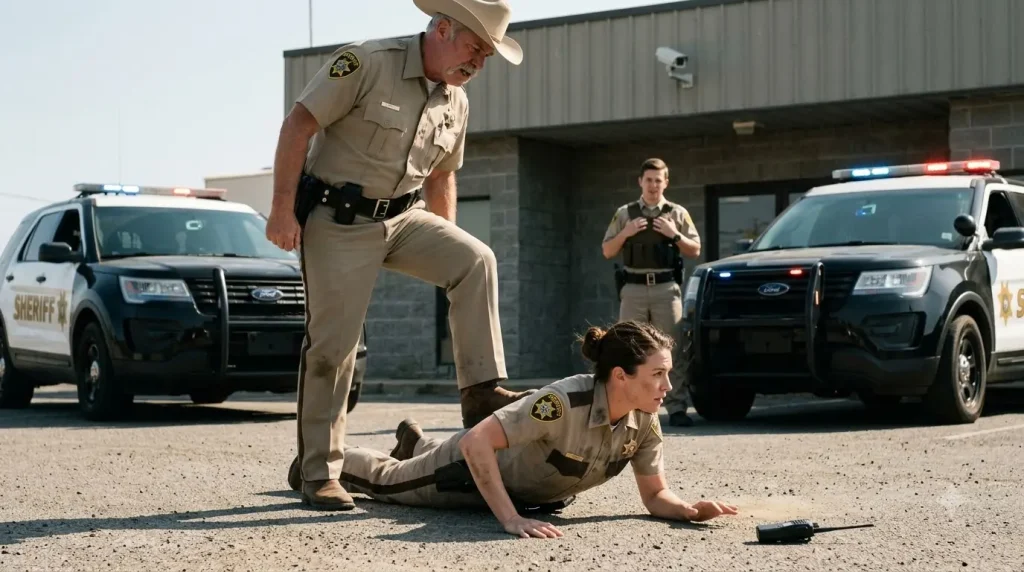
Really had worked county law enforcement before joining the state.
The employment record used by Red Mesa was real up to a point, with her Bureau service masked under a specialized interagency assignment.
Her academy certification was legitimate.
Firearms qualification legitimate.
Driving record legitimate.
Background investigation mostly true.
She did not invent a dead spouse or fake childhood.
The best undercover identities contained as much truth as possible.
On her first day, Sheriff Hollis had looked at her application for less than thirty seconds.
“State experience?”
“Some task-force work.”
“What kind?”
“Narcotics and professional standards support.”
That should have worried him.
Instead he smiled.
“Professional standards.”
“Yes.”
“Means Internal Affairs?”
“Sometimes.”
Hollis leaned back.
“Everybody hates Internal Affairs.”
Elena smiled.
“Usually people with something to explain.”
The sheriff laughed.
He liked her answer.
That told Elena something.
Men convinced they were untouchable often enjoyed jokes about accountability.
He hired her.
Her first month was boring.
Traffic stops.
Warrants.
Livestock complaints.
Domestic calls.
One drunk man who insisted his neighbor’s rooster was “psychologically attacking” him at sunrise.
Elena wrote reports.
Showed up early.
Did not volunteer opinions.
Did not ask investigative questions too quickly.
Sheriff Hollis barely noticed her.
That was success.
She watched.
Captain Robert Ames ran administration.
Fifty-six.
Quiet.
Always carried peppermint gum.
He controlled scheduling and complaint intake.
Lieutenant Daniel Reeves ran investigations.
Smart.
Cautious.
Avoided the sheriff whenever possible.
Sergeant Mitchell Price ran patrol.
Different from previous stories, but in this story Mason Cole would later work under him.
Price had been with Hollis seventeen years and openly admired him.
Deputy Mason Cole was the youngest member of Elena’s shift.
He laughed too quickly.
Apologized too often.
Knew every unwritten rule.
He became Elena’s most useful accidental source.
Not because he talked.
Because he warned her without knowing he warned her.
During her second week, Elena wrote a speeding citation to the county commissioner’s nephew.
Mason saw the name.
His face changed.
“You already submitted that?”
“No.”
“Good.”
“Why?”
Mason looked toward the patrol office.
“Maybe ask Sergeant Price.”
“Why?”
He lowered his voice.
“That family’s complicated.”
Elena smiled.
“Speed limit seemed simple.”
Mason did not smile.
Later Sergeant Price told Elena to change the citation to a warning.
“Reason?”
“Sheriff wants discretion.”
“After issuance?”
“You haven’t submitted it.”
“The stop is on camera.”
Price stared.
Then smiled.
“You always this technical?”
“Yes.”
“You’ll loosen up.”
She did not change it.
Nothing happened.
Not immediately.
Three days later, her preferred weekend schedule disappeared.
Coincidence perhaps.
Elena wrote it down.
Week four brought her first direct look at the complaint system.
A farm worker named Luis Mendoza arrived at the station with his wife.
He said a deputy had entered their trailer without permission and threatened him over a property dispute.
Elena was at the desk.
She began the complaint form.
Captain Ames appeared.
“I’ll take that.”
Elena handed it over.
Mendoza looked nervous.
Ames smiled warmly.
“Come with me.”
Twenty minutes later, the couple left.
Elena asked Ames where to log the complaint number.
“No complaint.”
She looked at him.
“They withdrew.”
“Why?”
“Misunderstanding.”
“Did they sign withdrawal?”
Ames stared.
“You always need a receipt?”
Elena smiled.
“Usually.”
Ames put peppermint gum into his mouth.
“Welcome to county work.”
The complaint never appeared in the database.
Elena reported that through her covert channel.
The Bureau requested no immediate action.
One missing complaint was not enough.
Week five, Mason accidentally gave her the first real piece.
They were eating takeout in a cruiser behind the courthouse when he said:
“You know you’re supposed to let the sheriff read domestic reports before sending them to DA, right?”
Elena stopped chewing.
“What?”
Mason froze.
“You didn’t know?”
“No.”
“Never mind.”
“Mason.”
He looked toward her.
“Why?”
He swallowed.
“Some families are… sensitive.”
“Meaning?”
“People connected.”
Elena waited.
Mason stared through the windshield.
“I didn’t say anything.”
She nodded.
“Okay.”
He looked surprised she did not push.
That night, she searched report metadata.
Six domestic violence cases involving politically connected families showed edit timestamps after the reporting deputy signed them.
Final narratives differed from archived drafts.
She could access only two original fragments.
Enough to suggest changes.
Not enough to prove who changed them.
Then week six brought Deputy Amy Keller.
Keller was thirty-four.
Seven years in Red Mesa.
Excellent performance evaluations.
Recently moved from investigations back to patrol without explanation.
Elena found her crying behind the equipment building after shift.
She almost walked away.
Keller looked up.
“Don’t.”
Elena stopped.
“Don’t what?”
“Pretend you didn’t see.”
Elena leaned against the wall.
“Okay.”
Keller wiped her face angrily.
“You ever have a supervisor tell you you’re imagining your own report?”
Elena said nothing.
Keller laughed bitterly.
“I wrote an arrest exactly how it happened.”
“What arrest?”
Keller shook her head.
“Forget it.”
Elena waited.
Keller continued anyway.
“Guy ran from a traffic stop.”
“Sergeant Price chased him.”
“Caught him behind a gas station.”
“Guy gave up.”
“Hands visible.”
“Price hit him twice after he was down.”
Elena’s eyes remained neutral.
“Your camera?”
“On.”
“What happened?”
Keller looked toward the building.
“Footage disappeared.”
“Report?”
“Sheriff told me the suspect tried grabbing Price’s weapon.”
“Did he?”
“No.”
“What did you do?”
“I refused to add it.”
Elena waited.
Keller’s jaw tightened.
“Next morning Sheriff called me into his office.”
“What did he say?”
“He said loyalty matters more than ‘technical truth.’”
Elena felt anger.
She buried it.
“Then?”
“Transferred me out of investigations.”
Keller looked toward Elena.
“You’re new.”
“Stay new.”
“What does that mean?”
“It means stop noticing things.”
Elena reported everything
The Bureau cross-checked.
The detainee was real.
Charge included attempted weapon grab.
Prosecutor had dismissed that enhancement for insufficient evidence.
Body-camera file listed corrupted.
Again.
Week seven, Elena found something more dangerous.
Evidence room.
She had arrested a man for felony possession after a traffic stop.
The drugs were sealed, weighed, signed, and logged.
Three days later, prosecutor called.
Weight in lab submission differed by fourteen grams.





