That almost made it worse.
They sat across from each other in a legal aid office.
Miguel was quiet.
Thin.
Wore a work shirt.
Elena said:
“I’m sorry.”
He looked at her.
“For what?”
“What happened.”
“You didn’t do it.”
“No.”
She swallowed.
“But I work for the same system.”
Miguel smiled without humor.
“That system got lots of people.”
Elena nodded.
“I know.”
He leaned back.
“My mom said I should thank you.”
“You don’t owe me thanks.”
“I told her.”
Elena almost smiled.
Then he became serious.
“You know what messed me up?”
“What?”
“Not prison.”
She waited.
“The report.”
He looked down.
“I kept reading it.”
“They wrote like they knew me.”
“Dealer.”
“Career criminal.”
“Threat.”
He looked back.
“They made a person on paper who wasn’t me.”
Elena felt the words.
He continued.
“And once the paper person existed, everybody dealt with him instead.”
Judge.
Prosecutor.
Jail.
Nobody met Miguel anymore.
They met the report.
Elena wrote that sentence in her notebook later.
It stayed.
Sheriff Hollis was indicted on multiple counts.
Official oppression.
Evidence tampering.
Obstruction.
Assault.
Falsification of records.
Not every allegation became a charge.
Some were beyond limitations.
Some lacked proof.
Some witnesses changed testimony.
One deputy who had privately accused Hollis of assault denied it before a grand jury.
Fear does not vanish because a case looks strong.
Sergeant Price pleaded to evidence tampering and assault.
Captain Ames received reduced charges after cooperation.
Several deputies were disciplined.
Two were cleared.
Elena insisted their clearances be announced as publicly as the accusations.
Some activists criticized her.
“They were part of the system.”
Elena answered:
“Then prove what they did.”
She refused collective guilt.
That principle cost her applause.
She was comfortable with that.
Mason Cole became the center of another argument.
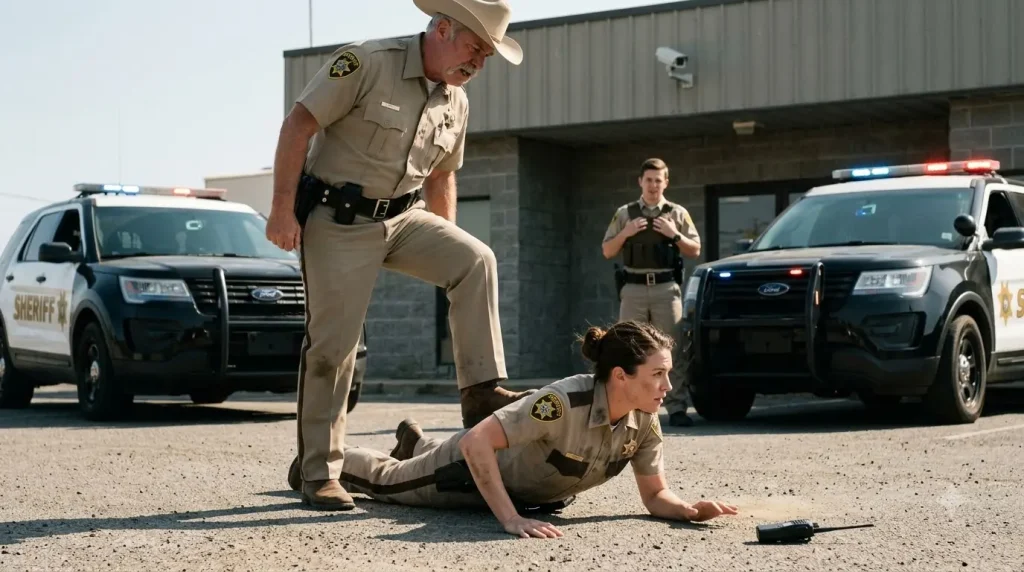
He had stood by while Hollis assaulted Elena.
He had laughed.
Then testified.
Some people wanted him fired.
Others called him a hero.
Elena thought both were too simple.
During his administrative interview, Mason admitted more than investigators knew.
He had watched Hollis shove a jailer two years earlier.
Watched Price slap a handcuffed detainee.
Watched Captain Ames destroy a civilian complaint.
Said nothing.
Why?
Mortgage.
A newborn daughter who had spent her first three weeks in intensive care. A father who had been a county deputy before him and told him that loyalty was the only currency that kept a man alive. Mason laid both trembling hands flat on the stainless-steel table in the state conference room and wept until he could no longer draw air. Elena watched him through the two-way glass beside Marcus Bell. She did not feel pity. She did not feel malice. She felt the quiet, cold ache of watching an ordinary man realize the exact market price at which he had traded his spine. The administrative review panel took three weeks to reach a verdict on Deputy Cole. State prosecutors did not charge him with criminal conspiracy. His cooperation had been swift, complete, and unsparingly detailed, providing the specific dates and radio logs that corroborated the missing domestic violence records. Yet the professional standards board stripped his county commission. He received a two-year suspension of his peace officer license. In law enforcement, a suspension of that length was a polite, quiet execution of a career. Nobody would hire a deputy whose primary legacy was testifying against his own sheriff under federal subpoena. On the morning he cleaned out his locker, Elena stood by the rear bay where his patrol car had once been parked. Mason carried a single cardboard box containing a ceramic coffee mug, an extra pair of handcuffs, and a framed photograph of his wife holding their baby. He did not look like the deputy who had laughed nervously in the hot sun. He looked hollowed out. Scrubbed down to the raw bone of whatever he was before he put on the uniform. He stopped three paces from Elena. “You think I deserve this?” he asked. His voice was barely louder than the dry Texas wind rustling the scrub oak by the fence. Elena kept her hands loose at her sides. “Do you?” Mason stared down at the concrete. The faint grease stain where Hollis had kicked her radio was still visible beneath their boots. “I think about that boy Tommy Vale,” Mason whispered. “I heard the hits too.” “I was sitting in the sally port doing my vehicle inspection, and I heard the dull thuds through the concrete.” “I told myself he probably tripped.” He looked up, tears burning in the corners of his reddened eyes. “I told myself a lie because I had a truck payment due on the fifteenth.” Elena did not soften her posture. She had seen too many officers drown in the luxury of self-pity once the consequences arrived. “You didn’t hit him, Mason.” “No.” “And you didn’t hit me.” “No.” “But you let them build the walls high enough that nobody outside could hear the screaming.” Mason’s mouth tightened into a jagged line. “Is there a way back from that?” Elena considered the question carefully. She thought about her own father, who had lived thirty years with the bitter taste of truth in an empty living room. “Not in a patrol car,” she said honestly. “Then where?” “Wherever you decide to stop laughing when people get hurt.” Mason nodded once, slowly, absorbing the blow without flinching. He walked through the gate and did not look back.





