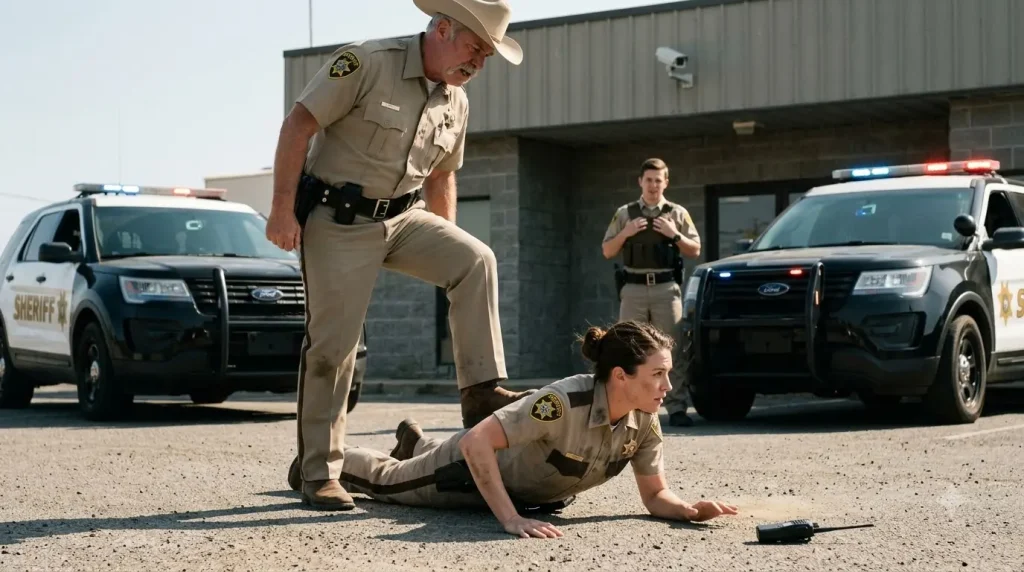
The healing of Red Mesa County was neither swift nor theatrical. In institutions hollowed out by corruption, the removal of the tyrant leaves behind a vacuum filled with suspicion and exhaustion. The governor appointed a temporary conservator to oversee the department while a special election was organized. Sarah Donnelly, the former deputy who had been fired and discredited after refusing to rewrite a domestic violence report, returned to the county seat three months after the trial. She did not return to ask for her badge back. She came to file an amended federal civil rights complaint against the county commissioners who had looked the other way for five terms. The county settled the suit for one point two million dollars. Part of that settlement was earmarked for a comprehensive, independent audit of every felony conviction obtained by the department over the previous six years. Deputy Amy Keller was reinstated to the investigations division. The state board cleared her record of all retaliatory reprimands. On the day she was promoted to lieutenant to oversee internal standards, she called Elena. The conversation was brief. “They offered me the desk in the corner,” Keller said. “Hollis’s old office.” Elena leaned against the railing of the balcony outside the Bureau headquarters in Austin. “Did you take it?” Keller laughed softly. “Hell no.” “I took the small office by the evidence room.” “The one where you can actually see who’s checking out the bags.” Elena smiled. “Smart.” “Are you ever coming back out here, Elena?” Elena looked out over the dry Texas hills stretching toward the horizon. “No.” “Why?” “An undercover investigator who leaves her name in a courtroom transcript belongs behind a desk or in another district.” “Besides,” Elena added, “it’s your department now.” Keller was quiet for a long moment. “I keep that torn report framed in my drawer,” Keller said. “The one Hollis ripped in half before he pushed you.” “Don’t frame it,” Elena advised. “Why not?” “Paper doesn’t keep people honest, Amy.” “People keep people honest.”
Two weeks later, Elena drove her twelve-year-old pickup to an old cemetery on the outskirts of El Paso. The afternoon sun had baked the caliche soil until it cracked into spiderwebs of gray dust. She carried a bottle of cold water and no flowers. Her father, Detective Hector Torres, had never cared for cut flowers. He had always called them pretty things that died too fast to be of any real use. Elena sat on the stone curb beside his grave marker. The granite bore his name, his dates, and a simple engraving of the badge he had been forced to surrender thirty years earlier. She rubbed her left shoulder where the deep tissue bruising had finally healed into a dull, familiar stiffness that only flared up when the weather turned cold. She took a sip of water. “We got one, Dad,” she said to the dry wind. No answer came, of course. Only the sound of semi-trucks rumbling along Interstate 10 in the distance. Her father had died with a glass of cheap bourbon in his hand, watching late-night news and muttering about the crooked lieutenants who had retired on full state pensions while he worked security at an auto parts warehouse. He had spent his final years warning her that the uniform would always protect itself before it protected the truth. He had been right about the danger. He had been wrong about the inevitability. Elena reached into her jacket pocket and pulled out her state investigator credentials. The gold star rested firmly on the blue leather case. Beside it, tucked into the plastic sleeve, was a folded piece of paper with seven handwritten lines. One through six were the violations she had counted aloud into the hot asphalt while Dean Hollis’s boot had pinned her to the earth. The seventh line was blank. Marcus Bell had asked her about that seventh line the day after the sentencing. He had bought her a cup of bitter cafeteria coffee and sat across from her desk with that tired, familiar scowl. “You told me seven would have been punching him,” Bell had said. Elena had looked at the blank line. “No,” she had answered. “Seven was staying quiet so I could keep my job.” She folded the paper and tucked it back behind the badge. She stood up, brushed the white dust from her trousers, and walked back to her truck. The radio on her dashboard crackled with a new assignment code from the Austin dispatch center. A small sheriff’s department up in the Panhandle had just reported three missing evidence containers and an unexplained server wipe. Elena put the truck in gear, turned onto the highway, and started the engine.





