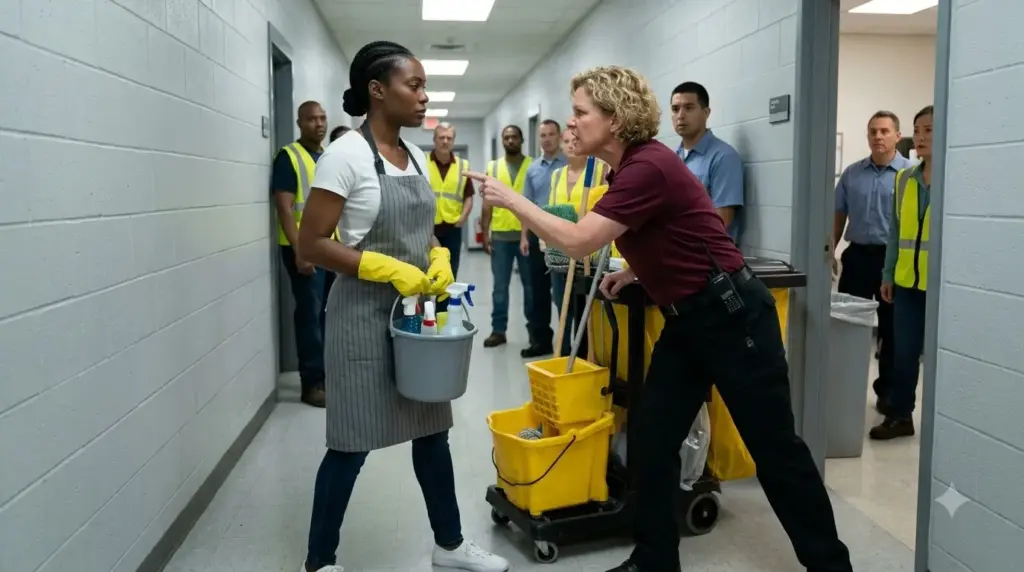
By noon, she knew more.
None of it enough.
Three former temporary workers described similar practices.
One said a supervisor made employees clean restrooms when they were late returning from break.
Another said cleaning assignments were threatened when workers asked why their hours had been cut.
A third said, “They send temps because nobody cares if we’re embarrassed.”
Naomi disliked that sentence more than the others.
Nobody cares.
She knew exactly what kind of workplace that sentence described.
Her mother had cleaned office buildings at night for fourteen years.
Naomi had been eight when she first understood people could become invisible while standing directly in front of somebody.
Her mother, Denise Carter, worked from six in the evening until two in the morning.
Office towers.
Medical buildings.
A law firm downtown.
Sometimes Naomi went with her on school holidays because childcare was impossible.
She sat in empty conference rooms doing homework while Denise emptied wastebaskets and vacuumed carpet.
At ten, Naomi learned what smelled worse than a dirty restroom.
People’s contempt for the person cleaning it.
Executives would stay late and step around Denise without greeting her.
Some left coffee cups on desks inches from her hand after she had already cleaned.
One lawyer once dropped a paper towel on the floor while Denise was mopping and said, “That’s what they pay you for.”
Naomi remembered her mother standing there.
Not angry.
Not submissive.
Tired.
Then saying:
“They pay me to clean the floor, sir. They don’t pay me to teach manners.”
Naomi thought she would be fired.
The lawyer stared.
Then picked up the paper towel himself.
That story became family legend.
But Denise never taught her daughter that cleaning was humiliating.
The opposite.
“There’s no shame in honest work,” she said.
“The shame comes when people use one job to prove another person is beneath them.”
That distinction stayed with Naomi.
So when she read punishment cleaning, the phrase felt especially ugly.
A toilet was not degrading.
Using toilet cleaning as public discipline told every custodian in the building that their ordinary job was being used as an insult.
By Monday afternoon, Sarah had gathered preliminary data.
Temporary employees at Dayton were disproportionately assigned unscheduled sanitation tasks compared with full-time production staff.
Not always as punishment.
Sometimes legitimate overflow.
But the assignments clustered under one supervisor.
Linda Marsh.
Shift operations supervisor.
Seventeen years with the company.
Strong production numbers.
Low scrap rate.
Excellent on-time performance.
High worker complaints.
Naomi had seen that combination before.
Companies loved managers who hit targets so reliably that everyone became afraid to ask what was being consumed to produce them.
The plant manager, Douglas Trent, rated Linda “exceeds expectations” three years in a row.
His notes praised her “discipline,” “control of labor,” and “ability to maintain output despite temporary workforce quality issues.”
Temporary workforce quality issues.
Naomi called Chief Financial Officer Malcolm Hayes.
He answered, “If this is about Dayton labor cost, finance didn’t create the schedule.”
“It isn’t.”
“Good.”
“It might be about payroll.”
His tone changed.
“What?”
“Any unusual manual adjustments?”
Malcolm typed.
“Give me an hour.”
Twenty-three minutes later he called.
“Naomi.”
“Yes.”
“We have a pattern.”
She closed her office door.
“What kind?”
“Dayton has high supervisor edits.”
“How high?”
“Almost four times manufacturing average.”
“Reason codes?”
“Missed punches, attendance corrections, break violations.”
“Who makes most edits?”
“Linda Marsh and two team leads.”
“Dollar impact?”
“Not huge individually.”
“Aggregate?”
“Still calculating.”
“Any negative adjustments after shift close?”
“Yes.”
Naomi became still.
“How many?”
“Enough that I’m uncomfortable.”
“Define.”
“In twelve months, two hundred fourteen adjustments reduced paid time after employee sign-off.”
“Temps?”
“One hundred seventy-three.”
There it was again.
Naomi asked:
“Why didn’t payroll flag?”
“It did.”
“What happened?”
“Local finance said manufacturing supervisors were correcting unclosed breaks and unauthorized overtime.”
“Who approved explanation?”
Malcolm hesitated.
“My team.”
Naomi said nothing.
He continued.
“We relied on plant certification.”
“You’re telling me finance saw abnormal edits and accepted local explanation.”
“Yes.”
“Any sampling?”
“Not beyond exception logs.”
Naomi breathed slowly.
“All right.”
Malcolm sounded defensive.
“Naomi—”
“I’m not accusing.”
“Yet.”
He laughed without humor.
“Fair.”
“Freeze deletion or overwrite capability on Dayton timekeeping records.”
“I can preserve logs without tipping plant?”
“Yes.”
“Do.”
“Pull original punches against final payroll.”
“Thirty-six months.”
“That’s a lot.”
“Yes.”
“I’ll need legal.”
“Call them.”
The next question was how to investigate.
Sarah wanted a corporate HR team onsite.
General Counsel Aaron Patel wanted outside counsel first.
Malcolm wanted payroll audit.
Naomi wanted all three.
But she also knew what would happen when three executives arrived in Dayton.
Coffee would appear.
Supervisors would smile.
The break room would become a model of respect.
Workers would receive subtle instructions before anyone interviewed them.
Naomi said:
“I want an observational audit.”
Aaron frowned through video.
“Meaning?”
“Somebody on the floor without local management knowing.”
“That creates employment and labor issues.”
“Then structure it legally.”
Sarah said:
“You want an undercover investigator?”
Naomi looked at her.
“Maybe.”
“Not you.”
Naomi did not answer.
Sarah immediately understood.
“No.”
Malcolm began laughing.
Naomi glared at the screen.
“This is not funny.”
“It is a little.”
Aaron said:
“Absolutely not.”
“Why?”
“You are chief executive.”
“Yes.”
“You cannot impersonate a temp worker and insert yourself into hourly operations because you read three complaints.”
“I can if legal creates a legitimate short-term observational assignment.”
“No.”
Sarah added:
“Also, half the company can Google your face.”
“Half the executive office.”
“Frontline staff?”
“Maybe fewer.”
Malcolm asked:
“What exactly are you hoping to learn?”
Naomi answered:
“What happens before the investigators arrive.”
Aaron leaned back.
“You understand if somebody asks you to operate equipment—”
“I won’t.”
“Chemical exposure?”
“No.”
“Restricted tasks?”
“No.”
“Working time?”
“Company can pay me one symbolic hourly check and donate?”
Aaron rubbed his forehead.
“You already have salary.”
“Then don’t pay.”
“That is worse.”
Sarah laughed.
“Please stop helping.”
The argument lasted forty minutes.
Eventually Aaron proposed a compromise.





