Outside compliance firm would create a broader observational audit program using trained mystery employees across multiple plants.
Naomi could participate in Dayton as a corporate compliance observer temporarily assigned through an approved staffing channel, but she would not perform production machinery work, hazardous sanitation, or anything requiring separate certification.
Her temporary personnel file would use her legal first name and middle surname variation—Naomi James Carter—without executive title.
No fake identity.
No false government documents.
No deception about safety qualifications.
Local management would know corporate had expanded temp staffing for audit-week demand, but not which worker was observer.
Naomi agreed.
Sarah still hated it.
“This is a terrible idea.”
“Then why did legal approve?”
“Legal approves many terrible things after reducing their liability.”
Aaron nodded.
“Accurate.”
Naomi smiled.
She started Wednesday.
Before going, she visited her mother.
Denise Carter was seventy-one and still lived in the same Baltimore row house she bought after Naomi’s company first became profitable.
Naomi had tried buying her something larger.
Denise said:
“I raised two children here. I know where every light switch is. Stop trying to relocate me because you have money.”
So Naomi stopped.
She sat at the kitchen table while Denise sliced apples.
When Naomi explained Dayton, her mother listened without interruption.
Then asked:
“You’re going to clean toilets?”
“I may.”
“Can you still clean one?”
Naomi stared.
“Mother.”
“I’m serious.”
“Yes.”
“No.”
“I can.”
Denise smiled.
“You own a company and suddenly remember bleach.”
Naomi laughed.
Then became serious.
“They’re using cleaning as punishment.”
Denise’s knife stopped.
“That’s different.”
“I know.”
“No.”
“I mean you need to be careful how you talk about it afterward.”
Naomi frowned.
Her mother put knife down.
“If you stand on television saying, ‘They made me clean toilets,’ like that’s the worst thing anybody can do, every janitor watching hears their job used as horror story.”
Naomi stared.
Denise continued.
“The problem isn’t cleaning toilets.”
“It’s humiliation.”
“Power.”
“Threat.”
“Maybe stealing people’s time.”
“Say that.”
Naomi nodded.
“I will.”
Denise pushed apple slices toward her.
“And don’t go in thinking you already know villain.”
“You always say that.”
“Because you always think faster than facts.”
Naomi smiled.
“Where did I get that?”
“Your father.”
“He blamed you.”
“Your father was wrong about many things.”
They both laughed.
Wednesday morning, Naomi arrived at Dayton Components at 5:43.
The plant manufactured industrial control assemblies used in commercial HVAC systems.
Not glamorous.
Large beige building.
Three production halls.
Two warehouses.
One administrative wing.
Nine hundred employees across shifts, including roughly one hundred fifty temporary workers.
Naomi parked where the staffing agency instructed.
Employee entrance.
No executive parking.
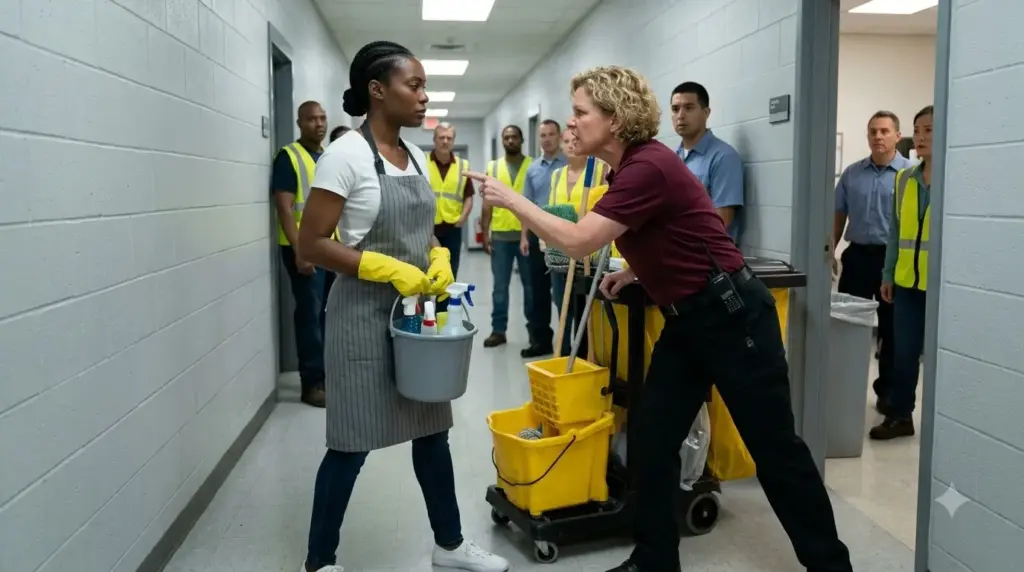
She wore the plain white T-shirt, gray striped apron, jeans, white sneakers, and yellow gloves visible in the image used for temporary sanitation staff.
The staffing coordinator, Brenda Cho, knew who Naomi really was.
Nobody else onsite was supposed to.
Brenda handed her a badge.
The title:
TEMPORARY FACILITIES SUPPORT
Naomi stared.
“What?”
Brenda whispered, “I am reconsidering every decision that brought me here.”
“Good.”
“If you get hurt, I’m moving countries.”
“I’m not getting hurt.”
“You’re a CEO in white sneakers walking into a plant undercover.”
“Compliance observer.”
“Undercover.”
“Legal hates that word.”
“I like legal less every minute.”
Naomi smiled.
Then went inside.
The first surprise was not Linda.
It was how ordinary everything felt.
Workers clocked in.
Coffee machines hissed.
Radios chirped.
Forklifts moved in marked lanes.
Some employees smiled.
Some looked exhausted.
A young Latino temp named Mateo showed Naomi where gloves were stored.
A Black woman in her twenties named Kiara helped her understand the break schedule.
Neither complained immediately.
That mattered.
Bad workplaces are rarely bad every second.
People laugh.
Help each other.
Bring food.
Share rides.
The system can be harmful while the community inside it remains human.
Naomi spent the first two hours helping facilities staff wipe break tables, restock dispensers, collect recyclable packaging, and clean common areas.
The actual sanitation employees were professional and organized.
Their lead, Mrs. Hall, was a sixty-year-old Black woman with silver braids and no patience for people who left half-full drinks in trash cans.
“You pour liquid out first,” she told Naomi.
“Otherwise bags leak.”
“Yes, ma’am.”
Mrs. Hall narrowed her eyes.
“You worked cleaning before?”
“Not professionally.”
“That answer means no.”
Naomi smiled.
Mrs. Hall showed her the proper way to separate cleaning cloths.
“You don’t use restroom cloth on food surfaces.”
“I know.”
“You’d be surprised.”
The work was physical.
Not unbearable.
Naomi’s shoulders hurt by nine.
At 9:20, Linda Marsh appeared.
Naomi recognized her from personnel file immediately.
Linda did not recognize Naomi.
She looked over the facilities cart.
Then Naomi.
“You new?”
“Yes.”
“Agency?”
“Yes.”
“Name?”
“Naomi Carter.”
Naomi waited.
Nothing.
Linda had probably never seen CEO’s full name in relation to a face.
The company had been founded as Carter Industrial Holdings, but five years earlier rebranded Carter Manufacturing Group. Naomi appeared in quarterly videos perhaps twice a year.
Plant employees rarely watched.
Linda said:
“Naomi.”
“Yes.”
“You move too slow.”
Naomi glanced at clock.
“I’m following Mrs. Hall’s sequence.”
Linda looked toward Mrs. Hall.
“She doesn’t run production.”
Mrs. Hall heard from across the room.
“I run sanitation.”
Linda ignored her.
“The east break room needs done before second break.”
Naomi said:
“It’s scheduled for eleven.”
Linda looked back.
“Did I ask schedule?”
“No.”
“Then do it now.”
Naomi nodded.
Not enough yet.
She followed.
Over the next hours, patterns appeared.
Linda spoke sharply to everyone.
Not only temps.
She was especially harsh with anyone uncertain.
At 10:05, a permanent employee arrived two minutes late from break.
Linda said:
“Watch clock.”
Nothing else.
At 10:32, Mateo returned three minutes late after helping another worker locate replacement safety glasses.
Linda made him stand beside line while she announced:
“Temporary means trial. If you can’t manage twelve minutes, don’t expect permanent badge.”
She then assigned him trash removal during his next break.
Off the clock?
Naomi asked Mateo later.
He shrugged.
“Usually.”





