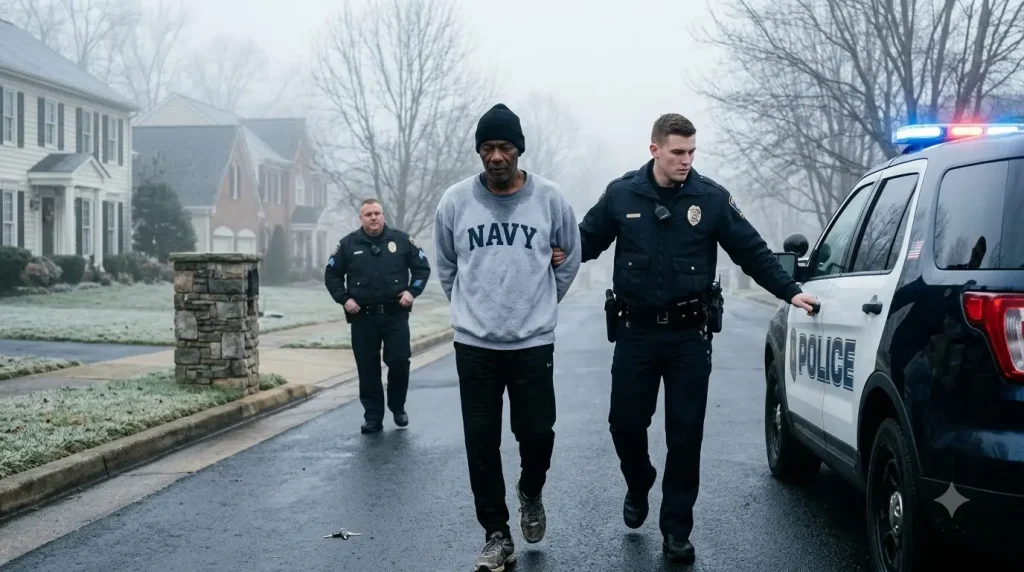
“Why does the exact minute matter, General?”
Isaiah looked from the lieutenant’s face to the small black square clipped to the center of Sergeant Carter’s uniform shirt.
“Because that model is an Axon Body 3,” Isaiah said.
His voice carried easily across the damp pavement.
“My security detail uses the same hardware at joint command.”
Carter shifted his weight from one boot to the other.
“Batteries die,” the sergeant muttered.
“They do,” Isaiah agreed.
“And when the battery on that unit depletes naturally, it enters a low-power state for ten minutes before shutdown and logs a system code to the cruiser’s wireless router.”
He turned his gaze slightly toward Officer Higgins.
“When an officer holds the top button down for three seconds to power it off manually, it emits two audible tones.”
Higgins’s mouth parted slightly.
Isaiah continued without raising his voice.
“Officer Higgins was standing four feet from Sergeant Carter when they exited Unit 23 at 6:21 a.m.”
“Officer Higgins’s camera was recording.”
“Which means his microphone recorded whether Sergeant Carter’s camera died on its own earlier this morning, or whether Sergeant Carter turned it off while watching me jog down the street.”
The silence around the three patrol vehicles became absolute.
Lieutenant Shaw did not look at Isaiah anymore.
He stared directly at Mitchell Carter.
A muscle flexed in the lieutenant’s jaw.
For three years, Nathan Shaw had been the only Black lieutenant in a thirty-eight-officer suburban department where Mitchell Carter had twenty-two years of seniority and friends on the town council.
Shaw had seen Carter’s “dead battery” reports before.
Always during early morning shifts.
Always on the edges of the wealthy subdivisions.
Never with a witness who knew the technical specifications of the hardware.
“Officer Higgins,” Shaw said quietly.
Higgins swallowed hard.
“Sir?”
“When did the sergeant’s camera go dark?”
Higgins looked at Carter.
Carter gave him a sharp, warning glare—the look of a veteran reminding a rookie who wrote his performance evaluations.
Then Higgins looked at the red compression marks circling the wrists of a four-star general.
Self-preservation won in less than two seconds.
“In the car, Lieutenant,” Higgins said, his voice barely above a whisper.
“Right before I hit the lights.”
Carter took a step forward.
“Blake, shut your—”
“Stand where you are, Sergeant,” Shaw snapped.
The command was sharp enough that the younger patrol officer holding the department camera flinched.
Shaw reached for his shoulder microphone and switched to the administrative command channel.
“Dispatch Supervisor, this is Lieutenant Shaw on Channel Four.”
A woman’s voice answered immediately.
“Go ahead, Lieutenant.”
“Pull the CAD log for the suspicious person call on Willow Creek Lane between 0600 and 0625.”
“Read me the caller’s phone number and the exact description logged by the intake operator.”
There was a pause.
Outside on the main road, another commuter sedan rolled past, its tires hissing against the wet asphalt.
Carter stared at the toes of his boots.
His face had gone the color of wet cement.
“Lieutenant,” the supervisor’s voice returned through the speaker.
“I’m looking at the morning queue right now.”
“We have no 911 or non-emergency calls logged for Willow Creek Lane this morning.”
Shaw’s eyes narrowed.
“Check the surrounding streets.”
“Oak Ridge, Pine Crest, Waverly.”
“Negative, Lieutenant.”
“Unit 23 called out a self-initiated pedestrian stop at 0621.”
“No prior dispatch call exists in the system.”
Higgins looked at Carter as if the older man had just pulled the pin on a grenade and handed it to him.
“You told me dispatch pushed a burglary prowler alert to your terminal,” Higgins blurted out.
“You said a resident called it in from the corner house.”
Carter did not answer.
He could not.
Everything Isaiah had suspected on the grass twenty minutes earlier sat exposed in the morning air.
There had been no nervous homeowner peeking through curtains.
There had been no vague description of an older male in dark clothing.
There had only been Mitchell Carter drinking coffee in a heated cruiser, spotting a Black man jogging past three-million-dollar homes before sunrise, and deciding to invent a pretext to run him off the street.
When Isaiah had known his rights and refused to cower, Carter had used Higgins’s eagerness to put him in steel.
“Both of you,” Shaw said, his voice dropping an octave, “place your duty belts and body cameras on the hood of my vehicle.”
“You are relieved of field duty effective this second.”
“Wait inside Unit 23 until the Chief arrives at headquarters.”
“Nathan, listen to me,” Carter started, stepping toward him with his palms out.
“It was a routine field interview that got out of hand—”
“It is Lieutenant Shaw,” Shaw said coldly.
“And if you speak another word before Internal Affairs reads you your administrative rights, I will personally add insubordination to the file.”
Carter closed his mouth.
With slow, stiff movements, he unbuckled his belt and laid it on the wet metal of the hood—the exact spot where Isaiah’s hands had been forced twenty minutes earlier.
Shaw turned back to Isaiah.
“General, if you’ll allow me, I will drive you back to Willow Creek Lane myself.”
Isaiah nodded once.
“Thank you, Lieutenant.”
“I have a 7:30 appointment at my residence I would prefer not to miss.”
They rode back in the front of Shaw’s unmarked command SUV.
Neither man spoke for the first half mile.
Shaw kept both hands at ten and two on the wheel, his posture rigid.
Finally, as they turned between the stone pillars marking the entrance to Willow Creek Lane, Shaw spoke without taking his eyes off the road.
“When I made sergeant eight years ago, my father told me that wearing brass in a town like this meant I’d spend half my career proving I belonged in the uniform,” Shaw said quietly.
“He never told me what it would feel like to take handcuffs off a man who spent thirty-five years proving it for the whole country.”
Isaiah looked over at the younger officer.





