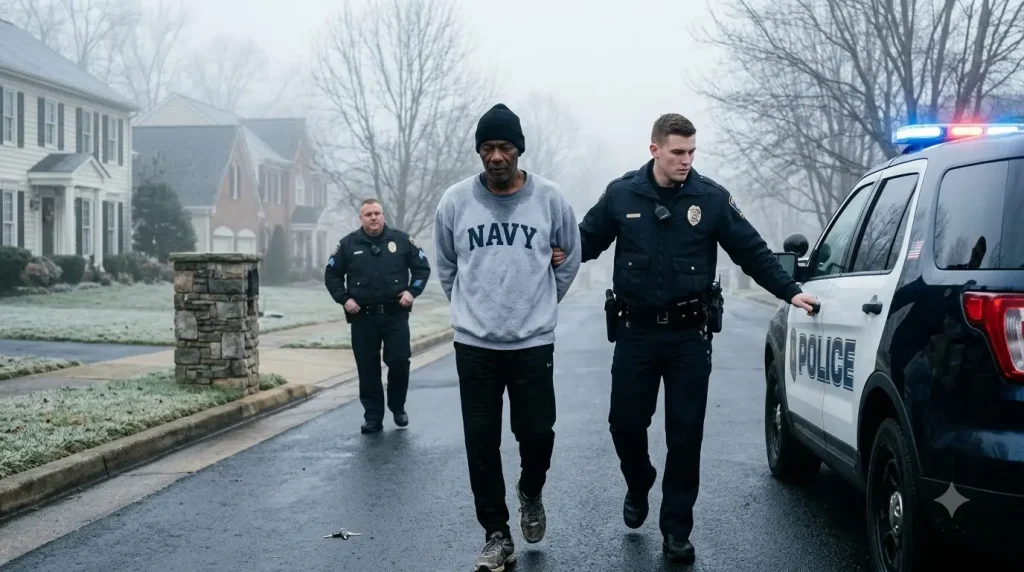
“You followed procedure the moment you stepped out of the vehicle, Lieutenant,” Isaiah said.
“You secured the evidence before you protected the department’s image.”
“That is rarer than you think.”
Shaw let out a slow breath, then frowned as he looked through the windshield.
“General,” Shaw said, slowing the SUV.
“Looks like you already have company.”
Four-forty-two Willow Creek Lane was no longer quiet.
Parked in the curved stone driveway sat two black Chevrolet Suburbans with federal government plates and whip antennas mounted to their roofs.
Beside the front porch stood Colonel David Anderson in full service dress uniform, speaking rapidly into a satellite handset while two military security specialists in dark suits stood near the garage.
Out by the curb, Margaret Ellis still wore her winter coat over her bathrobe.
She was talking to a tall, silver-haired man in a charcoal suit who stood beside a town-issued sedan with a gold Pine Valley Police Department emblem on the door.
Chief of Police Arthur Vance had beaten them to the house.
When Shaw’s SUV pulled to the curb and Isaiah stepped out of the passenger door in his faded Navy sweatshirt and running pants, every conversation on the lawn stopped at once.
Colonel Anderson lowered his handset immediately and walked briskly down the drive, stopping three paces away and coming to attention.
“General,” Anderson said, his eyes dropping instantly to the red indentation still visible on Isaiah’s left wrist.
“General Parks initiated a missing-principal protocol at 0705 when your secure phone went offline inside a local police transport.”
“DoD Legal and the Provost Marshal’s office are on an open line to the Pentagon.”
“Tell them to stand by, David,” Isaiah said calmly.
“I am unharmed.”
Before Anderson could reply, Chief Vance stepped forward from the sidewalk, his face pale beneath the morning sun.
He extended a hand that Isaiah did not take.
“General Montgomery,” Vance said, his voice oiled with the urgent courtesy of a career administrator watching a career-ending crisis unfold on his front lawn.
“I am Chief Arthur Vance.”
“I came straight from home the moment dispatch notified me of the confusion.”
“I want to offer my deepest, most personal apology for this morning’s misunderstanding.”
Isaiah looked at him evenly.
“What misunderstanding was that, Chief?”
Vance lowered his unshaken hand and cleared his throat.
“We’ve had a string of residential property crimes in the north sector over the last month,” Vance said.
“My officers were overly aggressive in their proactive patrol efforts and failed to recognize a new resident.”
“It was a failure of communication and training, and I assure you I am going to handle it internally this morning so you and your family aren’t burdened with any further inconvenience.”
Isaiah remained silent for three seconds.
It was a technique he had used in rooms from Kabul to Brussels.
Men who were lying or spinning always rushed to fill a silence.
“Internally,” Isaiah repeated softly.
“Yes, sir,” Vance said quickly.
“Counseling, retraining, and a formal letter of reprimand in their personnel jackets.”
“No need for this to become a spectacle that distracts from your work or upsets the community.”
From the edge of the grass, Margaret Ellis made a sharp, disgusted sound.
She walked right up to the police chief, her coffee mug gone, replaced by her smartphone held tightly in her gloved hand.
“Arthur Vance, don’t you stand on my neighbor’s grass and lie about proactive patrol,” Margaret said, her retired-principal voice cutting through the cold air like a ruler slapping a desk.
Vance winced.
“Margaret, please, this is an official matter—”
“I stood right there on my porch and told Sergeant Carter that this man bought 442 three weeks ago and had moving trucks in the driveway for three days,” Margaret said.
“Your sergeant laughed in my face, asked if I had inspected his property deed, and tried to order me back inside my own house when I started filming.”
She turned and held her phone out toward Lieutenant Shaw and Colonel Anderson.
“I have four minutes of high-definition video showing General Montgomery standing with his hands in plain sight, calmly giving his address while those two officers treated him like a convict before they ever put him in that car.”
Chief Vance’s jaw tightened.
He looked toward Lieutenant Shaw, expecting his watch commander to help him contain the civilian witness.
Shaw did not move to help him.
Instead, Shaw stepped beside Margaret and took a leather notebook from his breast pocket.
“Chief,” Shaw said, his voice steady and loud enough for Colonel Anderson to hear every syllable.
“There was no burglary call this morning.”
Vance blinked.
“What?”
“I had Dispatch Supervisor Miller audit the CAD system before we left the scene,” Shaw said.
“No citizen called 911.”
“Sergeant Carter fabricated the existence of a complainant to justify demanding identification from a pedestrian who had committed no offense.”
“Furthermore, Officer Higgins has already stated on the record that Sergeant Carter manually powered down his body-worn camera inside Unit 23 immediately prior to initiating the stop.”
Vance stared at Shaw, his face flushing dark red.
“Lieutenant, we will discuss personnel findings in my office—”
“I’m not finished, sir,” Shaw said.
He did not flinch under the chief’s glare.
“While we were driving back here, I had our systems administrator run an automated query on Sergeant Carter’s body-camera power logs over the last six months.”
“Nineteen times since June, Sergeant Carter’s camera has been manually powered down within sixty seconds of a self-initiated pedestrian or traffic stop.”
“All nineteen stops involved Black or Hispanic citizens.”
“Zero resulted in valid criminal charges.”
“And three resulted in informal citizen complaints that Captain Mercer closed as unsubstantiated because there was no video.”
The cold morning air seemed to freeze around Chief Vance.
Colonel Anderson’s pen was already moving rapidly across his military notepad.
Isaiah looked at the police chief.
“You called it a failure of communication, Chief Vance,” Isaiah said quietly.





