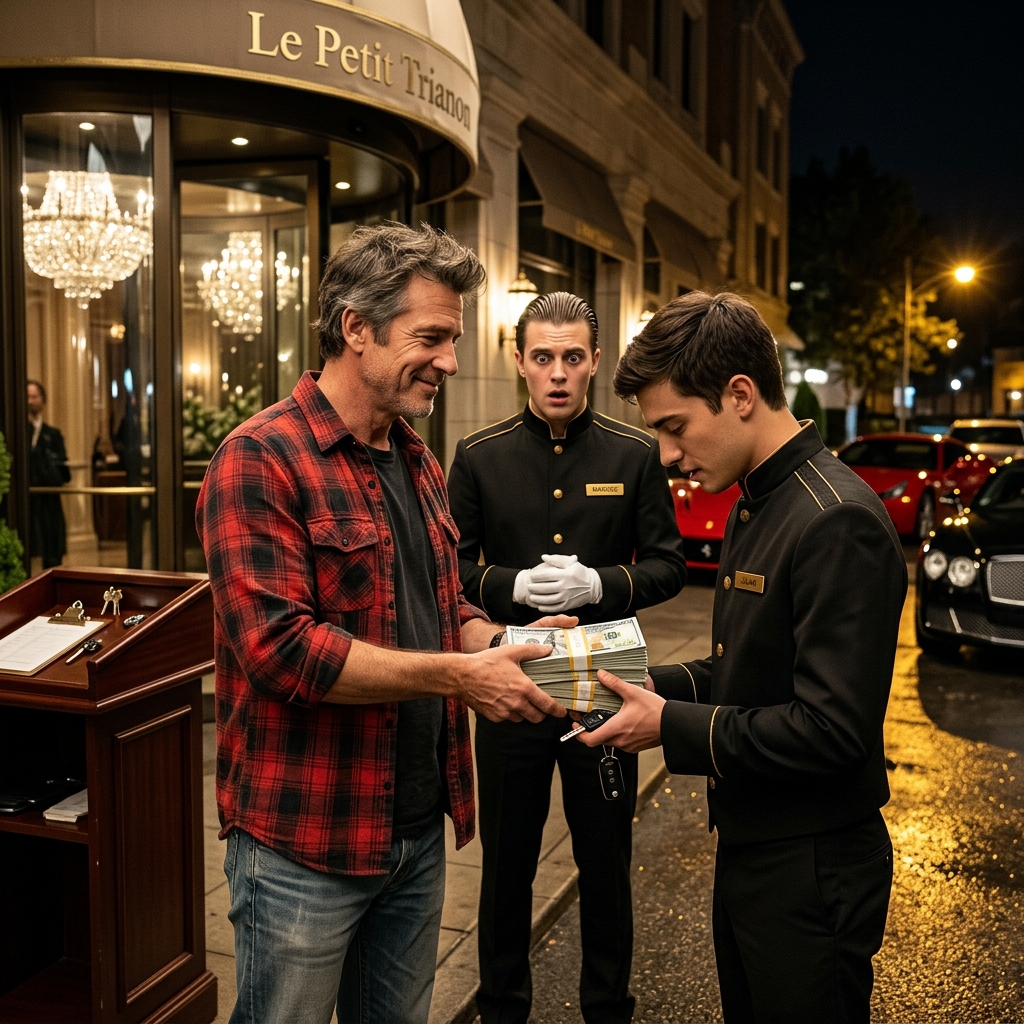
Marcus didn’t touch the ticket. He looked down at the slip of paper, then let his gaze travel slowly up the scuffed leather boots, across the threadbare flannel, past the salt-and-pepper stubble, finally settling on the man’s eyes with deliberate, clinical insolence.
“Ticket number?” Marcus asked, his tone flat as slate.
“Four-twenty,” the man said mildly.
Marcus tapped a manicured fingernail against his clipboard, making no move to reach for the board. Before he could speak, the revolving door spun again with a flurry of laughter.
A gentleman in a charcoal bespoke three-piece suit emerged, an overcoat of black cashmere draped over his forearm, an attractive woman in emerald silk clinging to his side. The gold dial of an Audemars Piguet caught the light as he shook a velvet glove free.
Marcus’s entire demeanor transformed within the space of a heartbeat. His spine snapped straight, his chin lifted, and a wide, reverent smile split his face.
“Right this way, Mr. Sterling!” Marcus said, stepping clean around the man in the flannel shirt as if he were nothing more than a stone pillar. “I hope the chef treated you well tonight, sir.”
“Usual brilliance, Marcus,” Sterling said, tossing a gold-stamped ticket onto the desk without breaking stride. “The GT3 RS. Bring it around front, will you? We’re running twenty minutes behind for the symphony.”
“Right away, Mr. Sterling! Front and center, three minutes flat!” Marcus snatched the cardstock, pivoted on his heel, and took off at a full sprint down the western ramp toward the heated executive subterranean deck, his dress shoes clattering against the concrete.
The man in the flannel shirt remained by the podium. He didn’t blink. He simply drew his hands back into his pockets, shifted his weight against the damp breeze, and watched the fog billow across the manicured rhododendrons.
Julian stepped forward to the podium, his hand reaching for ticket four-twenty. “Sir, I can—”
“Julian!”
The voice barked from the darkness of the lower ramp. Marcus had reappeared on foot, jogging back up to retrieve a second set of keys from the master lockbox. He caught Julian’s arm just as his fingers touched the white ticket.
“Leave it,” Marcus hissed beneath his breath, shoving Julian back half a step with his shoulder. “Sterling’s Porsche is blocked in by the senator’s Maybach down on Level One. I need you to run the Maybach keys down to Davis so he can clear the lane. Now.”
“Marcus, this gentleman was here first,” Julian whispered, keeping his voice strictly between them. “He’s been waiting.”
“He’s driving a five-hundred-dollar beater, you idiot,” Marcus snapped, his back to the man in the flannel shirt. “You think he’s going to hand you anything larger than pocket lint? Sterling dropped two hundred on us last Friday. Move your legs, Reyes, or I’ll have the head captain write you up for insubordination before midnight.”
Julian looked at the slip on the podium, then at Marcus’s sharp, venomous gaze. With a quiet swallow, Julian took the brass key fob for the Maybach and hurried down the eastern ramp.
Ten minutes crawled by.
The night grew colder. A fresh cluster of diners filed out of the restaurant’s gilded doors: a venture capitalist in a fleece vest over an Italian dress shirt, two real estate developers arguing loudly about zoning permits in SoMa, a tech executive who dropped a fifty-dollar bill on the podium before he even handed over his ticket.
Marcus ran like a greyhound. He brought up a silver McLaren 720S, idling it with theatrical revs in the center of the court to draw the eye of the patio patrons. He brought up an obsidian-black Range Rover SV, stepping out to open the door with a sweeping, aristocratic bow that earned him a crisp twenty from an outstretched leather-gloved hand. Each time he returned to the stand, he deliberately swept his eyes past the man in the flannel shirt, pretending to check the master log, pretending to adjust the pen tether, pretending the scuffed boots did not exist.
Fifteen minutes turned into twenty.
The man in the flannel shirt had not paced. He had not tapped his foot. He stood by the brass banister, his manila folder tucked firmly under his arm, watching the theater of the driveway with the mild, bemused curiosity of a botanist studying a particularly predictable strain of moss.
Inside that manila folder, pressed between two sheets of acid-free parchment, lay an acquisition contract executed less than forty minutes earlier in Private Salon C.
The documents bore the fresh, wet-ink signatures of Arthur Pendelton—majority owner and principal engineer of Clearwater Aerodynamics—and the executive board of Thorne Global Logistics. The transaction was a clean, non-hostile buyout of Clearwater’s high-efficiency composite turbine patents: an eighty-four-million-dollar cash transfer with an equity roll that had taken fourteen months of brutal cross-table negotiations to finalize.
In the dining room, Arthur had sat across from four corporate attorneys who each wore wristwatches that cost more than an average family’s annual mortgage. They had toasted with a 1982 Château Margaux that Arthur found tasted mostly like dry oak; he had quietly switched to club soda with a lime wedge. When the young lead counsel from Thorne had patronizingly offered to send a corporate town car to drive Arthur home to his modest farmhouse in Sonoma, Arthur had simply smiled, tapped his folder, and replied that he preferred to do his own driving.
Now, Arthur stepped back toward the podium.
“Excuse me, son,” Arthur spoke up gently. His voice was entirely devoid of anger, carried on a calm, low wave. “My car. It’s been twenty minutes.”
Marcus was in the middle of arranging a stack of fresh gold-embossed tickets. He didn’t stop his hands. He didn’t look Arthur in the face. He kept his chin tilted down toward his clipboard, a faint, mocking smirk pulling at the corner of his thin lips.





