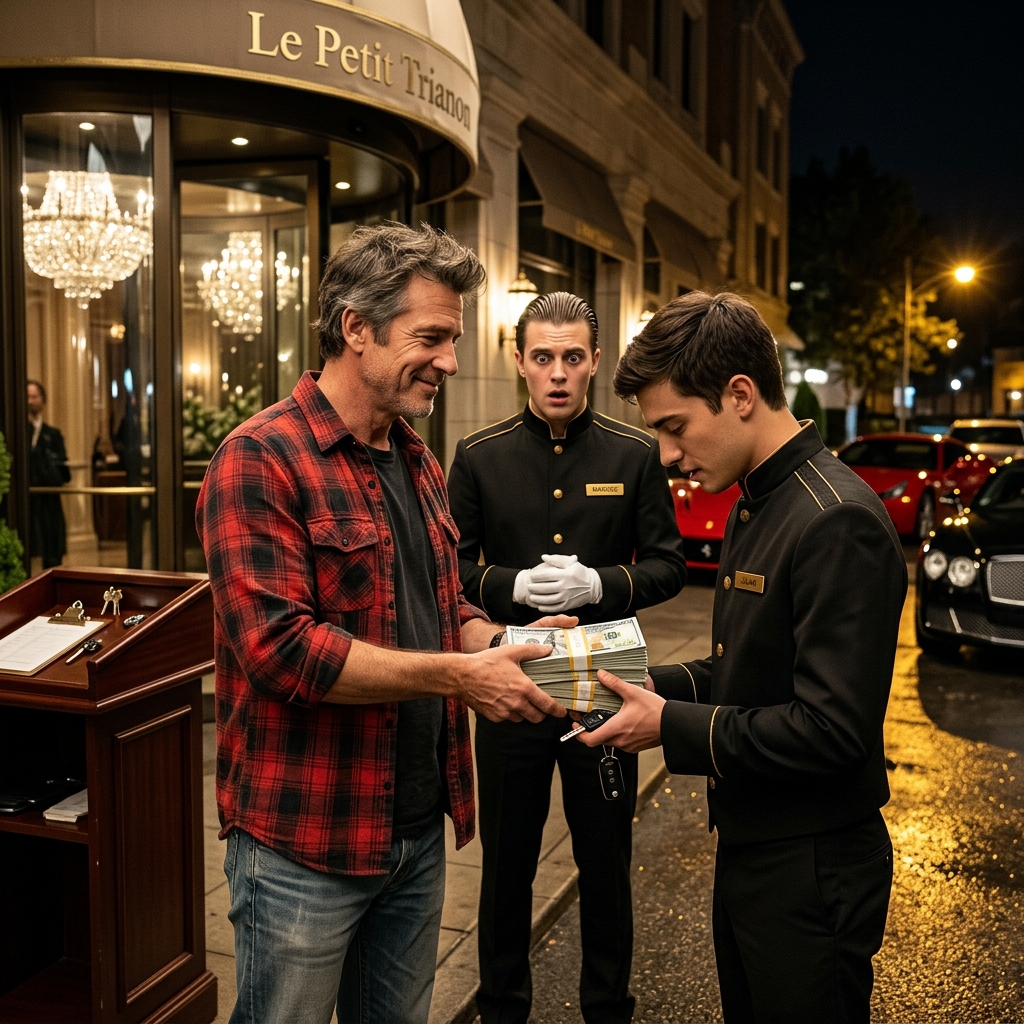
Arthur glanced over Julian’s shoulder, his eyes meeting those of Marcus, who was leaning against the brass podium with an amused, superior smirk, clearly waiting to see the older man fish through his pockets for loose quarters.
Arthur reached into the deep pocket of his frayed flannel shirt.
He didn’t pull out a metal money clip. He didn’t pull out loose change. He pulled out a neat, crisp stack of banknotes folded once down the center, held together by a simple paper currency band stamped with the seal of the San Francisco Federal Reserve.
Without breaking eye contact with Julian, Arthur took the young man’s right hand, placed the stack flat into his open palm, and closed Julian’s fingers over it.
“You have something very rare, young man,” Arthur said, his voice dropping into that deep, quiet gravel that carried an ancient, immovable weight. “You have pride in what you do, even when nobody is looking. Never let people who only see surfaces convince you that character doesn’t have a price.”
Julian felt the thickness of the paper beneath his knuckles. His fingers twitched with surprise, but before he could speak, Arthur gave his hand a single, firm squeeze.
“Get yourself a warm dinner tonight,” Arthur added, his eyes crinkling at the corners. “And don’t ever run on bad shoes.”
Arthur slipped into the driver’s seat of the silver Prius. He clicked his seatbelt into place, put the car into gear, and let the quiet hybrid glide smoothly away from the curb, its red taillights glowing softly through the thick white fog as it turned onto the avenue and vanished into the city.
Julian stood frozen on the travertine stone, his arm still suspended at his side.
Behind him, Marcus chuckled—a dry, grating bark that cut through the mist.
“What’d he give you, rookie?” Marcus asked, sauntering over with his hands tucked into his tailored burgundy vest, his chest puffed out with arrogant satisfaction. “A five? Maybe an old subway token? Told you, didn’t I? Guys like that come here once every ten years to order the chicken breast, and they think a handshake is payment. You wasted three sprints for lunch money.”
Julian didn’t answer. Slowly, his heart hammering against his ribs in an erratic, painful rhythm, he looked down at his right hand.
He uncurled his fingers.
The currency band had slipped loose. Resting across his palm was a tight, pristine deck of ten brand-new, uncirculated hundred-dollar bills. The blue three-dimensional security ribbons gleamed under the chandeliers like liquid sapphire; Benjamin Franklin’s watermarked face stared up through the golden light.
One thousand dollars.
Julian’s breath stopped entirely. The paper receipt in his vest pocket—the pink slip for three thousand four hundred dollars, the bill that had kept him awake until dawn for three consecutive weeks—seemed to burn against his chest. One thousand dollars. Nearly a third of his mother’s chemotherapy installment, handed to him by a man whose shoes were held together by old saddle grease.
A sharp, ragged gasp tore from Julian’s throat. His fingers shook so violently that the top bill fluttered in the maritime wind.
Marcus stopped dead in his tracks.
The smirk on Marcus’s face did not merely fade; it disintegrated. The blood drained from his cheeks so completely that his sharp, manicured features took on the dull, waxy pallor of a corpse under halogen light. His eyes widened, his pupils dilating as he stared down at the stack of blue-striped hundreds fanned across the younger valet’s trembling fingers.
“What…” Marcus’s voice cracked, dropping into an octave of pure, strangled disbelief. “What is that?”
“Ten,” Julian whispered, his voice shaking with a mixture of terror and awe. “Ten hundreds.”
“No,” Marcus breathed, taking a frantic, unthinking step forward, his hand twitching toward the money as if he could physically dispute its existence. “That’s… that’s not possible. That’s a thousand dollars. He was driving a ten-year-old Prius! He was wearing a flannel shirt from a discount rack!”
“He was a customer,” Julian said softly. He closed his fingers tightly around the bills, pressing them against his chest, right over the pink hospital receipt.
Just then, the heavy revolving doors swept open once more.
Richard Thorne, the managing director of Thorne Global Logistics, walked out onto the stone drive. He was accompanied by two senior vice presidents and the general manager of Le Petit Trianon, who was personally escorting the billionaire to the curb with an obsequious, hovering bow.
“Mr. Thorne, an absolute honor as always,” the general manager purred, wringing his hands. “Your Maybach is being brought around immediately.”
Thorne stopped at the edge of the carpet, lighting a slim cigar. He glanced down the long driveway, where the silver Prius had disappeared minutes before.
“Tell me, Laurent,” Thorne said to the general manager, his deep, authoritative voice carrying clearly across the quiet court. “Did Arthur get his car without trouble?”
The general manager blinked, caught off guard. “Arthur, sir? I… I’m not sure which gentleman you mean—”
“Arthur Pendelton,” Thorne said, exhaling a thin stream of gray smoke into the cold air. “The gentleman in the flannel who just bought out our aerospace division. The man whose turbine patents are going to power every commercial freighter on the west coast for the next thirty years. He insisted on driving his own car down from the ranch. I told him he should have taken my helicopter, but he said he likes the quiet on the bridge.”
The general manager went rigid. “Mr. Pendelton was here, sir? In the restaurant?”
“He closed an eighty-four-million-dollar buyout in Salon C an hour ago,” Thorne replied with an amused chuckle. “He’s worth four hundred million if he’s worth a dime, and he still dresses like he’s clearing brush on a ridge. Magnificent old bastard. Did your boys treat him well?”





