A young man at the fry station avoided eye contact, moving quickly, but not confidently. A girl refilling the napkin holders glanced up every few seconds to check if Simon was nearby. Even the older woman wiping the counters had the posture of someone trying to stay invisible. This wasn’t just poor management. It was fear.
Institutional normalized fear. A few minutes later, a small accident gave Arnold a clear glimpse of the pattern. Vera dropped a plastic cup lid while reaching for a stack behind the counter. The sound was barely noticeable, but Simon turned his head instantly. He didn’t shout.
He didn’t step in. He just stared. And that stare was enough. Vera froze for half a second before continuing. No apology, no words, just that awful lingering awareness of someone watching her every move.
Arnold leaned back and sighed quietly. He wasn’t surprised, just deeply, quietly disappointed. The kind of disappointment that settled behind your ribs and stayed there. He had built this company on the idea that respect wasn’t optional. It was operational.
That employees weren’t gears in a machine. And now right here in front of him was a system he no longer recognized. He turned to look at Mason, still busy with his food. For a moment, Arnold considered packing up and leaving. He could file a report later, push the system from the top, like he had done before, but something in him resisted that idea.
This wasn’t a problem that could be solved through emails and memos. It was rooted too deep for that. His gaze returned to Vera. Her jaw was clenched, her eyes fixed straight ahead, but he could see the fatigue around the edges. She wasn’t just tired, she was trying not to unravel, and yet she hadn’t walked away.
She hadn’t quit. That meant something. Simon, meanwhile, had stepped behind the counter. Arnold watched carefully as he opened the register. It looked routine, checking something, maybe adjusting change.
But then came a detail Arnold couldn’t ignore. Simon slipped his fingers into the drawer and quietly palmed a few folded bills before shutting it again smooth as silk like he had done it a thousand times. No one else noticed. No one even looked, but Arnold did. He didn’t react outwardly.
But a new calculation began in his mind. If Simon was skimming, he wasn’t doing it for the first time, which meant there might be a system, which meant someone above him might know or worse might be helping him hide it. He picked up his cup, took a long drink, and let his thoughts settle. This wasn’t just about Vera or even Simon. This was about what had taken root under his watch.
If he wanted to fix it, he needed to know how deep the rot went. And for that, he would need to be quiet, patient, but absolutely relentless. If fear was the system Simon had built, then Arnold would need to break it piece by piece. And he would start by listening to the people who had learned to speak through silence. Vera was the first, but he suspected she wouldn’t be the last.
Arnold sat motionless in the booth, his hands resting loosely on the edge of the table, fingers drumming lightly against the laminate surface, not out of nervousness, but focus. Across from him, Mason was still enjoying his lunch, oblivious to the tension his father now carried in his shoulders and behind his eyes. Arnold’s gaze didn’t wander. It was fixed on the quiet theater unfolding in front of him. The counter, the line of customers, the rhythm of the kitchen, the staff who moved like they were rehearsing under pressure.
There was no joy here. No hint of the casual comfort that should exist in a place meant to feed people. The air was too still. Conversations were minimal. Even when customers smiled, the employees gave only the required response, nothing more.
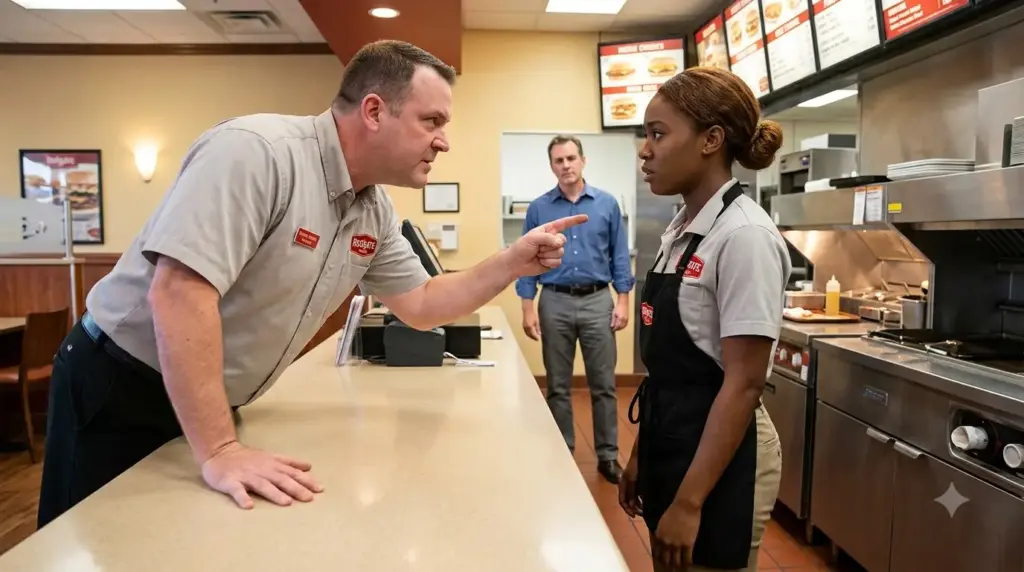
There was no lightness in their steps, no humor in their interactions, only compliance. Simon Aubrey remained close to the counter, standing just far enough away, not to be in the way, but close enough to cast a shadow figuratively and almost literally over every staff member who walked within 10 ft of him. He didn’t speak. He didn’t need to. His posture alone was enough.
Arms folded, chin tilted just slightly upward, eyes, scanning cataloging, waiting for someone to falter. Arnold watched him with the quiet precision of a man who had dealt with power misused before. Simon wasn’t managing. He was policing. And the staff, whether consciously or not, responded, as people do, under surveillance with caution, calculation, and fear.
A young man near the fry station fumbled briefly with a basket, nearly tipping it before catching it at the last second. No one commented, but Arnold saw how the boy’s hands tensed afterward, his motion slower, more rigid like a machine resetting after a glitch. Another employee, a young woman near the drink dispenser, walked carefully as she carried a stack of clean cups, her eyes darting toward Simon, even though he hadn’t moved. The tension wasn’t about doing a good job. It was about not making a mistake in front of him.
Vera, meanwhile, had returned to the register, her expression fixed into a kind of neutral efficiency that at first glance looked like professionalism. But Arnold saw something different. Her shoulders were set too high. Her voice when she called out an order number was steady but not relaxed. She moved quickly between tasks, but each gesture was calculated.
She wasn’t working. She was performing under pressure every moment measured and watched. Arnold continued watching, keeping his breathing calm and posture relaxed. He wasn’t just looking for problems. He was reading patterns.