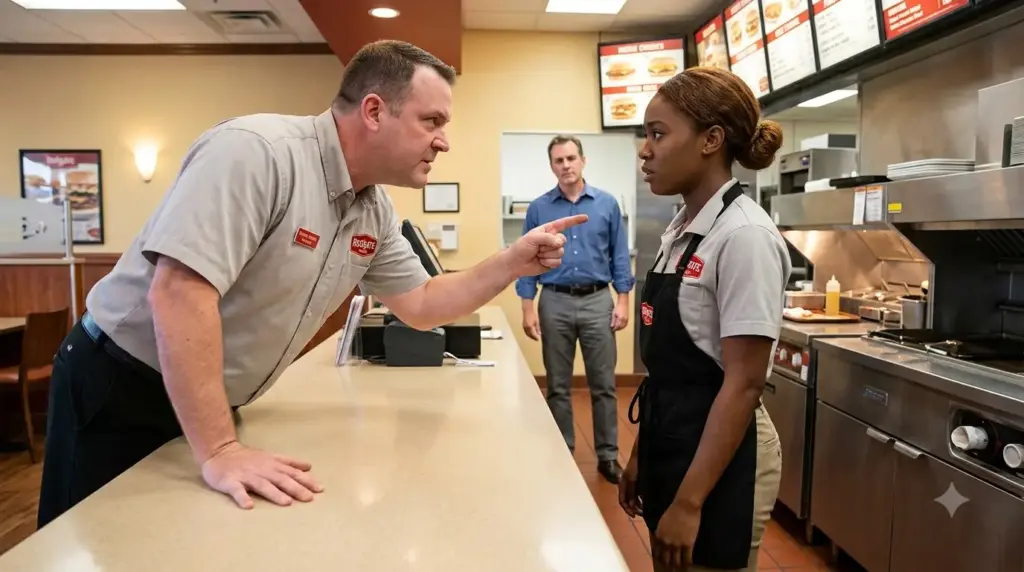
In a well-run store, you could feel energy cycling naturally. Employees joked with one another, helped each other out, picked up each other’s slack without fear of reprimand. There was a balance, but here there was none. It was a closed system of survival. No one spoke unless necessary.
No one lingered longer than they had to. Tasks were completed quickly and with the sole focus of avoiding scrutiny. The entire environment ran on fear. Then something small but telling happened. Vera was stocking lids at the end of the counter, her hands moving fast as the lunch line grew.
In her rush, one of the stacks tipped. A dozen plastic lids clattered onto the floor, rolling slightly before settling. It wasn’t loud. It wasn’t a disaster, but the entire team reacted like someone had knocked over a stack of glass. Vera froze for half a second before kneeling quickly to retrieve them.
Her head was down, hair falling over her cheek, hands moving faster than needed. No one helped. Not a single employee moved toward her, not even the cashier two steps away. They all kept their focus elsewhere as if helping her might implicate them. Simon turned slowly.
He didn’t speak. He didn’t need to. His eyes locked on Vera expression unreadable, but pointed. Arnold saw her glance up, then away her movements even faster now. She placed the recovered lids back into their bin, adjusted the stack, and stood as if nothing had happened.
Simon didn’t yell. He didn’t shake his head. He just stared for a moment longer, then turned back toward the kitchen door. The message had been received. Arnold’s stomach turned.
This wasn’t just control. This was conditioning, and it had worked. No one had questioned anything. No one had comforted Vera. No one had broken rank.
That spoke louder than any outburst. Moments later, Simon moved behind the register. Arnold watched closely as he typed a few keys on the terminal, then opened the cash drawer. From the outside, it looked like a routine check, something any manager might do. But Simon’s hand dipped into the drawer, lingered, and when it withdrew, it did so with a folded group of bills.
He didn’t count them. He didn’t write anything down. He simply closed the drawer with a smooth, practiced motion and tucked the money into the side pocket of his apron before stepping back. It had been quick, discreet, but Arnold saw it. And the way Simon moved afterward with total calm made it clear this wasn’t a one-time thing.
This was routine. Arnold’s jaw tightened, not visibly, but enough that his back mers pressed together. He didn’t react outwardly, but inside his mind shifted gears. This wasn’t just about toxic leadership anymore. This was theft, plain and simple.
And if Simon felt confident enough to do it in broad daylight in front of customers, then he had either gotten sloppy or believed no one would ever question him. Both were dangerous, but one was far more telling. He wasn’t afraid of being caught. Arnold reached for his drink, lifted it, and took a slow sip. He needed to think, not just about what he had seen, but what it meant.
One manager skimming from the till was bad. But this kind of confidence suggested something else. Protection or at the very least negligence from someone higher up. It wasn’t just the act, it was the comfort with which it was done. He looked around again at the other employees at Vera back at the register.
Her expression hadn’t changed. But now Arnold wondered if she had seen it too, if she had watched him do it before, if she had said anything, if she had paid for it. He couldn’t ask her yet. Not here. Not like this.
She didn’t know who he was. Not really. She thought he was just another customer, and for now, that was how it needed to stay. Trust was fragile, especially in places like this, especially when fear had been the rule for so long. Simon walked past Vera again slowly on his way back to the office.
Arnold noticed the way she stiffened slightly when she saw him coming just enough to be noticed by someone paying attention. She didn’t stop working. She didn’t flinch, but her fingers hesitated for half a second on the touchcreen. Just long enough for Arnold to see it. Simon didn’t speak to her.
He didn’t even look directly at her, but the air shifted again. The temperature metaphorically dropped a degree. Arnold could feel it. The silence after Simon disappeared into his office was heavy, but not from peace. From relief, Arnold turned his gaze back to Mason, who was now playing with a stray fry, dragging it in circles through the last of his ketchup.
The boy was happy, unbothered. But Arnold’s focus remained divided. Something here was wrong. Something deeper than just one bad employee. And if he was going to do something about it, he needed to know just how far this went.
This wasn’t a single incident. This was culture. And culture didn’t change with warnings. It changed when people were no longer afraid to speak. But first, they needed to know someone was listening.
Arnold had always believed in leading from within. Today, that belief was being tested, and he intended to pass. Quietly, patiently, relentlessly, Arnold waited until the lunch rush began to taper off before making his move. The noise in the dining area had softened, replaced by the low clinks of trays being cleared, and the quiet murmur of conversations from scattered tables. He had watched enough by now to feel certain of a few things.