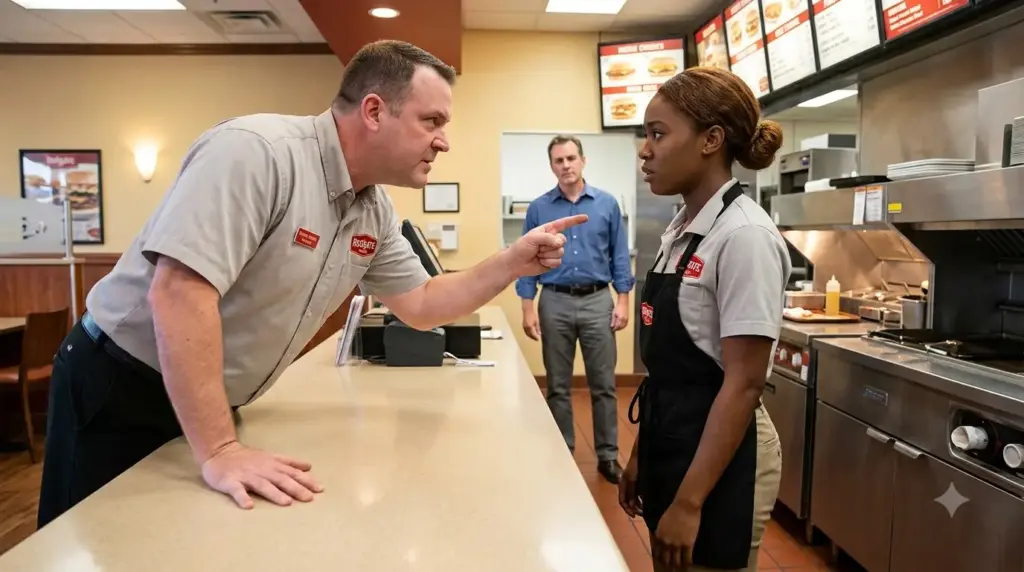
He asked once she said anonymously. Or I thought it was. A week later, I was off the schedule for 4 days. Her voice cracked just slightly on that last word. She looked down at her hands.
I used to think I was just unlucky. Then I stopped thinking that. Arnold felt something tighten in his chest. He knew that feeling. That shift from self-doubt to hard truth.
The moment when you stop asking what you did wrong and start seeing what’s really being done to you. You didn’t do anything wrong, he said. Vera gave him a long tired look. That doesn’t matter here. Arnold wanted to tell her it did.
He wanted to promise change, but she wasn’t looking for a promise. She was watching to see if he understood what it cost just to speak like this. If I wanted to help, he asked carefully. What would that look like to you? Vera shook her head slowly.
I don’t know. Nobody ever stays around long enough to ask that. Arnold nodded. Well, maybe it’s time someone did. Before either of them could say more, a sharp voice called from the back.
Vera, front line. She stiffened. Her eyes flicked toward the kitchen, then back to Arnold. Her voice dropped to a whisper. “If you’re serious, don’t say anything yet.
Just watch. See what happens next. ” Then she turned, straightened her shoulders, and walked back toward the counter with the same careful precision as before. Her face unreadable again. But something had shifted. Not in her job, not in her role, in her eyes.
She wasn’t alone anymore. And Arnold had no intention of letting that change. Arnold sat alone at the small desk in his hotel room. The soft hum of the mini fridge and the distant murmur of traffic outside the window, providing the only ambient noise. The glow from his laptop cast a pale light across his face, catching the tension around his eyes that hadn’t eased since he left the restaurant hours earlier.
Mason had long since fallen asleep, curled up with a blanket on the bed behind him, the innocence of childhood resting in stark contrast to the weight that pressed on Arnold’s chest. He stared at the login page of Redgate’s internal operations portal, his fingers hovering over the keyboard. This wasn’t how most CEOs spent their Saturday nights, but Arnold didn’t care. He wasn’t here to delegate. He was here to know.
Once logged in, the interface greeted him with familiar tabs, sales reports, payroll, inventory usage, scheduling. He didn’t need a tutorial. He had built this system, not the code, but the structure. How data flowed, how anomalies could be tracked, how truth could be uncovered if you knew where to look. He started with the Charlotte location, the same store where Simon was still working unchecked.
Opening the sales reports from the past 6 months, he noted immediately that the total revenue for that branch consistently fell 15 to 20% below stores of similar size and traffic. That by itself wasn’t enough to raise flags. There could be a dozen local factors. But when paired with the inventory usage logs, the numbers stopped making sense. The quantities of beef buns, fries, and condiments used matched the average for better performing stores, meaning food was moving.
It was being cooked, served, and consumed, but the money, it wasn’t being recorded. Arnold clicked over to the cash handling reports. Most stores showed digital transactions making up roughly 70% of daily sales with cash filling the rest. But in Charlotte, cash accounted for nearly half of the transactions. Yet, even with higher cash sales, the end of day reconciliations reported no significant discrepancies.
That was suspicious, especially for a location where he had personally witnessed Simon pocketing bills without a single keystroke. He moved on to payroll records. This was where things tightened. Employee clockins and clockouts were timestamped automatically. And in theory, those hours fed directly into the weekly payroll.
But in Charlotte, several employees, Vera among them, had a consistent pattern. They clocked in for full shifts, but their paid hours were trimmed by small manual adjustments. An hour here, 90 minutes there. Not enough to spark outrage individually, but collectively across weeks, it became theft. Arnold pulled Vera’s time log side by side with her payubs.
He traced the discrepancies, saw how the system listed her scheduled shift as 7 hours her clockin matched that exactly, but the paid line showed 5 hours and 45 minutes. Every week, the same story. And it wasn’t just her. Two other names popped up repeatedly, both part-time staff who hadn’t been present when he visited. Maybe they had already quit.
Maybe they had been pushed out. A growing knot settled deeper into his gut. He clicked through to the operations expense logs. Another red flag, a category labeled operational adjustments. On paper, it looked harmless.
An umbrella entry for minor expenditures not accounted for elsewhere. But here, it was being used far too frequently. One entry cited equipment recalibration. Another unexpected loss, another simply adjustment. None had documentation, no invoice, no manager notes, and all had been approved by Simon.
Arnold sat back, exhaled through his nose, then leaned in again. He sorted the adjustment entries by date, and cross- referenced them with Simon’s schedule. Every time Simon managed a closing shift, an adjustment appeared. Some as small as $30, others over 200. Always vague, always cashbased.
It was systematic, not sloppy, not impulsive. It was structured deliberate and buried just deep enough to pass unnoticed unless someone was looking for it. And now Arnold was looking. He closed the Charlotte tab and opened a second location one in Raleigh. Simon had worked there 12 months earlier.