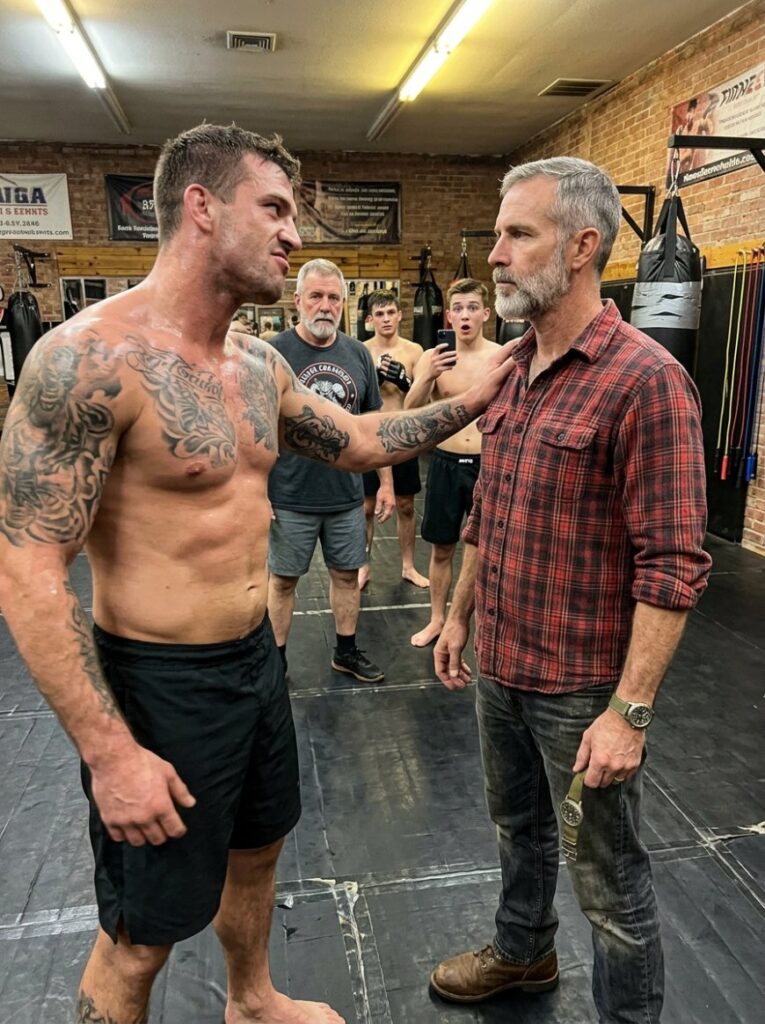

The coach’s face changed before anyone else in the gym understood what was happening.
One moment he had been standing near the cage with his arms folded, amused by the sight of a gray-haired carpenter confronting four younger men.
The next, the amusement vanished.
His shoulders lowered.
His eyes narrowed.
And he stared at me as though somebody had suddenly turned on a light inside an old memory.
“Daniel Mercer?” he said.
Dustin glanced at him.
“What?”
The coach ignored him.
He took one slow step toward me.
“You’re Daniel Mercer?”
I kept my eyes on Dustin.
“That’s what my birth certificate says.”
The coach breathed out through his nose.
For the first time since I had entered the gym, nobody laughed.
Dustin looked from him to me.
“You know this guy?”
The coach’s jaw tightened.
“I know the name.”
Dustin snorted.
“So what? He’s some retired jarhead?”
The coach spun toward him.
“Shut your mouth.”
That surprised everyone.
Especially Dustin.
Until that moment, Dustin had owned the room.
He was the undefeated local fighter.
The nephew of a man everybody in that part of town knew not to cross.
He had sponsors.
Money.
Friends in places that mattered.
He carried himself like consequences were things that happened to other people.
But now his own coach was looking nervous.
I had seen that reaction before.
Years earlier.
Different building.
Different men.
Same eyes.
Men usually became frightened when the story they had told themselves about a situation suddenly stopped matching reality.
I hadn’t driven there looking for a fight.
That mattered to me.
Marcy mattered more.
My daughter was lying in an emergency room with a concussion, bruised ribs, and enough fear inside her that she had looked doctors in the eye and told them she had fallen down a staircase.
I knew what fear did to people.
I had spent enough years around young Marines to recognize it.
Fear made strong men freeze.
It made honest people lie.
It made good people protect the person hurting them because the unknown consequence of speaking felt worse than the pain they already understood.
That was what Dustin had done to my daughter.
He had convinced her that silence was safer.
I looked at him.
“You’re going to stay away from Marcy.”
He recovered enough of his confidence to smile.
“There it is.”
He spread his arms.
“The dad speech.”
Nobody joined him.
He noticed.
That irritated him.
“You drove all the way down here to tell me who I can date?”
“No.”
I stepped closer.
“I came to tell you the relationship is over.”
His face hardened.
“That’s not your decision.”
“You made it her decision when you sent her to the ER.”
Dustin’s mouth twitched.
“She fell.”
“Don’t.”
One word.
Nothing loud about it.
But fifteen years teaching combatives had taught me something most men never learned.
Volume was rarely authority.
Control was.
Dustin’s coach knew that.
I could see it in the way he watched my feet instead of my face.
Dustin, however, kept pushing.
“She’s clumsy,” he said. “Always has been.”
I felt something dangerous move inside me.
Not anger.
Anger burns hot.
This was colder.
I thought about Marcy at seven years old, sitting on my shoulders at an air show while she covered my eyes with both hands and laughed because she thought she could steer me.
I thought about her first dance recital.
Her high school graduation.
The afternoon she called me from college because her tire was flat and she had no idea how to change it.
I had spent years teaching Marines how to survive violence.
And somehow I had failed to see that my own daughter had been learning how to survive it alone.
I forced my hands to stay loose.
“I’m going to give you one chance to make a smart decision.”
Dustin tilted his head.
“And if I don’t?”
“You stay away from her anyway.”
His smile returned.
“My uncle owns half the people who matter in this city.”
“That supposed to impress me?”
“It should.”
Dustin came closer until we were less than three feet apart.
“You think one hospital visit gives you the right to walk into my gym and make threats?”
“I haven’t threatened you.”
“Not yet.”
“Correct.”
His eyes flickered.
A small reaction.
But I caught it.
So did his coach.
Dustin glanced over his shoulder.
“Why are you just standing there?”
The coach said nothing.
Dustin pointed at three men near the cage.
“You. Marcus. Troy.”
The men straightened.
“Get him out.”
None of them moved immediately.
That embarrassed Dustin.
“Did you hear me?”
The largest one, Marcus, looked at the coach.
The coach finally spoke.
“I wouldn’t.”
Dustin stared at him.
“What is wrong with you?”
The coach kept his gaze on me.
“At Pendleton, there used to be an instructor people talked about. Older staff sergeant. Later gunnery sergeant. They called him Mercer.”
Dustin rolled his eyes.
“Wonderful. He taught push-ups.”
The coach ignored him.
“He ran close-combat evaluation for units rotating through advanced training. Force Recon guys. Scout snipers. Raiders.”
My eyes remained on Dustin.
The coach continued.
“There was a saying about him.”
I almost smiled.
I remembered the saying.
I had hated it.
The coach looked at Dustin.
“If Mercer takes off his watch, walk away.”
Every eye in the room dropped toward my left wrist.
My watch was still there.
Dustin barked out a laugh.
“You people are unbelievable.”
Then he slapped my shoulder.
It wasn’t hard.
It wasn’t meant to hurt.
It was meant to humiliate.
That was mistake number one.
I looked down at his hand.
He left it there.
Mistake number two.
“Take your hand off me.”
Dustin leaned closer.
“Make me.”
I could have broken his wrist.
Instead, I trapped his thumb, rotated his hand, stepped outside his balance, and guided him downward.
To everyone watching, it probably looked almost gentle.





