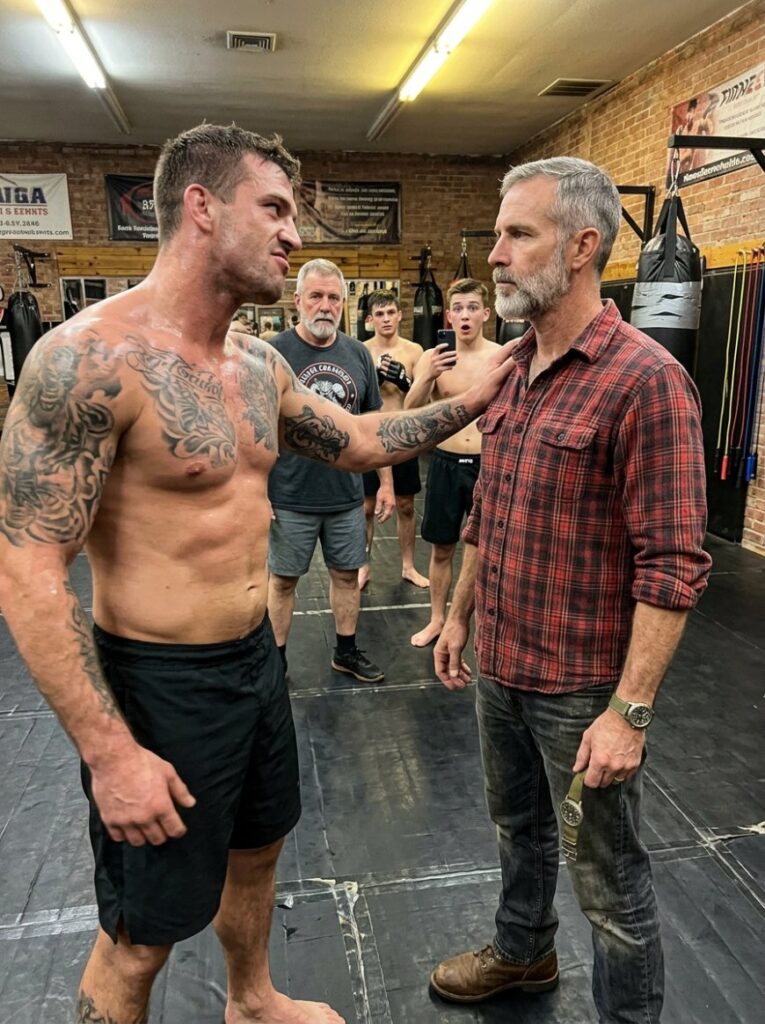
One second Dustin was standing.
The next, his cheek was pressed against the padded edge of the cage and his arm was immobilized behind him.
He gasped.
I applied no more pressure than necessary.
“Pain?” I asked.
He grunted.
“Answer.”
“Yes.”
“Then stop resisting.”
His body immediately relaxed.
I released him and stepped away.
The entire exchange lasted maybe three seconds.
Dustin spun around, face burning red.
“You son of a—”
The coach grabbed him.
“Enough!”
Dustin shoved him away.
“You work for me!”
“No,” the coach said. “Your uncle owns the building. That’s different.”
The sentence hit harder than any punch.
Dustin stared at him.
I reached into my jacket.
Three men instantly moved.
I stopped.
“Easy.”
I slowly pulled out my phone.
“No weapon.”
I unlocked the screen.
Dustin frowned.
“What’s that supposed to be?”
“Your problem.”
I pressed play.
For two seconds there was only static.
Then Marcy’s voice came through the speaker.
Soft.
Trembling.
Dustin, stop.
My chest tightened.
Then his voice followed.
Louder.
Clear.
If you leave me, you’re not just leaving me. You’re embarrassing my family.
Marcy answered.
I just want to go home.
Then Dustin again.
You go anywhere, my uncle gets involved.
Silence.
Then Marcy.
Why are you doing this?
His answer filled the gym.
Because you still think someone can protect you.
The recording continued.
Your father? That old man couldn’t protect himself.
Nobody spoke.
Dustin’s face had gone pale.
My wife had found the recording on Marcy’s phone at the hospital while trying to contact one of her friends.
Marcy had apparently started recording during an argument several nights earlier.
Maybe she planned to use it.
Maybe she wanted proof for herself.
Maybe she simply wanted someone to know the truth if something happened.
That thought had nearly broken me.
But there was more.
On the recording, Dustin’s voice became quieter.
If you talk to police, I make one call. Your father loses his business. Your mother gets followed. Maybe somebody makes a mistake driving home one night. You understand me?
I stopped the recording.
Dustin looked around.
His friends no longer looked impressed.
The coach had gone completely still.
“That’s illegal,” Dustin said.
I almost laughed.
“Recording laws are what you’re worried about?”
“You can’t use that.”
“You should probably let lawyers decide.”
His eyes sharpened.
“You gave this to police?”
I didn’t answer.
That frightened him more than yes would have.
He moved toward me.
“You gave that to police?”
I slipped the phone into my pocket.
“Stay away from my daughter.”
“You think you can destroy me?”
“I think you’ve done a good job of that yourself.”
Dustin shoved me.
Hard this time.
I stepped backward once.
The room tightened.
His coach swore under his breath.
I looked at Dustin.
“You get one.”
“What?”
“One shove.”
He laughed, but sweat had appeared along his hairline.
“And if I give you two?”
“Don’t.”
Dustin threw a right hand.
Fast.
He really was trained.
I’ll give him that.
He was strong, quick, and technically better than most men who believed they knew how to fight.
But competition creates habits.
There are rules inside a cage.
There are expectations.
Patterns.
A trained fighter often expects another fighter to play the same game.
I didn’t.
I slipped outside his punch, controlled his elbow, redirected him past me, and let his own momentum carry him into the cage padding.
He bounced off.
His friends stepped forward.
I raised one hand.
“Gentlemen.”
They stopped.
Not because they were afraid of me.
Not yet.
Because they were uncertain.
Uncertainty is powerful.
A man who thinks he can win is dangerous.
A man who isn’t sure whether he has misunderstood the entire situation becomes cautious.
Dustin didn’t have that instinct.
He charged again.
The coach caught him around the chest.
“Stop!”
“Get off me!”
“You’re making it worse!”
“I said get off me!”
Dustin ripped himself free.
Then headlights swept across the front windows.
Everyone turned.
Three black SUVs entered the parking lot.
Dustin froze.
Then a slow smile crossed his face.
“There.”
His confidence returned instantly.
“My uncle.”
The vehicles parked in a line.
Doors opened.
Men in dark jackets stepped out.
Six.
Then eight.
One remained beside each vehicle while the others approached the gym.
Dustin pointed toward the entrance.
“You should’ve gone to the hospital, Grandpa.”
The coach moved toward the window.
Something about his expression bothered me.
“What?” I asked.
He didn’t answer.
The men outside weren’t dressed like local muscle.
They moved too cleanly.
Too evenly spaced.
Nobody smoked.
Nobody talked.
Two watched the parking lot while four approached the entrance.
Professional spacing.
Professional posture.
Then a fourth vehicle turned into the lot.
Black sedan.
Government plates.
My stomach tightened.
Dustin grinned.
“Looks like my uncle brought friends.”
“No,” I said.
Dustin looked at me.
“No what?”
“Those aren’t his people.”
The sedan stopped.
The rear door opened.
A tall man stepped out.
Mid-sixties.
Silver hair.
Dark overcoat.
He walked with a slight stiffness in his left leg.
I recognized the limp before I recognized his face.
Suddenly I wasn’t standing inside an MMA gym.
I was thirty-nine again.
Dust.
Heat.
Helicopter rotors.
A young captain bleeding through his uniform while I dragged him behind a concrete barrier and screamed at two Marines to return fire.
Seventeen years disappeared in a second.
The tall man approached the doors.
The coach whispered, “Colonel?”
Technically, he had been Colonel Adrian Cross when he retired.
Before that, Major Cross.
Before that, Captain Cross.
And once, a long time ago, the man whose life I had saved when a training assignment became something far uglier overseas.
The gym doors opened.
Cross entered.
The men with him remained outside.
He looked around.
Then his eyes found me.
For several seconds, neither of us spoke.
Finally, he smiled.





