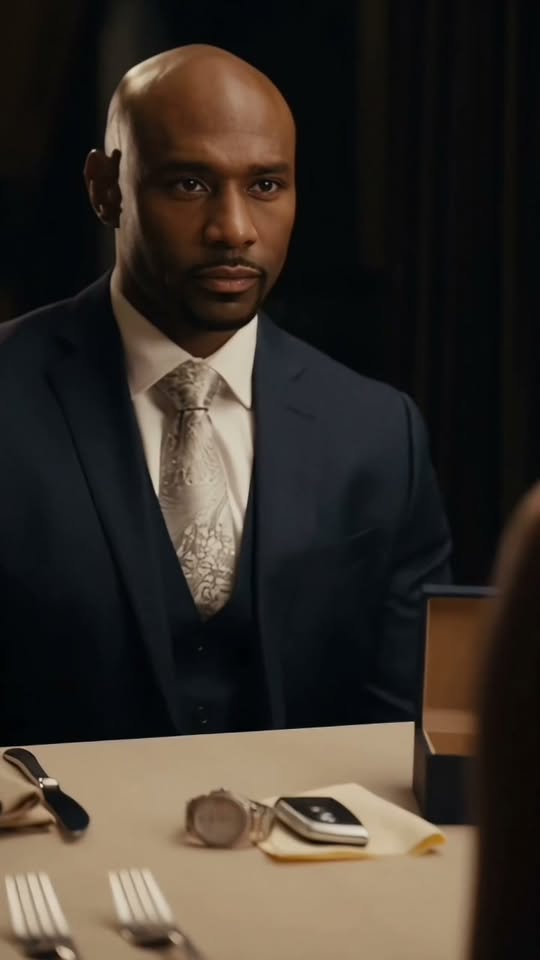
The glass-walled elevator of the Aurelia Tower moved with a sickening, liquid smoothness, carving through forty-five floors of obsidian air until the grid of the city flattened into a vast constellation of cold neon. Inside the cabin, Vanessa adjusted the fall of her burgundy gown. The sequins hissed against the velvet lining of her wrap, tiny teeth of glass catching the recessed LEDs and scattering crimson sparks across the mirror.
She checked her hair: neat, miniature braids pulled back into an architectural bun at the crown of her head, tight enough to stretch her high cheekbones into predatory sharpness. Her lips, painted in a neutral, lacquered gloss, were pulled thin against her teeth.
Across from her, standing with his hands folded loosely over the silver buckle of his belt, Marcus Vance watched her reflection rather than her face.
He wore a bespoke three-piece suit cut from English wool so dark it drank the light—deep navy, double-vented, draped over a chest and shoulders built from twenty years of early-morning discipline. His scalp was clean-shaven, his beard trimmed along the jawline with surgical symmetry, his eyes completely still. He had the unsettling stillness of deep water in a stone reservoir. A man who occupied space without having to announce his mass.
“You’re staring,” Vanessa said, not turning around. She touched her diamond studs—small, safe gifts from her own mother, not the kind of jewelry she believed a woman of her caliber ought to be wearing to the highest dining room in the tri-state area.
“I’m admiring,” Marcus replied. His voice was a low baritone that sat in his chest, unbothered by the lift’s altitude change. “It’s been fourteen months, Vanessa. I know how much you wanted tonight to matter.”
She turned then, letting her gaze sweep over him from the knot of his silver silk tie to the mirror-polished leather of his Oxford shoes. He looked wealthy, yes, but in that quiet, understated way that drove her insane. Marcus didn’t wear visible logos. He drove a ten-year-old diesel truck to his construction sites, carried his blueprints in bruised canvas rolls, and spent his weekends inspecting pouring concrete in Newark or negotiating dry-dock leases in Elizabeth. He told her he was a partner in an infrastructure logistics firm. When she asked for numbers, he spoke in margins, percentages, and bonded debt—dry, bloodless words that didn’t buy penthouse terraces or turn heads at charity galas.
“It matters because of who is sitting three tables away,” Vanessa whispered, her voice tightening as the brass indicator chimed for the penthouse level. “Julian Cross is here tonight. The acquisitions director for the Vantage Group. If he sees me with someone who looks like an assistant project manager, the entire pitch for my agency’s summer contract is dead before we hit dessert.”
“Julian Cross is a vulture who buys distressed paper from bankrupt developers,” Marcus said mildly as the elevator doors whispered open into the foyer of L’Hiver. “You don’t need to perform for him.”
“In my world, Marcus, performance is equity,” she snapped, stepping out before he could offer his arm. “Try to remember that before you order house wine.”
The foyer smelled of white lilies, melted beeswax, and old cognac. Floor-to-ceiling sheets of structural glass framed an unbroken panorama of the harbor, where container ships moved through the black water like creeping embers. Beneath the chandeliers—cascades of smoky hand-blown glass that mimicked frozen rain—the room moved to the hushed clatter of Christofle silver against Limoges porcelain.
The maître d’ bowed, his eyes lingering on the embroidery of Marcus’s silver tie for half a beat longer than was strictly professional, before leading them to the south terrace corner table. It was the best table in the room, perched above the drop, isolated from the center aisle by a screen of living bamboo and dark marble.
Vanessa slid onto the banquette, the burgundy sequins whispering against the cream leather. She scanned the dining room immediately.
There, sixty feet away near the central hearth, sat Julian Cross, surrounded by two junior partners in razor-thin Italian wool and a woman whose wrist bore three stacked Cartier Love bangles that clicked together like ice cubes whenever she lifted her champagne flute. Cross looked up, his pale eyes catching Vanessa’s. He nodded—a curt, appraising flick of the chin that acknowledged her presence while simultaneously pricing her out of the room.
Vanessa felt a hot prickle of shame burn behind her ears. She set her clutch on the tablecloth, her fingers digging into the calfskin.
“He’s watching,” she murmured, leaning across the candle. “Marcus, please tell me you didn’t leave your jacket in the cloakroom. It’s the only thing you’re wearing that looks like it cost more than a mortgage payment.”
Marcus sat down with slow deliberation. He did not look at Julian Cross. He did not look at the wine list the sommelier placed at his elbow with two hands. He simply unbuttoned the bottom button of his waistcoat, unfolded his linen napkin, and placed it across his lap.
“The jacket is fine where it is,” Marcus said.
A waiter appeared, ghost-like, pouring chilled sparkling water into crystal goblets. Vanessa barely waited for the boy to step away before leaning forward again, her manicured nails tapping an erratic, nervous rhythm on the tablecloth.
“Where is it?” she asked.
Marcus looked up, his dark eyes level. “Where is what?”
“Don’t play with me, Marcus. Not tonight. Not after the week I’ve had with the bank.” Her voice had lost its social gloss, dropping into that sharp, corrosive frequency she usually reserved for subordinates who missed copy deadlines. “You said you had something for me. You said tonight was the anniversary that would change the trajectory of everything. I told my mother. I told Candice. If you brought me up here to give me another lecture on diversified index funds while Julian Cross watches me drink tap water, I swear to God I will get up and leave.”





