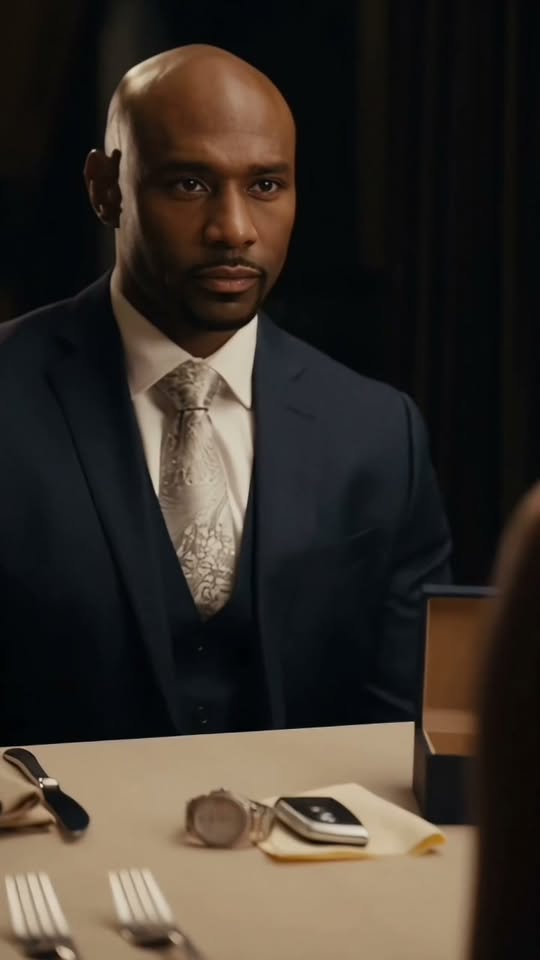
When he finished, he did not blot the signature. He let the ink stand wet, reflecting the gray light of the midday sky like a pool of ditch water.
He laid the pen down on the bog oak.
“It is done, Maya,” he said.
Maya did not look at the signature. She did not reach for the document. She looked at Julian’s face—at the deep, yellowing bags beneath his eyes, the hollows of his temples, the faint blue trace of veins beneath his paper-thin skin.
“It is not done, Julian,” she said. “It is simply recorded.”
She turned and walked toward the private elevator. Reynolds gathered the heavy documents, his old arms straining under the weight of the buckram folders, his head bowed as he followed her across the parquet.
At the threshold of the elevator, Maya paused. She did not look back at Marcus, who remained standing against the window, his head in his hands, his shoulders shaking with the silent, dry sobs of a man whose reality had dissolved between his fingers.
She looked only at Julian.
“The house in Dornoch is being cleared this afternoon,” she said. “The keys will be handed to the parish council at five o’clock. They intend to use the grounds for an extension of the municipal cemetery.”
The elevator doors slid shut, the heavy rubber seals meeting with that soft, final hiss of escaping air.
Chapter VI: The Low Water Mark
The room was very quiet now.
The rain had finally turned to snow—heavy, wet flakes that plastered themselves against the acoustic glass of the terrace before melting into long, gray tears that slid toward the granite sills forty stories below.
Marcus had not moved from the window. His forehead was pressed against the cold glass, his breath fogging the pane in small, irregular circles that shrank and expanded with his labored breathing.
“What do we do now, Julian?” he whispered. His voice was hollow, stripped of everything that had made him Marcus Vance. “Julian? What do we do?”
Julian did not answer.
He sat behind the bog-oak desk, his hands resting flat upon the blotting paper on either side of the builder’s plate from the Cairngorm. The brass was cold, but beneath his fingers, it felt remarkably smooth—polished by thirty years of salt water, shell-gravel, and the slow, indifferent work of the tides.
He reached into the top drawer of his desk.
There was no gun there. Julian Vance had always detested the vulgarity of firearms; a pistol was an instrument for men who lacked the patience to let their mistakes mature into disasters.
Instead, he brought out a small, amber glass medicine bottle with a ground-glass stopper, tied with a piece of waxed twine that bore the label of an apothecary in Inverness.
The label was dated October 14, 1982.
It was full to the neck with a dark, oily liquid that smelled faintly of bitter almonds and damp earth.
Julian untied the twine with his thumb, his movements methodical, neat, unhurried. He set the stopper down beside his fountain pen.
He looked at Marcus.
“You should go downstairs, Marcus,” Julian said. His voice was surprisingly gentle, the voice he had used thirty years ago when he explained to his young nephew why they could not spend the summer in the Highlands because the business required their presence in the south. “The receivers will be at the front desk in ten minutes. If you are still in the building, they will take your watch before you reach the street.”
Marcus slowly turned around. His face was gray, the skin around his eyes bruised and sunken. He looked at the amber bottle on the desk, then at Julian’s hands.
He did not speak. He did not scream. He did not try to reach for the bottle.
He simply walked across the library, his expensive shoes making a wet, sticky sound on the parquet where the melted sleet from Maya’s boots had pooled, and pushed open the heavy mahogany doors that led to the service corridor.
The door clicked shut behind him, the latch falling into the strike with a clean, well-oiled click that was almost polite.
Julian was alone.
He picked up the amber bottle. He held it up to the gray light from the terrace, watching the small air bubble rise through the viscous, dark syrup.
Thirty-two men.
He had never known their faces, except for the boy Archie, whose photograph—a cheap tintype taken in a studio on the Broomielaw—he had kept in his pocketbook for three weeks after the sinking before burning it in the grate of his club in Edinburgh. The boy had had large, protuberant ears and a cowlick that refused to stay down under the grease of his engineer’s cap.
Julian brought the rim of the glass bottle to his lips.
The liquid was cold. It did not burn the tongue; it had a strange, sweetish, metallic taste that reminded him instantly of the water that used to collect in the bottom of the iron rainwater butt behind his grandmother’s house in Dornoch—water that had filtered through fifty feet of pine needles and rusted zinc before dripping into the dark.
He drank it in three long, even swallows.
He set the empty bottle down on the blotter, perfectly centered between the Montblanc pen and the brass plate of the Cairngorm.
He folded his hands over his stomach, leaned back into the deep leather cushions of his armchair, and closed his eyes.
Below him, through the floorboards, through the twelve inches of reinforced concrete and the steel trusses that held Vance Capital forty stories above the wet streets of Manhattan, the city continued its immense, indifferent movement: the yellow cabs splashing through the gutters on Fifth Avenue, the trains groaning through the dark tunnels under Park, the tickers chattering their five-digit codes into the fluorescent light of the trading pits.
Julian did not hear them.





