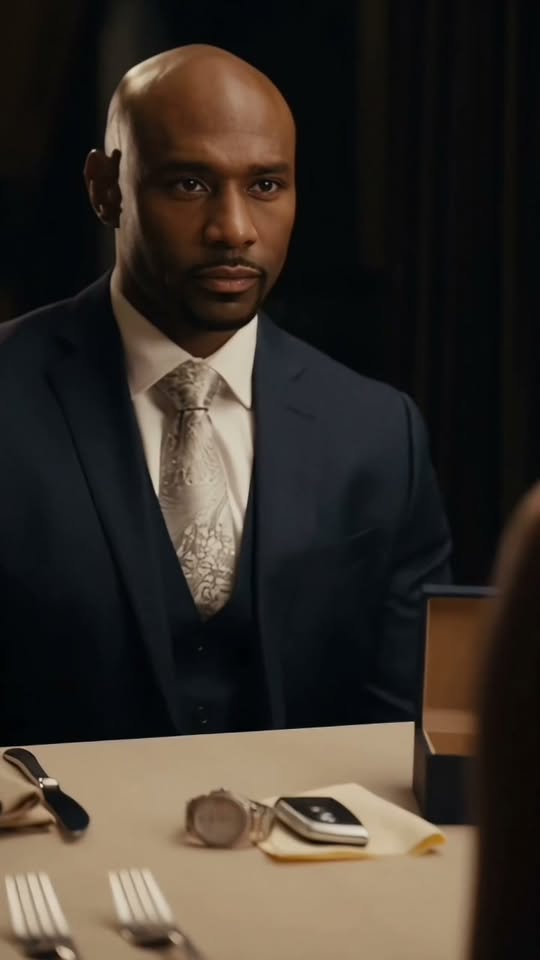
Maya turned toward him with slow, deliberate pity.
“You still don’t understand, do you, Marcus?” she said. “You think this is a settlement conference. You think we are here to divide the silver before the bailiffs arrive.”
She walked toward him, her leather boots clicking with rhythmic, terrifying precision against the herringbone parquet.
“There is no real estate, Marcus.”
Marcus blinked, his mouth opening slightly. “What are you talking about? The deeds are in the safe downstairs. The Bedford property alone was appraised at forty-two million last spring.”
“The deeds were pledged,” Arthur Reynolds said from behind the desk, his old hands trembling as he smoothed a legal document against his knee. “In nineteen-ninety-eight. Julian used them as secondary collateral for an indemnity policy issued by a captive insurer in Bermuda. A policy designed to protect the general partners against… maritime liabilities arising from prior operations.”
Marcus looked at Julian. Julian’s head was bowed, his chin resting against the silk knot of his cravat, his eyes closed.
“You pledged Bedford?” Marcus whispered. “You pledged my father’s trust assets?”
“Your father had no assets, Marcus,” Julian said without opening his eyes. “Your father was a clerk in the Glasgow office who spent his life signing bills of lading he was not permitted to read. When he died, he left four hundred pounds and seven suits of clothes that were too large for him. Everything you have had—the apartment on Fifth Avenue, the box at the Metropolitan Opera, the bespoke suits—was paid for out of the reserve fund established by the Cairngorm settlement. You have been living on the interest of thirty-two dead sailors since the day you were christened.”
Marcus swayed where he stood. He reached out to brace himself against the window pane, his fingers leaving greasy smudges on the immaculate glass.
“No,” he muttered. “No. I built Vance Capital. I did the trades. I made the firm seventy million dollars on the Argentine sovereign debt default alone.”
“With whose capital, Marcus?” Maya asked, stopping three feet from him. “Whose money was in the prime brokerage accounts when you placed the orders? It wasn’t yours. It wasn’t the pension funds’. It was the money that was paid to my father to keep him from screaming in the night about the sound of water coming through the coal bunkers.”
She reached out and took the lapel of his Savile Row coat between two fingers. She did not tug it; she simply held the wool, her touch light, dismissive, the way an auctioneer touches a damaged lot before passing it to the porter.
“You are not a financier, Marcus,” she said softly. “You are an inheritance that has run out of time. By five o’clock this evening, the United States Marshals will be at the door of your apartment on Seventy-Second Street with an order of replevin. Every watch in your collection, every painting on your walls, every shirt in your cedar closet belongs to the receiver for the North British and Hebridean Underwriters Association.”
Marcus looked down at her hand on his coat. A single bead of sweat had formed on his clean-shaven upper lip, catching the cold gray light from the park.
“And you?” he croaked. “What do you get out of this? You’ll be as ruined as the rest of us. The family name will be filth in every exchange from London to Tokyo.”
Maya smiled. It was the first time her lips had curved, and the expression was so cold, so ancient, that it seemed to belong to a stone carving on a medieval tomb rather than a living woman.
“The family name has been filth since eighteen-ninety-one, Marcus,” she said. “I am simply taking it out of circulation.”
Chapter V: The Settlement
The grandfather clock in the corner of the library began its slow, mechanical preparation for the noon chime. Inside the rosewood case, the heavy brass weights groaned as the gears engaged, releasing the escapement with a dry, rhythmic clack that sounded like an iron pawl falling into a ratchet.
Arthur Reynolds looked at his pocket watch, snapped the cover shut, and looked at Julian.
“The London court gave us until twelve-fifteen to file the consent order, Julian,” Reynolds said. “If you sign the confession of judgment, Maya has agreed that the criminal referral to the Lord Advocate will be stayed until the assets are fully distributed to the surviving kin.”
Julian opened his eyes. They were completely clear, the bloodshot haze of the past eighteen months replaced by a strange, terrible lucidity.
“The surviving kin,” Julian murmured. “There are three grandchildren in Greenock. One in New Zealand. And a woman in a nursing home in Kirkcaldy who believes she is still twenty-two years old and waiting for her brother to come home from the Baltic.”
“She will have her brother’s pension,” Maya said. “To the last pennyweight.”
Julian reached out. His fingers found the Montblanc Meisterstück. He unscrewed the cap with two slow turns, the threads clicking into place with that familiar, precision-machined whisper that had accompanied every major contract of his life.
He pulled the Somerset paper toward him.
“Where do I sign, Arthur?”
Reynolds stepped forward, his liver-spotted hands trembling as he turned the heavy buckram pages of the consent order until he reached the final execution clause. He pointed with a silver pencil to the clean line beneath the seal of the High Court of Admiralty.
“Here, Julian. As surviving managing partner of Vance & Sons, and as sole executor of the estate of Alistair Vance.”
Julian placed the nib on the line.
The ink was black, dense, and glossy against the cream cotton of the page. He wrote his name: Julian Alistair Vance. The letters were firm, upright, the flourishes minimal, the strokes even and disciplined, exactly as he had signed the bills of lading in the small, kerosene-lit office at the Greenock docks thirty-two years before.





