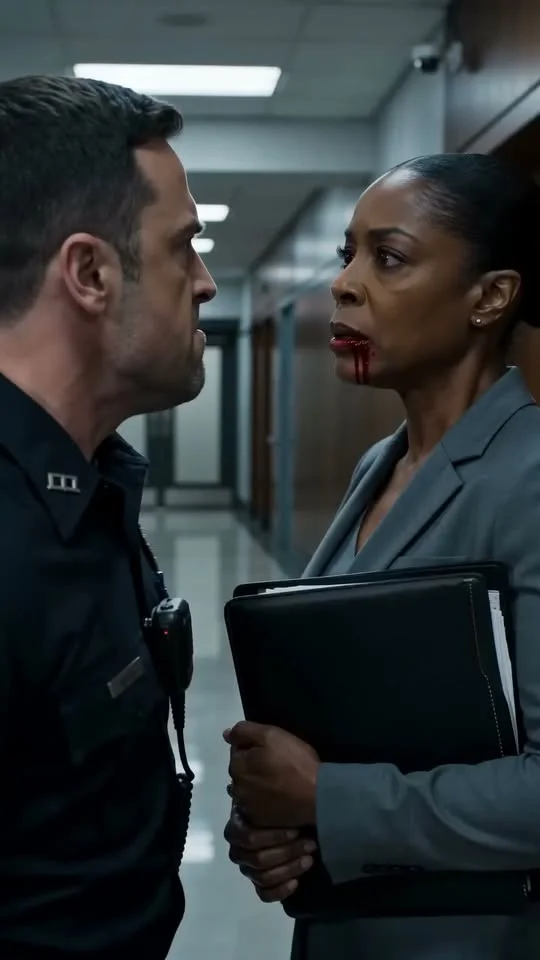
The slap cracked through a crowded courthouse hallway, and Officer Bradley Miller immediately reached for his handcuffs—as if the Black woman he had just struck were the criminal. Her briefcase lay open at her feet, legal papers spread across the floor, and blood marked the fingertips she pressed to her injured lip. What Miller didn’t realize was that a security camera above the western stairwell might have recorded the one thing his accusation could never survive: what actually happened.
“YOU’RE UNDER ARREST FOR ATTACKING AN OFFICER!” he shouted, turning the humiliation into a public spectacle. People nearby began gathering as he prepared to cuff her, while the woman in the charcoal suit stood amid her scattered papers, facing an officer determined to make his version of events the only one anyone heard.
CHAPTER 2 – The Mistake He Refused to Admit
Only minutes earlier, Miller had mistaken her for Maya Reynolds, a defendant he believed was trying to escape a courtroom. He had seen a woman without a judicial robe entering through the public entrance and decided he knew exactly who she was—and what she deserved.
There was a reason Judge Josephine Caldwell had come through that entrance: the courthouse’s private elevator had broken down. Without her robe, Miller decided she looked like someone who belonged in handcuffs.
“I’m Judge Caldwell,” she told him. Instead of checking her identification or reconsidering his mistake, he laughed.
When she offered to show him her ID, Miller grabbed her arm. She demanded that he justify his authority, while he acted as though her questions were proof that she needed to be controlled.
“Under what authority are you detaining me?” she demanded. Miller answered with contempt: “You people always think you can talk your way out of anything.”
Then Josephine pulled her arm away—and he struck her. In an instant, a mistaken identity became a blow, and the officer who had misjudged her accused her of the very kind of violence he had inflicted.
The hallway filled with witnesses, but Miller didn’t step back or admit he had made a mistake. He drew his handcuffs and announced that she had assaulted him first, presenting himself as the victim while Josephine’s injured lip and the papers at her feet told a different story.
That was when Senior Bailiff Thomas Gallagher came rushing around the corner. He saw the woman in the charcoal suit and recognized her immediately.
“YOUR HONOR?!”
Miller froze. For one brief moment, the truth of who stood before him was impossible to ignore—but recognition did not bring an apology.
“She assaulted me first!” Miller insisted. “I was defending myself!” He doubled down, trying to lock his story into place before the witnesses and the blood on Josephine’s fingertips could speak for themselves.
Josephine didn’t shout. She didn’t threaten him with her position, and she didn’t try to win the hallway by making a scene.
Instead, she looked up at the small security camera mounted above the western stairwell. Then she spoke to Gallagher in a quiet, controlled voice.
“Mr. Gallagher, I want that recording preserved. Every second of it.”
Gallagher reached for his radio. Josephine wasn’t asking anyone to take her word for what happened.
Then Gallagher turned toward Miller. His expression carried a warning the officer had not expected to hear.
“Officer, there’s something you need to understand about that camera.”
CHAPTER 3 – Every Second Preserved
Miller’s face changed. Whatever confidence had carried him from the mistaken identification to the slap, the accusation, and the handcuffs suddenly seemed less certain.
What had that camera captured? And if the recording showed what really happened in that hallway, how much of Miller’s story would remain standing when every second was played back?
The camera’s tiny red light blinked once.
“It doesn’t record to the courthouse system,” Gallagher said. “The feed is mirrored to the state judicial security office. You can’t erase it from this building.”
Miller’s hand stopped against the open loop of his handcuff case.
For the first time, the hallway became completely still. Even the elevator at the far end seemed to hold its mechanical breath. Josephine could hear a sheet of paper sliding across the polished floor in the draft from the stairwell.
Then Miller moved.
He lunged toward Josephine’s briefcase.
Gallagher stepped between them so quickly that Miller struck his shoulder instead. The older bailiff did not shove him back. He simply planted his shoes, lifted one hand, and spoke into his radio with the other.
“Judicial security emergency, western stairwell. Officer involved. Lock the control room and send a supervisor.”
“I was picking up her papers,” Miller said.
“No,” Josephine answered.
Her voice was quiet, but Miller looked at her as though she had raised it.
A woman standing near the drinking fountain lowered her phone. An elderly man who had watched from a bench stood with both palms pressed to his cane. A young clerk crouched to gather Josephine’s documents, then stopped when he noticed the red print of Miller’s fingers darkening on her forearm.
“Judge Caldwell,” Gallagher said, his voice softening, “please don’t touch anything else. Medical is coming.”
Josephine removed her fingers from her lip. Fresh blood gleamed against her skin.
Miller looked away.
Two judicial security officers arrived from the south corridor. Their steps were measured, but their eyes went first to Josephine’s face, then to the open handcuff case at Miller’s hip.
Lieutenant Elena Ruiz came behind them. She took in the scene without asking anyone to explain it in front of the crowd.
“Officer Miller, place your hands where I can see them.”
His mouth opened.
“Lieutenant, this is being blown out of proportion.”
“Your hands.”
He obeyed slowly.
Ruiz removed his service weapon and radio. When she reached for his handcuffs, he glanced at Josephine again, searching her face for panic, anger, or some opening he could use.
She gave him none.
“You know me,” he said to Ruiz. “You know I wouldn’t hit a judge.”





