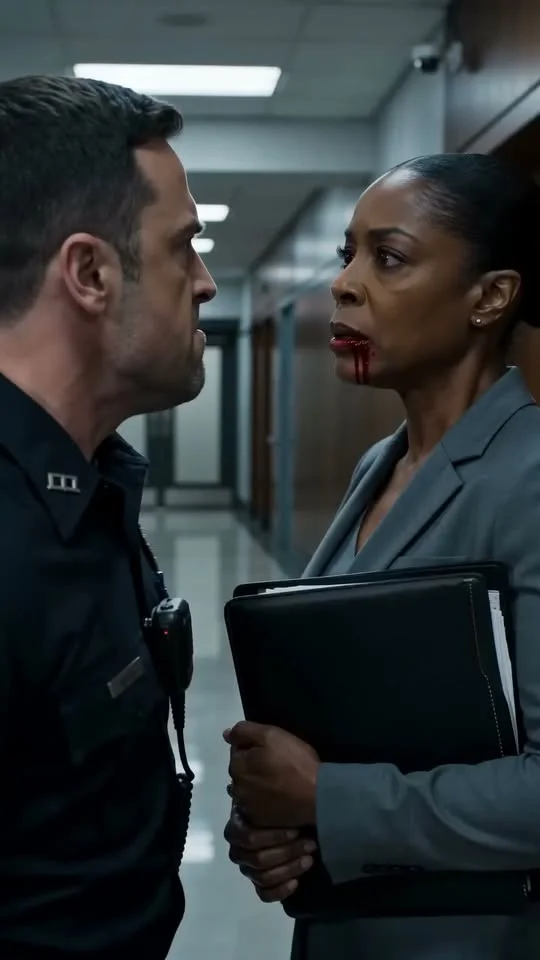
Four months before the assault, Maya’s second complaint had reached Josephine’s chambers. It had arrived without the correct cover sheet and under a misspelled case number. A clerk had placed it in a stack scheduled for disposal.
Josephine had found it there late one evening.
She did not remember Maya’s name. She remembered only the sentence underlined twice: There is no camera where he takes us because he knows nobody can prove what happens there.
Josephine had forwarded the letter to judicial security and ordered an emergency review of the blind spots. When the first funding request stalled, she had used discretionary courthouse safety funds to authorize one camera as a pilot.
The camera above the western stairwell had been installed the afternoon before Miller struck her.
Josephine stared at the date on the work order.
“Yesterday,” she whispered, remembering Gallagher’s warning in the hallway.
He nodded.
“The state connection went live at six that morning.”
She lifted Maya’s original letter with both hands.
“If she hadn’t written this—”
“There would have been witnesses,” Gallagher said.
“There were witnesses when he accused me. Some of them believed him before they believed their own eyes.”
Gallagher lowered himself into the chair across from her.
“The camera did not create the truth, Judge. It only stopped him from burying it.”
Josephine read the underlined sentence again. Maya had asked someone to care long before either of them knew how much would depend on the answer.
“Does she know?”
“No.”
Josephine reached for the telephone.
Maya arrived at chambers forty minutes later, damp from the rain and suspicious of Gallagher’s refusal to explain. She found Josephine standing beside the window with the letter in her hand.
“What happened?” Maya asked.
“Nothing bad.”
Maya did not relax.
Josephine crossed the room and offered her the page.
At first, Maya only frowned. Then she recognized her own handwriting.
“Where did you get this?”
“You sent it here.”
“I sent a lot of letters.”
“This one reached me.”
Maya read the work order beneath it. Her eyes moved across the installation date once, then returned to it.
“No,” she said.
Josephine waited.
Maya looked up, stunned.
“That camera was there because of me?”
“Yes.”
“But if you ordered it, then you knew about Miller.”
“I knew someone had reported being threatened in a blind corridor. Your complaint had become separated from the identifying documents, so I didn’t know who wrote it or which officer was involved. I should have demanded a broader investigation instead of only fixing the physical blind spot.”
Maya’s lips parted, but no words came.
Josephine’s voice roughened.
“I thought installing a camera was the beginning of an answer. I did not know I would be the one standing beneath it.”
Maya sat down hard in the nearest chair.
For months, she had carried the belief that Josephine’s title had saved them both—that the system had acted only because the wrong woman had been struck.
Now the order of events shifted.
A defendant’s discarded letter had moved a judge.
The judge’s quiet order had placed a camera in a dark corridor.
And when the officer raised his hand, Maya’s own refusal to remain silent had already prepared the witness he could not intimidate.
Maya pressed the letter to her mouth.
“I kept thinking none of it mattered,” she said through the paper. “Every form. Every date I wrote down. I thought I was just making a record of nobody helping me.”
Josephine knelt in front of her.
“You made the record that helped me.”
Maya lowered the letter. Tears moved silently down her face.
“You believed me before you knew me.”
“Not enough,” Josephine said. “But enough to put the camera there.”
Maya shook her head.
“No. Don’t do that.”
“Do what?”
“Turn the part where you listened into another reason to blame yourself.”
Josephine became still.
Maya folded the letter along its old creases with painstaking care.
“He spent months making me feel powerless,” she said. “I need this to belong to me. Just this once, don’t take away what I did by telling me what you failed to do.”
Josephine bowed her head.
The rain whispered against the glass.
“You’re right,” she said.
Maya held out her hand.
Josephine took it.
Gallagher turned toward the window, granting them privacy without leaving.
That summer, the courthouse opened a legal advocacy office for defendants and witnesses reporting misconduct. Maya accepted a paid position there while completing her paralegal certification. Her desk stood in the public lobby, in full view of the entrance, beneath a brass sign bearing no judge’s name and no politician’s promise.
It read: EVERY PERSON HAS THE RIGHT TO BE HEARD.
The first woman who approached Maya spoke so quietly that the sounds of the lobby nearly swallowed her words.
Maya did not ask her to speak up.
She moved her chair closer.
“I’m listening,” she said.
On the first anniversary of the assault, Josephine invited Maya, Gallagher, Ruiz, and the young clerk to dinner at her home. No reporters waited outside. No uniforms were required. Gallagher brought bread he had burned along one edge and defended with the seriousness of courtroom testimony. Ruiz brought flowers in a chipped blue pitcher because she had forgotten to buy a vase.
Maya arrived last, carrying a framed photograph.
It was not an image from the trial or the courthouse steps. It showed the western hallway on a quiet morning. Sunlight poured through the stairwell window, turning the polished floor gold. The camera was visible only as a small dark shape above the frame.
Josephine traced the edge of the photograph.
“Who took this?”
“The old man with the cane,” Maya said. “He volunteers with me on Tuesdays now.”
Gallagher peered over Josephine’s shoulder.
“He made that corridor look almost peaceful.”
“It is peaceful,” Maya said. “Now.”





