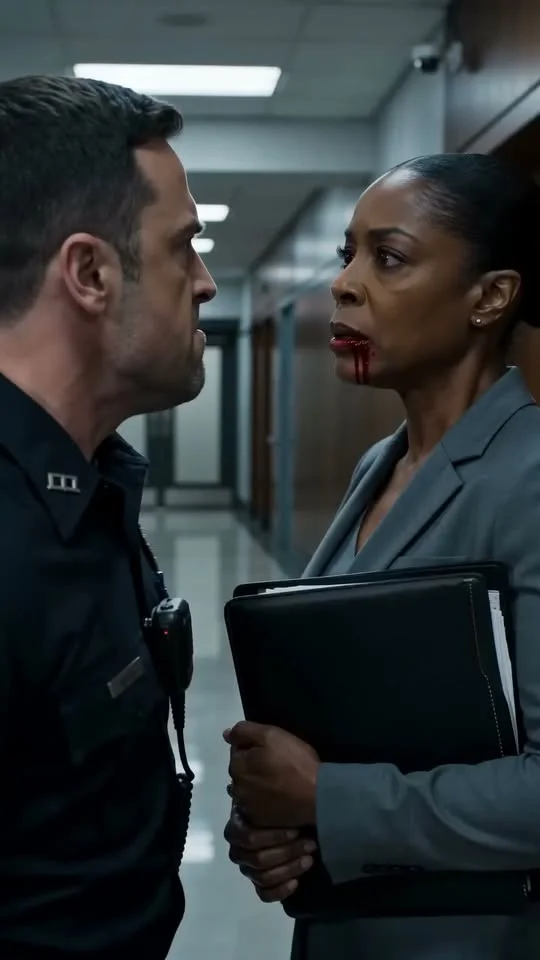
The judge ordered him seated. When he refused, court officers approached. Miller backed away from them and struck the counsel table with his hip. A glass of water overturned, spreading across his papers and carrying ink toward the edge.
“Don’t touch me,” he said.
The words hung there, surrounded by everything he had denied to others.
The officers took his arms carefully. They told him what they were doing before they did it. They gave him the restraint and clarity he had denied Josephine.
This time, the handcuffs closed around Bradley Miller’s wrists.
CHAPTER 5 – What the Camera Gave Back
The criminal conviction came three weeks later.
Assault. Official misconduct. Witness intimidation. Falsification of an incident report.
Miller’s badge was revoked permanently. The court barred him from future law-enforcement employment, and the judge imposed a custodial sentence after finding that his authority had not merely enabled the offenses but had been used as their weapon.
The investigation into Maya’s complaints uncovered two earlier reports from women who had appeared in misdemeanor court. One had withdrawn her allegation after Miller visited her workplace. Another had moved out of the county before her hearing and never returned.
Both women came back to testify.
The supervisor who had marked their complaints unresolved was dismissed after investigators discovered that he had repeatedly routed allegations away from internal affairs. The courthouse adopted independent reporting procedures, mandatory external review, and a rule requiring officers to document every stop inside public judicial spaces.
Yet when the sentence was pronounced, Josephine felt no triumph.
Miller stood at the defense table with his hands clasped behind him. For one brief moment, his eyes found hers. There was still resentment in them, but the power had gone out of it. He could no longer turn his certainty into someone else’s cage.
The deputies led him through a side door.
It closed with a soft hydraulic sigh.
No one applauded.
Maya sat beside Josephine, staring at the empty space where Miller had been. Her notebook rested in her lap. The corners were worn white from her fingers.
“Is it over?” she asked.
Josephine took time before answering.
“This part is.”
Maya nodded, but tears gathered along her lower lashes.
“I thought I’d feel different.”
“How?”
“Bigger, maybe.” She gave a small, embarrassed breath. “Like winning would give me back the person I was before he made me afraid of every uniform in the hallway.”
Josephine looked toward Gallagher, who stood near the rear doors speaking with one of the other witnesses.
“The court can punish what he did,” she said. “It cannot order your body to forget.”
Maya pressed her thumb into the notebook’s bent spine.
“Does yours forget?”
Josephine touched the faint mark that still remained inside her lower lip.
“Not yet.”
They left together through the public entrance.
Outside, winter sunlight lay pale across the courthouse steps. News crews waited behind the barricades, but Josephine did not stop. Maya paused when shutters began clicking. Her shoulders rose toward her ears.
Josephine held out her hand.
Maya looked at it.
Then she took it.
They walked down the steps side by side.
In the months that followed, healing arrived without ceremony.
It came when Josephine entered the western corridor for the first time and did not turn around.
It came when Maya attended her final hearing and the prosecutor moved to dismiss the medication charge. The judge granted the motion, sealed the record, and wished her well. Maya remained seated for several seconds after everyone else stood, waiting for someone to tell her there had been a mistake.
No one did.
Gallagher waited outside with a paper cup of coffee and a blueberry muffin from the courthouse cafeteria.
“That’s it?” Maya asked him.
“That’s it.”
“I can go?”
He smiled.
“You’ve always been allowed to go. Some people just worked very hard to make you forget it.”
Maya looked down at the dismissal order. Gallagher pretended not to notice when a tear struck the page.
Lieutenant Ruiz received authority to rebuild the courthouse security unit. She posted the new complaint procedure beside every public elevator and stairwell, not hidden on an administrative website or behind a locked office door. Each notice carried a direct number to an independent state investigator.
The young clerk who had gathered Josephine’s papers enrolled in evening law classes. The elderly man with the cane sent Josephine a handwritten letter saying he regretted that fear had kept him silent in the hallway. She wrote back that truth sometimes needed a moment to find its voice, but the next person might not have that moment.
He began volunteering twice a week at a legal aid desk in the courthouse lobby.
Josephine returned to the bench, but certain sounds followed her. The snap of a binder closing could stiffen her spine. A raised male voice in the corridor could pull the air from her lungs. When that happened, she stopped pretending nothing had touched her.
She breathed.
She named five things she could see.
She let Gallagher walk beside her without insisting she was fine.
One evening in early spring, he appeared at her chambers carrying a narrow archival box.
“The state released the camera records,” he said.
Josephine looked up from her desk. Rain silvered the windows, just as it had on the afternoon Maya told her the truth.
“I’ve seen the footage.”
“Not these records.”
Gallagher placed the box before her but kept one hand on the lid.
“There’s something I should have told you earlier. I wanted to wait until the prosecution was finished so no one could claim it affected testimony.”
Josephine removed her glasses.
“What is it?”
He opened the box.
Inside lay copies of work orders, installation approvals, and a letter written in blue ink. Josephine recognized Maya’s name at the bottom.
The western stairwell camera had not been part of a routine upgrade.





