Maya reached into her bag again and placed a small black notebook on the table.
“Because I started writing down every date. Every time he followed me. Every badge number of everyone who was there.”
Gallagher looked at the notebook but did not reach for it.
Maya turned to Josephine.
“This morning he saw me near Courtroom Five. He told me I had one last chance. Then Bailiff Owens came out, and Officer Miller walked away. I thought it was over.”
“What did he want today?” Ruiz asked.
“For me to sign a statement saying my complaint was a misunderstanding.”
A knock sounded.
An internal affairs investigator entered with a tablet sealed in a clear evidence sleeve. Her face held the guarded stillness of someone carrying news that could alter every person in the room.
“The footage is verified,” she said. “Officer Miller initiated physical contact. Judge Caldwell made no threatening movement. The strike is unobstructed, and the audio is clear.”
Maya closed her eyes.
The investigator did not sit.
“There’s more. Six minutes before Judge Caldwell entered the corridor, the camera recorded Officer Miller speaking on his phone beneath the stairwell. He said Maya Reynolds would withdraw her complaint before she reached court.”
Ruiz looked at Maya’s returned envelopes.
“He knew exactly where she was supposed to be,” Josephine said.
“Yes.”
The mistaken identity remained real, but the reason behind Miller’s pursuit had changed. He had not believed Maya was escaping justice. He had believed she was escaping his control.
The room held that truth in silence.
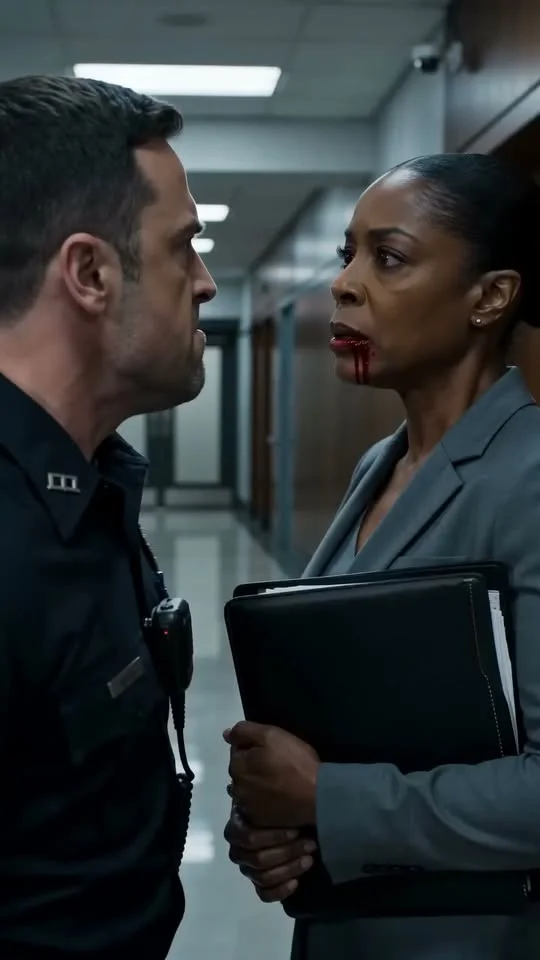
Josephine looked through the rain-striped window. Her own reflection stared back, lip swollen, charcoal jacket creased, one side of her hair loosened from its pins.
The investigator slid a form across the table.
“Judge Caldwell, the district attorney can proceed on the assault captured by the camera. But your formal complaint will determine whether this is treated as an isolated use-of-force case or examined alongside a pattern of misconduct.”
Josephine read the first line.
The administrator’s warning followed her into the room: confidence in the court.
If she signed, the footage would become evidence in a public case. Her face would be replayed. Commentators would study the angle of her body and measure the speed of her hand. Strangers would decide whether she had sounded respectful enough while being grabbed.
If she did not sign, Miller’s attorneys could narrow everything to an internal policy violation and bury Maya’s allegations beneath technical language.
Maya seemed to understand the choice before Josephine spoke.
“You don’t have to do it for me,” she said.
Josephine’s hand stopped over the signature line.
Maya looked down at the notebook.
“They always make us ask the person with more power to risk something before they admit what happened to the rest of us.”
No accusation sharpened her voice. That made the words land harder.
Josephine removed the ice pack. She tasted blood again where the cut had reopened.
“I won’t ask you to stand alone,” she said.
She signed.
The criminal hearing began eleven days later in a courtroom from which Josephine had formally recused herself. She sat behind the prosecution table rather than on the bench. Maya sat one row back with Gallagher beside her.
Miller entered in a dark suit.
Without his uniform, he appeared smaller, but not humbled. His attorney argued that he had made a split-second decision while confronting someone he reasonably believed to be a fleeing defendant. He described Josephine’s movement as sudden. He called the strike regrettable but instinctive.
Then the footage played.
The screen showed Josephine offering her identification.
It showed Miller refusing to look at it.
It showed his hand closing around her arm.
His voice filled the courtroom.
“You people always think you can talk your way out of anything.”
Josephine heard a woman in the gallery inhale.
Onscreen, she pulled free. Miller struck her. The sound cracked through the speakers with the same terrible flatness it had possessed in the hallway.
No one moved.
Miller stared at the table.
The prosecutor paused the video on the frame immediately after the blow. Josephine’s head was turned. Miller’s hand remained raised. Her own hands were empty.
Then the prosecutor played the earlier phone call.
Miller’s voice was lower there, but unmistakable.
“She’ll fold. They always do once they know nobody upstairs cares.”
Maya bent forward as though the sentence had touched a wound beneath her ribs.
Gallagher placed his open hand on the bench between them. He did not touch her. After several seconds, she placed her fingers in his palm.
Miller’s attorney requested a recess.
Before the judge could rule, Miller stood.
“She’s lying,” he said, pointing at Maya. “This is all because of her.”
His attorney pulled at his sleeve.
Miller shook him off.
“She was manipulating the system. Caldwell walked in acting like she owned the place, and now everyone wants to destroy my life because I did my job.”
Josephine rose.
The judge warned her to remain seated, but Miller was already looking directly at her.
“You could have ended this,” he said. “You could have handled it privately.”
Josephine’s hand trembled once at her side. She closed it, then let it open again.
“You tried to make privacy a place where truth could suffocate,” she said. “You mistook silence for permission.”
Miller laughed, but the sound broke in the middle.
“You think that camera makes you brave?”
“No,” Josephine said. “It makes you visible.”
Maya stood behind her.
“So do I,” she said.
The courtroom turned toward her.
Her face had gone pale, but she stepped into the aisle with her notebook held against her chest.
“You said nobody upstairs cared. You were wrong.”
Miller’s expression shifted. The confidence left first, then the anger that had covered his fear. What remained was naked calculation as he searched the room for someone still willing to protect him.
No one looked back.





