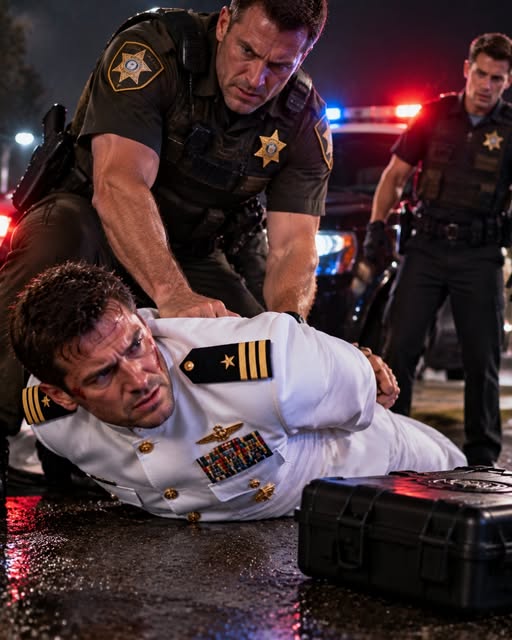
The silence that followed the severed phone call was neither clean nor peaceful. It had the suffocating, heavy texture of a submarine compartment after an alarm sounds and the bulkheads seal shut.
Officer Ray Maddox stood over the steel interrogation table, chest heaving slightly beneath his dark county uniform, the receiver still clutched in his hand like a weapon he had forgotten how to aim. For three seconds, his jaw worked without sound. He looked at the dead phone screen, then at the black pelican-style transfer case resting squarely between us, and finally down at me.
“Hawthorne Six?” Maddox spat the words out, trying to summon a sneer, but the pitch of his voice had thinned out. “You think throwing some alphabet-soup code at me is going to shake my knees? This isn’t a war zone, Grant. This is Oak Creek County. Out here, the Virginia State Code governs, and right now, you are a non-compliant subject detained for obstruction, resisting an officer, and brandishing during a traffic stop.”
“Every word you just spoke,” I said, keeping my breathing measured through the dull fire burning in my collarbone, “is a distinct charge under Title 18 of the United States Code. Deprivation of rights under color of law. False swearing. Tampering with an active military logistics transit.”
“Shut up,” Maddox barked, slamming his palm flat onto the aluminum table. The metal rang like a struck bell. “You don’t talk. You sit there until the Sheriff gets down here and decides whether we dump you in general population or let your duty officer come scrape you off our bench.”
In the threshold of the doorway, Caleb Norris had not moved. His young, sunburnt face had completely drained of color. His duty belt looked two sizes too large on his hips, and his thumbs were hooked into his vest straps—not in a posture of authority, but in the instinctive brace of someone waiting for a mortar round to hit.
“Ray,” Norris said again, his voice dropping into that raspy register men use when they are trying to stop a fatal mistake in real time. “Look at his collar devices. Those aren’t surplus store pins. He’s an O-5. And the dispatch log… Ray, dispatch didn’t log our stop until four minutes after you pulled the taser.”
Maddox whirled on the younger man with a viciousness born entirely of fear. “I told you outside, Caleb! You back me up, or you get your desk cleared out before morning. I saw him reach. You saw him reach. If he was carrying an unauthorized weapon in that lockbox, our stop is completely justified from bumper to bumper.”
“I was not reaching,” I said calmly. “And there is no firearm in that case.”
“Then what’s in it?” Maddox demanded, stepping back to the table and leaning down until his eyes were level with mine. “Drugs? Black-market equipment from the Norfolk supply depot? Counterfeit procurement seals? We’ve been watching Route 17 for three weeks. Your command vehicles think they own the state routes between the yards and Richmond. You think the county doesn’t have a right to inspect cargo traveling across our tarmac?”
I looked past his reddened eyes to the camera mounted in the upper corner of the ceiling. Its small red diode was blinking steadily.
“You didn’t stumble onto my vehicle by chance, Officer Maddox,” I said, letting every syllable drop into the room with deliberate weight. “Your department attempted to isolate my gray government-issue sedan at mile marker seventy-two. Then at sixty-four. Then at fifty-nine, where an unmarked patrol unit tried to box me into the exit lane. You were instructed to pull me over. Six separate times your dispatch attempted to arrange a pretextual stop before you finally lit your light bar outside the construction zone.”
Maddox’s pupils contracted. A muscle along his cheek twitched uncontrollably.
“Who told you that?” he hissed.
“You did,” I replied. “When you followed me for nine miles without calling in my plates until you reached a dead zone in county jurisdiction. You wanted me somewhere without civilian witnesses, where the road was dark enough to claim I lunged at you.”
“You’re full of dirt,” Maddox sneered, but his hand moved away from his taser holster. Instead, his fingers drifted toward the sealed transfer case.
The case was made of high-density ballistic resin, coated in matte-black non-reflective polymer. Across the center ran a heavy tamper-evident red band, embedded with a microscopic fiber weave and stamped with the raised seal of the Office of the Inspector General, Department of Defense. On the right latch sat a biometric keypad paired with an analog barrel lock—the kind that required two independent keys turned simultaneously within five seconds of each other.
“Let’s see what requires all that cloak-and-dagger garbage,” Maddox muttered, reaching toward the left latch.
“Officer Maddox,” Norris warned from the door, taking a half-step inside, his hand unconsciously dropping toward his hip. “Don’t touch the lock. If that’s federal property, cutting that seal without a federal warrant is an automatic felony. My uncle spent twenty years in the Marshals Service—they don’t negotiate that stuff, Ray. They don’t even call the magistrate. They just show up with paper.”
“Your uncle isn’t the Sheriff of Oak Creek,” Maddox snapped.
He reached into his utility pocket and pulled out a heavy steel multitool. He flicked the flat blade open with a flick of his wrist.
“Officer,” I said, not raising my voice by a fraction of a decibel. “Listen to me very carefully. If you insert that blade into the latch assembly, you will trigger an internal localized short that vaporizes the solid-state drives inside. At the exact millisecond that circuit breaks, an encrypted transponder will broadcast an emergency distress signal directly to the Naval Provost Marshal at Joint Expeditionary Base Little Creek and the Federal Bureau of Investigation’s Norfolk Field Office. You will not only be charged with destruction of evidence; you will have initiated an active national security containment operation against this facility.”





