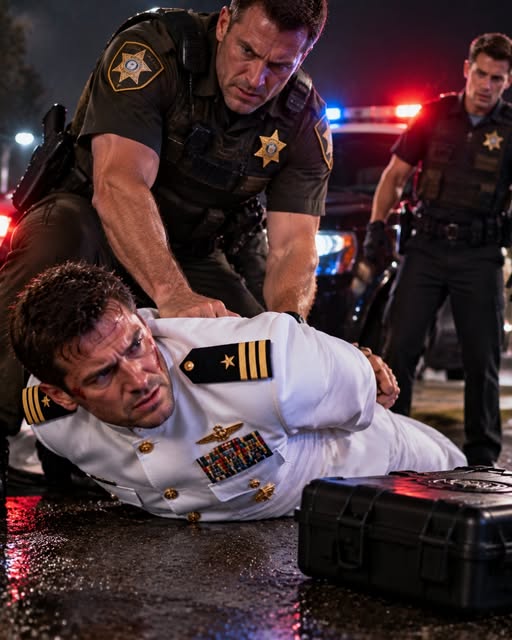
“You didn’t stumble onto my vehicle by chance, Officer Maddox,” Grant said, letting every syllable drop into the room with deliberate weight. “Your department attempted to isolate my sedan at mile marker seventy-two. Then at sixty-four. Then at fifty-nine, where an unmarked patrol unit tried to box me into a timber turnout. You were instructed to pull me over. Six separate times your dispatch attempted to arrange a pretextual stop before you finally lit your light bar outside the construction zone.”
Maddox’s pupils contracted. A muscle along his jaw twitched uncontrollably. “Who told you that?”
“You did,” Grant replied. “When you followed me for nine miles without calling in my plates until we reached a dead zone in county jurisdiction. You wanted me somewhere without civilian witnesses, where the road was dark enough to claim I lunged at you.”
“You’re full of dirt,” Maddox sneered, though his right hand drifted away from his taser holster and settled near the edge of the transfer case.
The case sat like a monolith between them. Across its matte-black lid, the crimson Inspector General seal caught the fluorescent glare. On the right latch sat a biometric keypad paired with an analog barrel lock—the kind that required two independent keys turned simultaneously within five seconds of each other.
“Let’s see what requires all that cloak-and-dagger garbage,” Maddox muttered, his fingers brushing the left latch.
“Officer Maddox,” Norris warned from the doorway, taking a half-step into the room, his hand unconsciously dropping toward his hip. “Don’t touch the lock. If that’s federal property, cutting that seal without a federal warrant is an automatic felony. My uncle spent twenty years in the Marshals Service—they don’t negotiate that stuff, Ray. They don’t even call the magistrate. They just show up with paper.”
“Your uncle isn’t the Sheriff of Oak Creek,” Maddox snapped.
He reached into his utility pocket, pulled out a heavy steel multitool, and flicked the flat blade open with a sharp snap of his wrist.
“Officer,” Grant said, not raising his voice by a fraction of a decibel. “Listen to me very carefully. If you insert that blade into the latch assembly, you will sever an internal continuity loop that triggers a localized thermite-grade short across the solid-state drives inside. At the exact millisecond that circuit breaks, an encrypted transponder will broadcast an emergency distress signal directly to the Naval Provost Marshal at Joint Expeditionary Base Little Creek and the Federal Bureau of Investigation’s Norfolk Field Office. You will not only be charged with destruction of federal evidence; you will have initiated an active national security containment operation against this facility.”
Maddox froze. The steel edge of the blade hovered less than a quarter-inch from the crimson tape.
For five heartbeats, the only sound in the room was the hum of the overhead tubes and the harsh whistle of Maddox’s breath through his crooked nose. His bravado was a thin veneer over raw, uneducated malice, but even a bully recognizes the sound of a heavy door locking behind him.
Then, footsteps echoed down the uncarpeted concrete hallway outside.
They were not the soft, rubber-soled tread of road deputies. They were the heavy, deliberate strike of polished ostrich-skin western boots with stacked leather heels—the walk of a man who had never once hurried for anyone in his county.
The door swung all the way open, banging hard against the rubber wall-stop.
Sheriff Harlan Vance stepped into the room.
Vance was sixty, carrying the broad, thick shoulders of a former college linebacker who had allowed twenty years of barbecue, bourbon, and county politics to settle into a solid barrel around his waist. His silver hair was trimmed crisp and tight beneath a tan Stetson he did not bother to remove. A gold five-point star gleamed on his khaki shirt above four rows of service ribbons that smelled faintly of dry-cleaning fluid and expensive cigars.
In his right hand, he held a plain manila folder. In his left, a chipped ceramic mug of station coffee.
He did not look at Grant first. He looked at Maddox, whose blade was still poised over the black case.
“Put the knife away, Ray,” Vance said, his voice a slow, gravelly Virginia drawl polished through four uncontested re-election campaigns. “You look like a boy trying to open a can of beans with a lawnmower.”
Maddox snapped the multitool shut and shoved it into his pocket, a dark flush creeping up his neck. “Sheriff. He was giving Norris attitude. Wouldn’t state his clearance, wouldn’t verify the manifest—”
“I told you to put the tool away,” Vance repeated without glancing back. “I didn’t ask for a chorus.”
He turned his pale, calculating blue eyes down toward Grant.
He took his time. He studied the torn wool at Grant’s knees, the chalky limestone dust clinging to the gold command-at-sea pin above his ribbons, the dried trickle of blood staining his white collar, and the purple indentations where the steel cuffs bit into his wrists.
“Commander Grant,” Vance said softly. He pulled out the metal folding chair opposite Grant, spun it backward, and straddled it with a groan of leather, resting his forearms across the backrest. “You’ve caused quite a flutter on the radio for eleven o’clock on a Tuesday night.”
“Sheriff Vance,” Grant answered. “Your deputy is holding an active-duty naval officer without legal cause. I have been struck with a conducted energy weapon while my hands were raised. I have been denied contact with my command. And your officers have attempted to breach a classified Department of Defense transfer container.”





