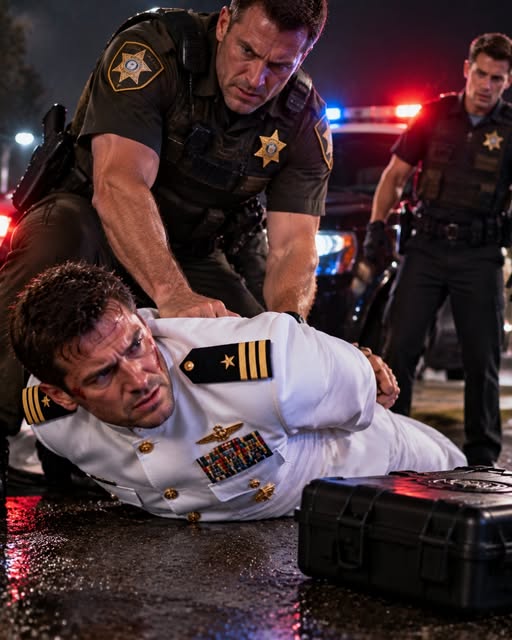
The rain along Route 17 did not fall so much as it hung in the air, a cold, gray mist rising off the blacktop and clinging to the windshield of the government-issue sedan like wet ash. Beyond the sweep of the wipers, the pine forests of Oak Creek County pressed in on both sides of the highway, dense and featureless in the November dark.
Commander Elias Grant kept both hands at ten and two, his eyes shifting in a practiced, rhythmic triangle: the wet asphalt ahead, the dim amber glow of the dashboard clock—10:14 p.m.—and the rearview mirror.
In the mirror, two hundred yards back, a pair of low-slung halogen headlights held steady.
They had been there since mile marker seventy-two.
At first, Grant had given the driver the benefit of the doubt. Route 17 was a two-lane artery cutting north from the naval yards of Norfolk toward the federal corridors of Northern Virginia; plenty of late-shift commuters and long-haulers pushed through the Tidewater dark. But at mile marker sixty-four, when Grant had eased his foot off the accelerator to drop from fifty-five to forty-five, the headlights behind him had not closed the gap. They had matched his deceleration to the mile per hour. Five miles later, near the dark mouth of a timber-hauling turnout, a second vehicle—an unmarked dark-colored SUV with a push-bumper barely visible in the mist—had drifted out of the treeline, pulling alongside his rear quarter-panel as if to herd him onto the shoulder.
Grant had not taken the bait. He had held his lane, maintained his speed, and watched the SUV peel off at the next county spur.
Now, there was only the single cruiser behind him, riding just outside the range where its silhouette could be cleanly read.
On the passenger seat beside Grant, secured to the seat-frame anchor by a braided steel tether, sat a matte-black transfer case. It was roughly the size of a thick briefcase, molded from high-density ballistic resin and sealed across the center with a crimson tamper-evident band. Embedded in the polymer of that band was a microscopic fiber weave and the raised seal of the Office of the Inspector General, Department of Defense. Inside were four encrypted solid-state drives containing five years of forensic accounting—wire transfers, falsified hull-maintenance invoices, and shell-company ledgers linking Tidewater Marine Logistics in Chesapeake to a web of regional infrastructure kickbacks.
Grant was scheduled to place that case into the hands of an Assistant United States Attorney in Alexandria at 0800.
He reached down with his right hand, keeping his eyes on the road, and checked the secure satellite phone resting in the center console. One bar of signal. They were entering the hollow between the Blackwater River basin and the Oak Creek ridge—a six-mile dead zone where cellular towers died and county radio repeaters reigned supreme.
The exact moment the signal bar vanished, the night behind him exploded into strobing red and blue.
Grant did not flinch. He tapped his right blinker, eased the gray sedan onto the gravel shoulder beside a rusted construction-zone barricade, and shifted into park. He killed the engine, turned on the interior dome light, rolled his window down four inches, and placed both palms flat against the top of the steering wheel.
Before the cruiser’s engine had even settled into an idle, Grant reached down with his left thumb—one smooth, practiced motion—and pressed the speed-dial key on the console’s hardwired command handset. The line hissed, fighting the ridge interference, then caught a faint, crackling carrier tone.
“Little Creek Watch Floor, duty officer speaking.”
“Hawthorne Six,” Grant said, his voice pitched low and even, barely audible over the patter of rain on the roof. “Route seventeen, mile marker fifty-four. Unscheduled intercept. Keep the line open.”
He did not wait for a reply. He returned his left hand to the steering wheel just as the glare of a high-lumen flashlight slammed into the side of his face.
“Step out of the vehicle!”
The voice was sharp, ragged at the edges, carrying the brittle aggression of a man who had already decided how the next sixty seconds were going to end.
Grant squinted against the beam. “Good evening, Officer. I am Commander Elias Grant, United States Navy, on active courier transit. My credentials and federal transit orders are in my breast pocket. May I ask the reason for the stop?”
“I didn’t ask for your life story, sailor,” the deputy snapped. The beam dropped from Grant’s eyes to the gold oak leaves pinned to the collar of his Service Dress Blues, then swung across the cabin and locked onto the black transfer case on the passenger seat. “You crossed the double yellow twice back at the bypass. Now open the door, keep your hands where I can see them, and step onto the asphalt.”
A second shadow moved up on the passenger side, flashlight playing nervously over the rear window. The voice that came from that side was younger, thinner. “Ray, he’s got government plates. Look at the sticker on the windshield—that’s a DoD fleet decal.”
“Shut up and cover the passenger door, Caleb!” the first deputy barked. He yanked Grant’s door open himself. Cold rain blew into the cabin. “Out! Now!”
Grant moved slowly, deliberately, keeping his elbows clear of his torso. His wool uniform coat hung open over his white dress shirt and black tie. He planted his shined dress shoes on the wet gravel, stood to his full height, and raised both hands to shoulder level, palms open.
“Officer,” Grant said calmly, “my vehicle is equipped with a federal GPS telemetry recorder. It will confirm I have not crossed the centerline since leaving Norfolk. If you wish to verify my transit authority, my command is currently on an open line inside the cab—”
The deputy—a thick-necked man in his late thirties with a crooked nose and eyes that darted from Grant’s chest to the open car door—stepped inside Grant’s personal space. He smelled of wintergreen dip and stale sweat.





