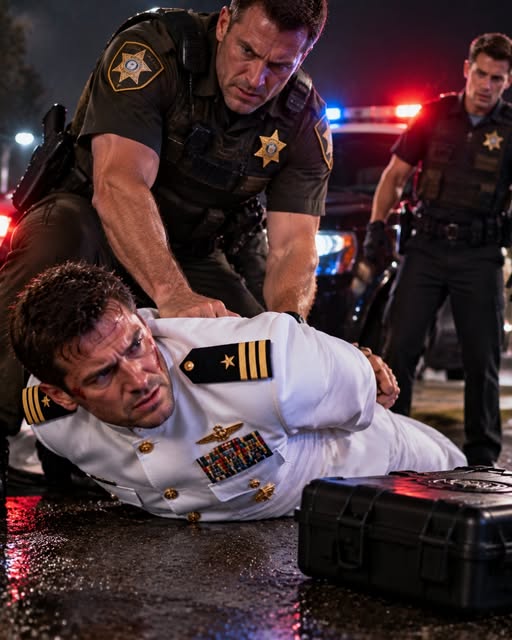
Maddox froze, the edge of the blade resting less than a quarter-inch from the red security tape.
For five heartbeats, the only sound in the interrogation room was the low hum of the fluorescent tubes overhead and the harsh whistle of Maddox’s breath through his broken nose. His bravado was a thin veneer over raw, uneducated malice, but even a bully knows when a door has locked behind him.
Then, heavy footsteps echoed down the uncarpeted hallway outside.
The boots were expensive—not the standard-issue rubber-soled combat boots worn by road deputies, but polished ostrich-skin western boots with hard leather heels that struck the concrete with deliberate, theatrical authority.
The door swung all the way open, banging against the plastic wall-stop.
Sheriff Harlan Vance stepped into the room.
Vance was sixty, with the broad, thick shoulders of a former college linebacker who had allowed twenty years of barbecue, whiskey, and county politics to settle around his gut. His silver hair was cut clean and sharp under his tan Stetson, which he did not remove. His gold five-point star was pinned over a crisp khaki shirt with four rows of service commendations that smelled faintly of dry cleaning and cigar smoke.
In his right hand, he carried a plain manila folder. In his left, a cold cup of station coffee.
He didn’t look at me first. He looked at Maddox, whose blade was still extended toward the transfer case.
“Put the knife away, Ray,” Vance said, his voice a gravelly, slow Virginia drawl that had been perfected through four successful re-election campaigns. “You look like a boy trying to open a can of beans with a lawnmower.”
Maddox instantly snapped the tool closed and shoved it into his pocket, his face flushing dark. “Sheriff. He was giving Norris attitude. Wouldn’t state his clearance, wouldn’t verify the manifest—”
“I told you to put the tool away,” Vance repeated, not looking back. “I didn’t ask for a chorus.”
He turned his pale, calculating blue eyes down toward me.
He took his time. He looked at the torn fabric at my knees, the chalky white dust clinging to my medals, the thin trickle of dried blood that had run down from my brow into the collar of my dress shirt. His gaze lingered for a moment on the gold command-at-sea pin above my ribbons, then moved down to my wrists, still bound behind the chair with steel Smith & Wesson cuffs that had pinched my skin purple.
“Commander Grant,” Vance said softly. He pulled out the metal folding chair opposite me, turned it backward, and sat down with a groan of leather. He rested his forearms across the backrest. “You’ve caused quite a flutter on the radio for eleven o’clock on a Tuesday night.”
“Sheriff Vance,” I answered. “Your deputy is currently holding an active-duty naval officer without legal cause. I have been struck with a conducted energy weapon while my hands were raised. I have been denied contact with my command. And your officers have attempted to tamper with a classified transfer container.”
Vance smiled, a tight, humorless parting of graying lips.
“Well now, son,” Vance said, “that sounds like a real dramatic version of events. But down here in the county, we have to look at the paperwork. Deputy Maddox reports you were weaving across the centerline near the Route 17 bypass. When he initiated a lawful traffic stop, you refused three direct orders to step out, acted aggressively toward the patrol vehicle, and reached toward your right hip where a sidearm could reasonably be concealed. Everything he did follows our department’s tactical engagement guidelines to the letter.”
“He is lying,” I said simply. “And you know he is lying, because you issued the order to intercept my vehicle thirty-five minutes before I entered county lines.”
Vance didn’t blink. His smile remained fixed, but the warmth around his eyes vanished like water poured onto hot iron.
“Oak Creek has mutual-aid agreements with three regional task forces, Commander,” Vance said smoothly. “We receive intelligence tips all the time. Sometimes a tip tells us that an official government vehicle might be utilized by personnel engaged in off-manifest logistics movements. Diversion of military-grade hardware. Unregistered transfers between private contractors and naval dockyards. It’s a sad thing when high-ranking men lose their way, but it’s my job to protect this county’s roads from whatever falls off the back of a Norfolk truck.”
The puzzle pieces snapped together with terrifying clarity.
This wasn’t a rogue traffic stop by an arrogant country cop looking for a thrill. This was a targeted interception. The transfer case I carried didn’t contain weapons or cash; it contained five years of forensic audit files regarding procurement kickbacks between Tidewater Marine Logistics—a private contractor operating out of Chesapeake—and regional public works officials who had been laundering maintenance funds through county infrastructure grants.
And Sheriff Harlan Vance’s brother-in-law was the majority owner of Tidewater Marine Logistics.
“You’re not trying to search this case for contraband, Vance,” I said, looking him dead in the center of his chest. “You’re trying to destroy it before it reaches the United States Attorney’s Office in Alexandria tomorrow morning.”
Vance’s fingers tightened slightly against his coffee cup.
For several seconds, nobody moved. Maddox looked between the Sheriff and me, his eyes wide with a realization he clearly hadn’t fully processed until that moment. Norris took two steps backward, his back hitting the wall of the corridor.
“Commander,” Vance said, lowering his voice until it was almost a whisper, “you are forty miles outside your base. Your cell phone is in an evidence envelope. Your uniform is torn. And in about ten minutes, Deputy Maddox is going to transport that box to our secure evidence vault in the basement, where it will remain locked until our local circuit judge signs an inspection order at nine o’clock tomorrow.”
“You won’t have nine o’clock,” I told him.





